 Description:
This
perennial sedge is 1-2' tall, forming loose tufts of both
fertile and
infertile shoots that are erect to ascending. The culms are 3-angled,
light to medium green, and glabrous to sparsely pubescent. About
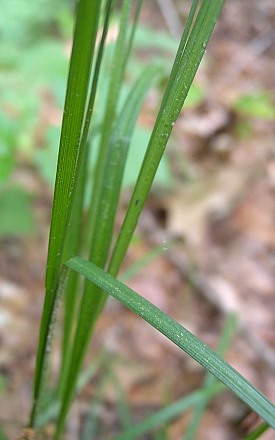
3-5 alternate leaves develop along each culm. The ascending to widely
spreading leaf blades are up to 12" long and 4 mm. across; they are
medium green and sparsely pubescent. The leaf sheaths are relatively
tight and moderately pubescent. At the junction of each blade and
sheath, there is a short-membranous ligule that is longer than wide.
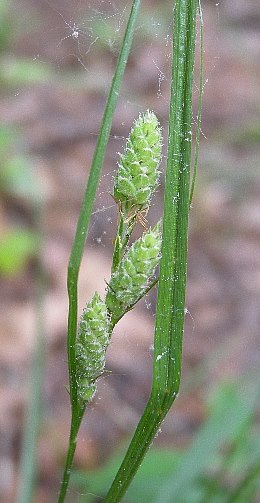
Each fertile culm terminates in an inflorescence consisting of a
terminal spikelet at the apex, 1-3 lateral spikelets, and their leafy
bracts. The terminal spikelet is about ½–¾" long, short-cylindrical in
shape, and gynecandrous; it has pistillate florets and scales along the
upper three-fourths of its length, while staminate florets and scales
are below. The lateral spikelets are similar in appearance to the
terminal spikelet, except they are a little shorter and they have only
pistillate florets and scales. The peduncle of each spikelet is
slender, short, and straight. At the base of the lowest peduncle, there
is a leafy bract as long or longer than the inflorescence, while the
remaining bracts are much smaller in size. In each spikelet, the
perigynia of the pistillate florets are ascending and densely packed
together. Each perigynium (a bladder-like sac covering the developing
achene) is about 2.0 mm. long and 1.0–1.5 mm. across; it is light green
(while immature), densely pubescent, obovoid-ovoid, bluntly 3-angled,
and nearly beakless. The membranous pistillate scales are about 2.0 mm.
long, 1.0 mm. across, and ovate with an awn-like tip. The blooming
period occurs from late spring to early summer and lasts about 2 weeks.
The florets are wind-pollinated. The achenes are about 1.5 mm. long.
The root system is fibrous and rhizomatous.
Description:
This
perennial sedge is 1-2' tall, forming loose tufts of both
fertile and
infertile shoots that are erect to ascending. The culms are 3-angled,
light to medium green, and glabrous to sparsely pubescent. About
3-5 alternate leaves develop along each culm. The ascending to widely
spreading leaf blades are up to 12" long and 4 mm. across; they are
medium green and sparsely pubescent. The leaf sheaths are relatively
tight and moderately pubescent. At the junction of each blade and
sheath, there is a short-membranous ligule that is longer than wide.
Each fertile culm terminates in an inflorescence consisting of a
terminal spikelet at the apex, 1-3 lateral spikelets, and their leafy
bracts. The terminal spikelet is about ½–¾" long, short-cylindrical in
shape, and gynecandrous; it has pistillate florets and scales along the
upper three-fourths of its length, while staminate florets and scales
are below. The lateral spikelets are similar in appearance to the
terminal spikelet, except they are a little shorter and they have only
pistillate florets and scales. The peduncle of each spikelet is
slender, short, and straight. At the base of the lowest peduncle, there
is a leafy bract as long or longer than the inflorescence, while the
remaining bracts are much smaller in size. In each spikelet, the
perigynia of the pistillate florets are ascending and densely packed
together. Each perigynium (a bladder-like sac covering the developing
achene) is about 2.0 mm. long and 1.0–1.5 mm. across; it is light green
(while immature), densely pubescent, obovoid-ovoid, bluntly 3-angled,
and nearly beakless. The membranous pistillate scales are about 2.0 mm.
long, 1.0 mm. across, and ovate with an awn-like tip. The blooming
period occurs from late spring to early summer and lasts about 2 weeks.
The florets are wind-pollinated. The achenes are about 1.5 mm. long.
The root system is fibrous and rhizomatous.
Cultivation:
The preference is dappled sunlight to light shade, mesic to dry
conditions, and rocky or sandy soil containing some decaying organic
matter (e.g., fallen leaves). This sedge is usually found where the
ground vegetation is rather sparse.
Range & Habitat:
The native Swan's Sedge is scattered across most areas of Illinois,
except the NW
section of the state (see Distribution
Map). It is an uncommon sedge. Habitats include rocky upland
woodlands, wooded slopes, upland savannas, and sandy savannas. This
sedge is often found in wooded areas where oak trees are present and
the shade of the overhead canopy is not too dense.
Faunal Associations:
This sedge occurs primarily in thin upland woodlands where
there is reduced competition
from other kinds of ground vegetation. Insects that feed on sedges (Carex spp.) in this
kind of habitat include larvae of the leaf-miner
moths Elachista
argentosa and Elachista
madarella, and such aphids as Carolinaia caricis,
Iziphya albipes,
Iziphya flabella,
and Vesciculaphis
caricis.
Some bird species eat the seeds of sedges in upland
woodlands; they include such species as the Wild Turkey, Bobwhite,
immature Ruffed Grouse, Cardinal, Eastern Towhee, and several sparrows.
The seeds of such sedges are also eaten by the Fox Squirrel and Gray
Squirrel. In contrast, White-Tailed Deer rarely browse on the foliage
because they prefer broad-leaved plants.
Photographic
Location:
A rocky upland woodland at the Portland Arch in west-central Indiana.
Comments:
This is one of the more hairy sedges in Illinois. Swan's Sedge is very
similar to Carex virescens (Hairy-Fruited Sedge)
and it was considered a variety of the latter species at one time.
Swan's Sedge differs primarily by its shorter spikelets (¾" long or
less); it also has leaf blades that are slightly more narrow and its
habit of growth tends to be more erect. Two other hairy sedges are Carex
hirsutella (Hairy-Leaved Sedge) and Carex hirtifolia
(Hairy Sedge); these sedges also occur in upland woodlands.
Hairy-Leaved Sedge differs from Swan's Sedge by its hairless perigynia,
while the terminal spikelet of Hairy Sedge consists entirely of
staminate florets and scales. Another common name of Carex
swanii is Savanna Sedge.