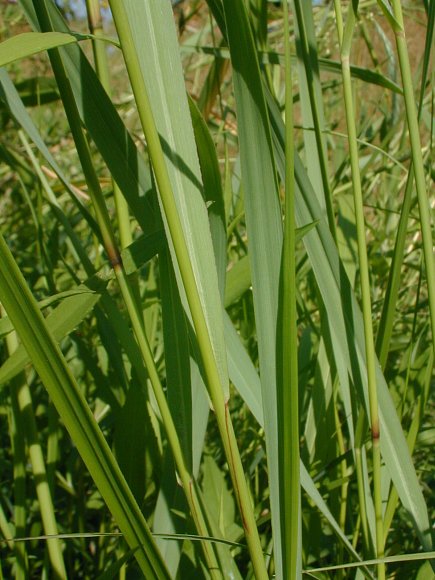
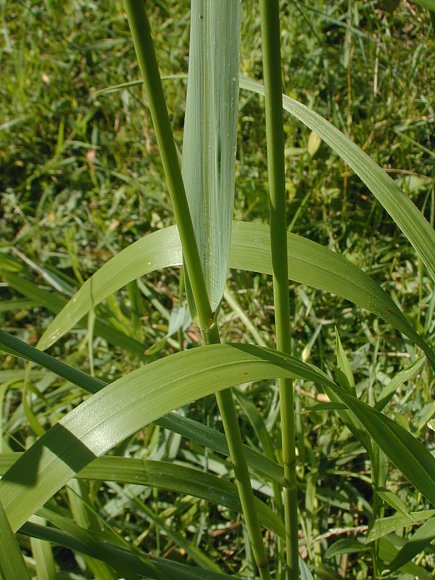
Description: This perennial grass is 3-6' tall and more or less erect; usually it forms tufts of leafy culms that are erect to ascending. The culms are light to medium green (less often light blue and glaucous), terete, glabrous, and fairly stout. Several alternate leaves occur along the entire length of each culm; their blades are ascending to widely spreading. The leaf blades are up to 15 mm. across and 2' long; they are usually medium green (less often light blue and glaucous), hairless to mostly hairless, and either flat or slightly indented along their midveins. The leaf sheaths are about the same color as the blades and hairless; they are open at their apices, forming a V-shape. The ligules have bands of white hairs, while the nodes are swollen and often dark-colored.
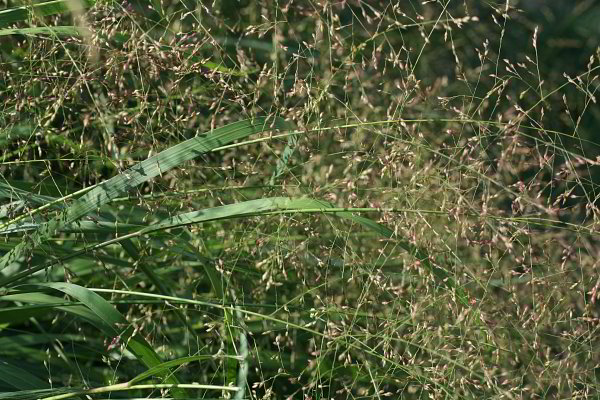
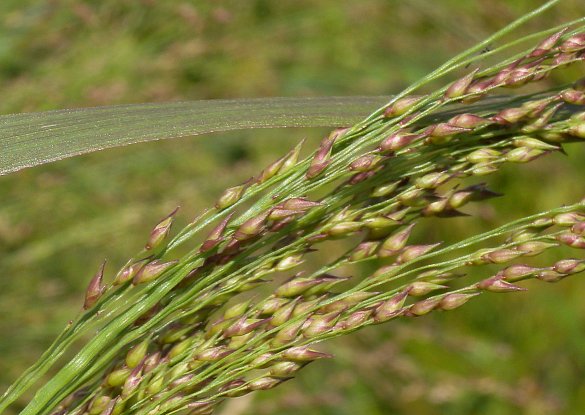
Each fertile culm terminates in an inflorescence that is 7-20" long and about one-half as much across when it is fully open. This inflorescence is an airy panicle of spikelets; it is broader toward the bottom than the top and pyramidal in outline. Along the rachis (central stalk) of the inflorescence, there are either solitary lateral branches or pseudo-whorls of 2-3 lateral branches. The ascending to widely spreading branches divide into branchlets and pedicellate spikelets. The rachis, lateral branches, branchlets, and pedicels are light green (rarely light blue and glaucous), glabrous, and slender; they are straight, slightly curved, or slightly wiry. During the period of bloom, the spikelets are 3-5 mm. long, light green to reddish green (rarely light blue and glaucous), lanceoloid in shape, and glabrous. Each spikelet has 2 glumes, 2 lemmas (one fertile and the other sterile), a palea, and a perfect floret. The smaller glume is about two-thirds of the length of the spikelet, while the remaining glume and sterile lemma are the same length as the spikelet. The glumes and sterile lemma are ovate, convex along their outer surfaces, longitudinally veined, and narrowly acute at their tips. The fertile lemma is 2.5–3.5 mm. long, ovate, convex along its outer surface, veinless, membranous, and acute at its tip.
The perfect floret of
each spikelet consists of 3 stamens, 2 stigmas, and an ovary.
The blooming period occurs during
mid-summer, lasting about 1-2 weeks. The florets are cross-pollinated
by the wind. Afterwards, the spikelets of the inflorescence become
light tan and fall in their entirety to the ground. The grains have
adherent pericarps. The root
system is fibrous and rhizomatous; it can penetrate up to 10 ft. into
the ground. Reproduction is by seed and from clonal offsets of the
rhizomes.
Cultivation:
The preference is partial to full sunlight, moist to mesic conditions,
and deep fertile soil. However, this robust grass can tolerate
practically any kind of soil and it will adapt to drier conditions.
Most growth and development occurs during the summer. This grass can
spread aggressively, therefore it should not be over-planted.
Range & Habitat: The native Switch Grass is a common plant that has been found in most areas of Illinois, except for a few counties in the southern half of the state (see Distribution Map). Habitats include black soil prairies, clay prairies, sand prairies, typical savannas and sandy savannas, open woodlands, rocky bluffs, sand dunes, edges of marshes, sandy pannes, banks of rivers and ponds, prairie restorations, areas along railroads, roadsides, ditches, and abandoned fields. Because of its above-average tolerance of salt, this species can become the dominant grass along little-mowed roadsides where salt is applied during the winter. Like other prairie species, this native grass recovers readily from occasional wildfires. It is more tolerant of disturbance and habitat degradation than most prairie grasses. Sometimes Switch Grass is cultivated in gardens as an ornamental plant.
Faunal Associations: Various insects feed on Switch Grass and other Panicum spp. (Panic Grasses). These include the caterpillars of such skippers as Atrytone logan (Delaware Skipper), Hesperia leonardus (Leonard's Skipper), Hesperia sassacus (Indian Skipper), Poanes hobomok (Hobomok Skipper), Polites themistocles (Tawny-edged Skipper), and Wallengrenia egremet (Northern Broken-Dash). Other insect feeders include the larvae of grass leaf-miner moths (Elachista spp.), the larvae of gall flies, plants bugs (Collaria spp.), stink bugs, Sipha flava (Yellow Sugar Cane Aphid) and other aphids, leafhoppers (Graminella spp., Polyamia spp.), mealybugs, leaf beetles, thrips (Chirothrips spp.), and grasshoppers. See the Insect Table for a more complete list of these species. The seeds of Switch Grass and other Panicum spp. (Panic Grasses) are eaten by a variety of birds, including wetland birds, upland gamebirds, and granivorous songbirds (see the Bird Table for a listing of these species). The seeds of these grasses are also eaten by the Prairie Deer Mouse and wild House Mouse (Whitaker, 1966). The very young foliage of this grass is edible to cattle and other hoofed mammalian herbivores (Georgia, 1913). Because Switch Grass remains upright during the winter and often forms large clumps, it provides good cover for various birds and mammals during this time of year.
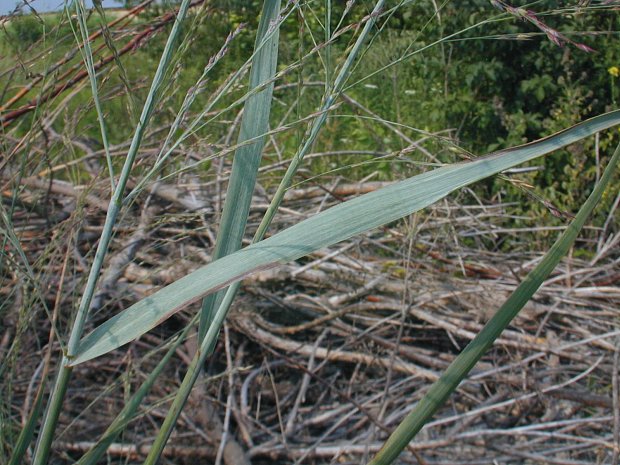
Photographic
Location:
A wildflower garden at Crystal Lake Park in Urbana, Illinois, and along
a railroad in Savoy, Illinois.
Comments:
This is one of the dominant grasses of the tallgrass prairie. Like the
other dominant grasses, Switch Grass (Panicum virgatum)
has a C4 metabolism that enables it to withstand summer weather that is
hot and dry. This is the tallest and most robust panic grass (Panicum
sp.) in Illinois, and it can be distinguished from most of
the others by its size. One common species with a similar appearance
that resembles a small specimen of Switch Grass is Fall
Panicum (Panicum dichotomiflorum). This latter
species is hairless or mostly hairless like Switch Grass, but its
spikelets are smaller in size (2-3 mm.). Furthermore, the
first glumes of Fall Panicum are about one-fourth the length of their
spikelets, while the first glumes of Switch Grass are about two-thirds
the length of their spikelets. Other tall-growing Panic Grasses have
hairier sheaths and/or leaves, and they also have smaller spikelets
than Switch Grass. With increases in the price of gasoline,
Switch Grass has been evaluated as a possible source of alcohol that
could be used as an alternative fuel. Apparently, it can produce more
alcohol per acre than corn and doesn't require replanting in the spring
because of its perennial habit. However, the bulkiness of its foliage
could impede efficient shipping and processing.