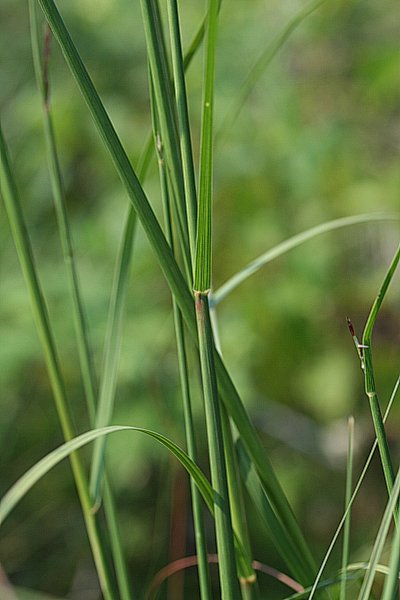
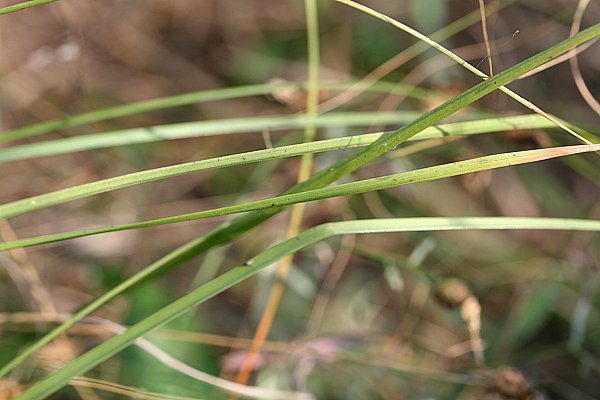
Description: This perennial grass is 2½–5' tall; it is often tufted at the base, sending up multiple culms from a crown. The light to medium green culms are unbranched, stiffly erect, terete, rather stout, and glabrous. Each culm has 4-7 alternate leaves; most of these leaves are located along the lower one-half of each culm. The leaf blades are up to 2' long and 4.5 mm. across; they are ascending to widely spreading with long slender tips. The leaf blades are medium green, flat or rolled upward along their margins, and mostly glabrous, although long white hairs are sometimes present on the upper side near their bases. The margins and lower sides of these blades are often scabrous (rough-textured). The leaf sheaths are medium green, glabrous, and longitudinally veined. The ligules are ciliate, while the nodes are mostly hidden by the sheaths and insignificant. Each culm terminates in a spike-like panicle about 4-12" long. This narrow panicle is mostly hidden by the uppermost sheath when it is young, but it becomes more exposed at maturity. The short branches of the panicle are erect throughout. In addition to the terminal panicle, a culm may produce one or more axillary panicles below. These axillary panicles are largely enclosed by adjacent leaf sheaths and they are inconspicuous.
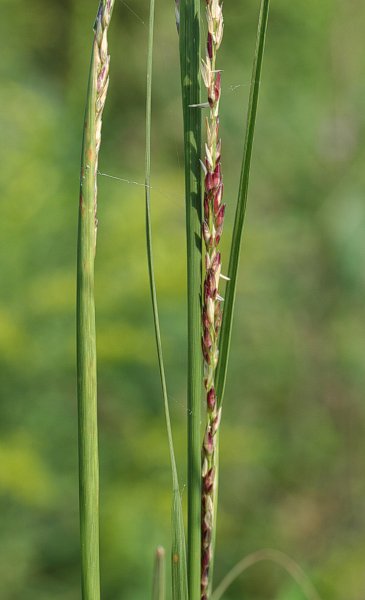
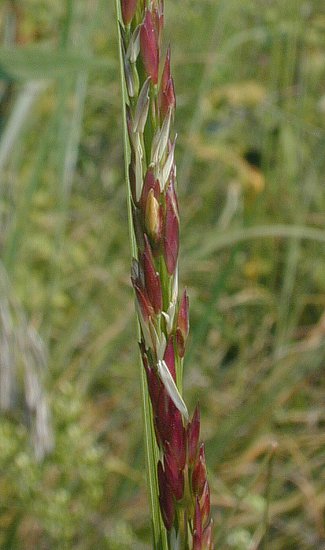
The individual spikelets of a panicle are 4.5–6.0 mm. long, 1-1.5 mm. across, narrowly lanceoloid in shape, slightly flattened, and glabrous; they are often organized into groups of 2-3 on the branches, and their pedicels are short. Very young spikelets are white, but they become purplish green during the blooming period. Each spikelet consists of a pair of glumes, a single lemma, and a palea enclosing the perfect floret. The glumes are unequal in size: the shorter glume is 2-3 mm. long, while the longer glume is 3-4 mm. long. The lemma and palea are about equal in size (4.0–6.0 mm.) and they are longer than either glume. The glumes and lemma of each spikelet are single-veined, while the palea is 2-veined. The blooming period occurs from late summer to mid-autumn, lasting about 1-3 weeks. The florets of the terminal panicle are either self-pollinated or wind-pollinated, while the florets of axillary panicles are largely self-pollinated. Afterwards, the spikelets become light tan when their grains are ripe; disarticulation is above the glumes. Individual grains are 1-1.5 mm. long, ovoid to broadly oblongoid, somewhat flattened, and brown. The root system is fibrous. This grass reproduces by reseeding itself.
Cultivation:
The preference is full sun and mesic to dry conditions. Many types of
soil are tolerated, including those containing loam,
clay-loam, sand, or gravelly material. Calcareous soil that is slightly
acidic to alkaline is preferred. This grass species has excellent
drought tolerance because of its C4 metabolism.
Range & Habitat:
Tall Dropseed is occasional in most areas of Illinois (see Distribution
Map), where it is native. Habitats include black soil
prairies, sand prairies, gravel prairies, hill prairies, typical
savannas and sandy savannas, open woodlands in rocky upland areas,
limestone glades, abandoned fields, areas along railroads, and
roadsides. Tall Dropseed prefers areas with a history of minor to
moderate disturbance, including grazed prairies, savannas that are
subjected to occasional wildfires, and infrequent mowing along
roadsides. However, this grass will decline in abundance if it is
subjected to high levels of disturbance.
Faunal Associations: According to Felt (1917), the false spider mite, Dolichotetranychus carnea, deforms the seedheads (spikelets) of Dropseed grasses (Sporobolus spp.). Several species of grasshoppers feed on the foliage of Tall Dropseed (see Grasshopper Table); this prairie grass is one of the preferred host plants of Eritettix simplex (Velvet-striped Grasshopper), Orphulella speciosa (Pasture Grasshopper), and Syrbula admirabilis (Handsome Grasshopper). Grasshoppers are an important source of food for many insectivorous songbirds and upland gamebirds. The seeds of Dropseed grasses are eaten by some granivorous songbirds, particularly during the winter. These species include the Slate-Colored Junco, Lapland Longspur, Smith Longspur, Field Sparrow, White-Crowned Sparrow, and others. Some upland gamebirds probably eat the seeds as well. The Prairie Vole eats both the seeds and foliage of Tall Dropseed (Fleharty & Olson, 1973). Some hoofed mammalian herbivores, such as bison and cattle, graze on the foliage of this and other Dropseed grasses, particularly when it is immature.
Photographic
Location:
A prairie remnant along a railroad just north of Champaign, Illinois.
Comments:
This is the forgotten grass of the tallgrass prairie. While Tall
Dropseed is not one of the dominant grasses of this ecosystem, it is
about as common as the better-known Prairie Dropseed (Sporobolus
heterolepis). Even though they belong to the same genus, Tall
Dropseed doesn't closely resemble the latter species, which has a
long-stalked spreading inflorescence. In contrast, Tall Dropseed has a
narrow terminal inflorescence that is only partially exserted from the
uppermost sheath during the period of bloom. Other species in this
genus with partially exserted inflorescences are either small annual
species (e.g., Sporobolus vaginiflorus and Sporobolus
neglectus), or the lemmas of their spikelets are finely hairy
(e.g., Sporobolus clandestinus). Tall Dropseed
should be used in prairie restorations more often than it is. Another
scientific name of this grass is Sporobolus
asper.