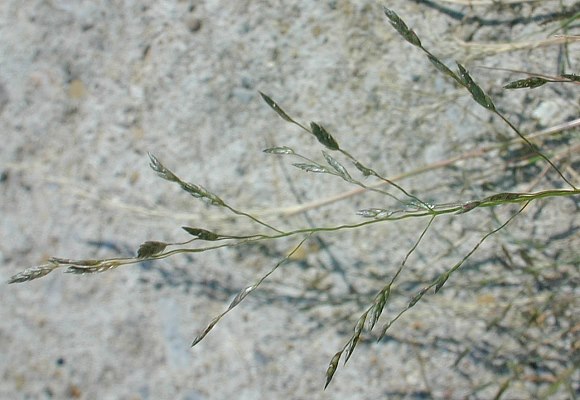
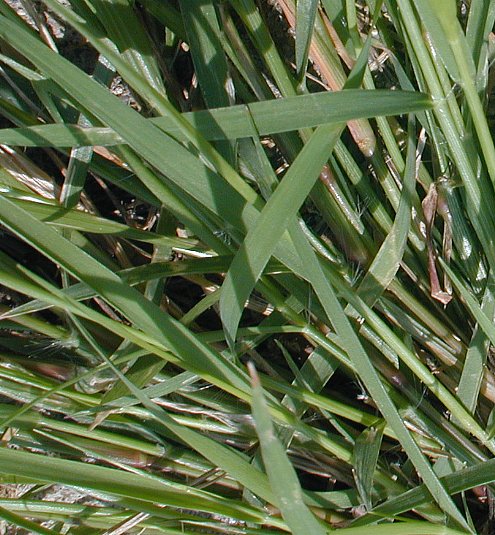
Description: This grass is a summer annual consisting of a sprawling tuft of flowering culms with alternate leaves. Each culm is usually branched toward its base, but becomes unbranched above. The slender culms are light green or purple, glabrous, terete, and about ½–2' in length. The leaf blades are 1-6" long and 1.5–3.0 mm. across; they are yellowish green to green, hairless, and flat. The leaf sheaths are light green, veined, and hairless – except at the junctions of the sheaths with the blades, where there are thin collars of long white hairs. The sheaths are shorter than the internodes; the exposed nodes are swollen, hairless, and either light green or purple. The central culm (and any lateral culms) terminates in a panicle of spikelets about 3-9" long and 1-4" wide at the bottom. The panicle is airy in appearance and narrowly pyramidal in shape. Along the central axis (rachis) of the inflorescence, there are several lateral branches that are ascending. These lateral branches are alternate, opposite, or whorled in groups of 3 along the central axis. Both the central axis and lateral branches are slender, glabrous, and either straight or slightly wiry.
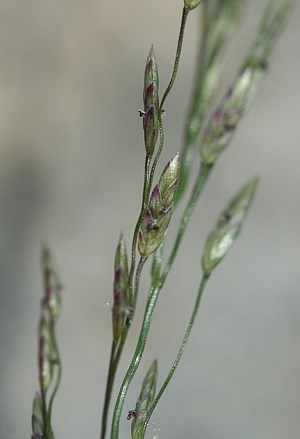
Each lateral
branch produces 1-5 spikelets along the upper one-half of its length;
each spikelet has a short slender pedicel. The spikelets and their
pedicels are either appressed or slightly divergent along the length of
each branch. Each spikelet is 4-8 mm. long and about 1.5 mm. across,
consisting of 2 glumes and 5-15 lemmas that are arranged in two
overlapping ranks. The spikelets are light gray-green or lead-colored,
glabrous, smooth along their margins, and flattened; sometimes the tips
of their lemmas are tinted purple. The first glume is 0.5–1.0 mm. long,
while the second glume is 0.7–1.5 mm. long; they are keeled, elliptic,
and single-veined. Individual lemmas are 1.0–2.0 mm. long; they are
keeled, elliptic, and 3-veined. The lateral veins of the lemmas are
conspicuous when a spikelet is viewed with a 10x hand lens. The
blooming period occurs from mid-summer to the early fall, lasting about
1-2 weeks for a colony of plants. The florets of the spikelets are
cross-pollinated by the wind. The mature grains are 0.5–1.0 mm. long,
short oblongoid-ellipsoid in shape, and slightly flattened; they are
small enough to be blown about by
the wind. The root system is fibrous. This grass spreads by reseeding
itself.
Cultivation:
The preference is full sun, dry conditions, and a barren soil
containing sand, gravel, or clay. This grass has a C4 photosynthetic
metabolism, enabling it to tolerate periods of hot dry weather.
Range &
Habitat:
Tufted Love Grass is found in all counties of Illinois (see Distribution
Map), where it is native. Habitats include thinly wooded
upland areas, sandy savannas, dry sand prairies and gravel prairies,
sand bars along rivers, areas along roads and railroads, cracks in
sidewalks and parking lots, fields, and barren waste areas. This grass
is found primarily in habitats with a history of disturbance; it is a
pioneer species.
Faunal Associations:
Insects that feed on Tufted Love Grass (Eragrostis pectinacea)
and other love grasses (Eragrostis
spp.) include the caterpillars of Poanes hobomok
(Hobomok Skipper) and Poanes
zabulon (Zabulon Skipper), Chaetocnema pulicaria
(Corn Flea Beetle), larvae of the fly Cerodontha dorsalis
(Grass Sheath Miner), larvae of the gall wasp Eurytomocharis eragrostidis
(Love Grass Borer), Colopha
ulmicola (Elm Cockscomb Aphid), and the leafhopper Flexamia areolata;
see Bouseman et al. (2006), Wagner (2005), Clark et al. (2004), Needham
et al. (1928), Felt (1917), Blackman & Eastop (2013), and Hicks
(2014) for more information.
Photographic Location:
A crack in the parking lot of the webmaster's apartment complex.
Comments: This is one of the weedy annual love grasses (Eragrostis spp.). Some of these species are native, while others have been introduced from Eurasia. The native love grasses that are perennials have more fidelity to higher quality habitats (e.g., sand prairies). Distinguishing among different species of love grass is rather difficult. The following characteristics of Tufted Love Grass are useful in making an accurate identification: 1) its spikelets are appressed or slightly divergent along the length of the lateral branches, rather than strongly divergent, 2) there are no glandular secretions (looking like tiny glossy dots) along the margins of its leaves nor along the keels of its lemmas, 3) individual spikelets are about 1.5 mm. across, 4) there are 5-15 lemmas per spikelet, and 5) there are no tufts of hair where the lateral branches join the central axis of the inflorescence. Of these different characteristics, #1 above is the most distinctive and striking. Other common names of Eragrostis pectinacea are Slender Love Grass, Small Love Grass, and Carolina Love Grass.