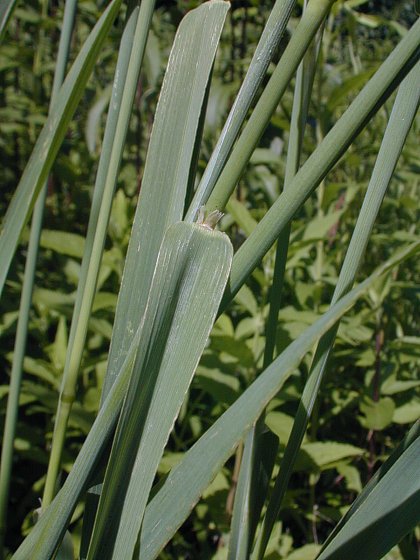
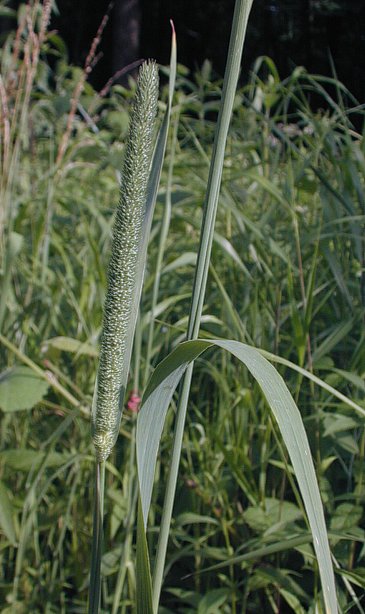
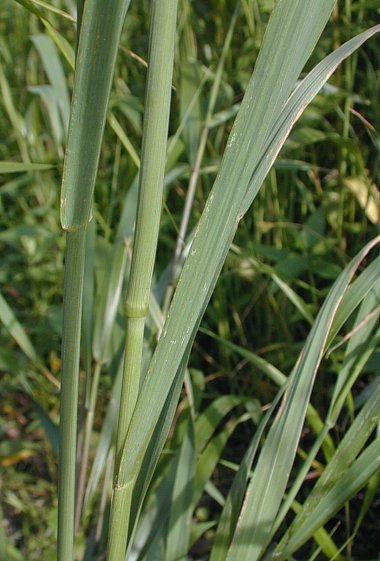
Description: This perennial grass is 2–3½' tall, producing either solitary culms or small tufts of culms. It is relatively short-lived. Each culm is light green, glabrous, terete (circular in cross-section), unbranched, and erect; the nodes of each culm are slightly swollen, green, and glabrous. There are 3-6 alternate leaves along the entire length of each culm. The leaf blades are up to 8 mm. (1/3") across and 9" long; they are dull green to grayish blue, hairless, flat, and linear in shape. The leaf margins are scabrous (rough-textured), while their bases are usually more wide than the culm. The ligules are white-membranous. The leaf sheaths are dull green to grayish blue and hairless like the leaf blades. Each culm terminates in a spike-like panicle of florets that is narrowly cylindrical; this inflorescence is 2½–6" long, about 8 mm. across, and dull whitish green or whitish gray-blue (while immature). The spikelets are densely packed together along the entire length of the inflorescence; they are slightly ascending.
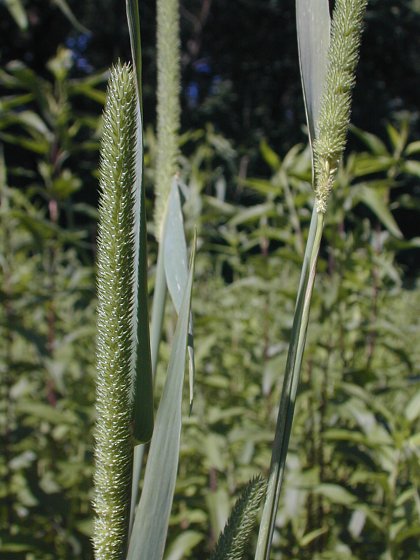
Each spikelet is 3-4 mm. long, consisting of 2 glumes, a fertile lemma, a palea, and a perfect floret. Both glumes are 3-4 mm. long and sharply folded; they are green along their keels, while their overlapping margins are membranous. The keels of these glumes are bristly-ciliate; the tips of these glumes have short awns about 1.0-1.5 mm. in length. The fertile lemma is 1.5-2 mm. long; it is shorter than the glumes and enclosed by them. Across from the lemma is a membranous palea; they enclose a single floret that has a glabrous ovary, 3 stamens, and a pair of feathery (plumose) stigmata. The lateral branches and pedicels of the spike-like panicle are very short. The blooming period occurs during early to mid-summer, lasting about 1-3 weeks. During this time, the anthers of the florets release abundant amounts of pollen. As the grains ripen, the spike-like panicles become light brown or stramineus (straw-colored). These grains are very small (less than 2 mm. in length) and they remain enclosed within the persistent glumes. The base of the culm sometimes becomes swollen, forming a corm that stores food energy, and there are shallow fibrous roots below. This grass occasionally forms colonies.
Cultivation:
This grass prefers full or partial sun, mesic
conditions, fertile soil containing loam or clay-loam, and
cool to warm temperatures. It is somewhat aggressive in
disturbed areas; regular lawn-mowing or heavy grazing is
not tolerated.
Range & Habitat:
Timothy is a common grass that occurs in every county of Illinois (see Distribution
Map).
It was introduced from Europe, either accidentally or deliberately,
into the United States during the early 18th century. It was used as a
source of hay for
horses and other farm animals; this practice continues to the present
day. Habitats include fields, pastures, disturbed meadows,
fence rows in open areas, vacant lots, powerline clearances, roadsides,
grassy embankments, upper slopes of drainage canals, and waste
areas. Timothy is found
in disturbed areas more often than natural habitats.
Faunal Associations: Various insects feed on Timothy, including Aptinothrips rufus (Red Grass Thrips), Neophilaenus lineatus (Lined Spittlebug), Cephus cinctus (Grass-stem Sawfly), larvae of Thymelicus lineola (European Skipper), larvae of the moth Leucania pseudargyria (False Wainscot), larvae of the moth Oligia fractilinea (Lined Stalk Borer), and larvae of the leaf-miner moth Elachista illectella (Vance, 1974; Hamilton, 1982; Felt, 1917; Bouseman et al., 2006; Covell, 1985/2006). Other insect feeders include leaf beetles, billbugs (Sphenophorus spp.), larvae of leaf-mining flies (Cerodontha spp.), plant bugs, stink bugs, aphids, meadow katydids (Conocephalus spp.), and grasshoppers (Clark et al., 2004; Vaurie, 1983; Needham et al., 1928; Watson, 1928; Knight, 1941; Rider, 2009; Blackman & Eastop, 2013; Gangwere, 1961; Vickery & Kevan, 1985; Wyoming Agr. Exp. Sta., 1994). The Insect Table lists these species in more detail. The seeds are eaten to some extent by the Bobwhite and a variety of granivorous songbirds (see Bird Table for a listing of these species). Mammalian herbivores graze on the foliage of Timothy, including rabbits, deer, horses, cattle, and sheep. Among small rodents, the Deer Mouse eats the seeds, while the Prairie Vole eats the leaves (see Whitaker, 1966; Cook et al., 1982).
Photographic
Location:
A powerline clearance at Busey Woods of Urbana, Illinois.
Comments:
This charming grass has escaped from agricultural fields and can be
found everywhere. The most distinctive feature of this grass is its
narrowly cylindrical seedheads; the mature foliage is somewhat coarse.
Unfortunately, Timothy is a major cause of allergies in some areas
because it releases large amounts of pollen during the first half of
summer. For this reason, some people may be less than charmed to find
its presence in their neighborhood. While there are other grasses in
Illinois that have cylindrical seedheads (e.g., Setaria spp.
and Alopecurus spp.), their spikelets are usually
more bristly and shiny from the presence of long hairs. The short hairs
that are observable on the inflorescence of Timothy are actually paired
awns of the spikelets. These awns are flexible rather than stiff while
the spikelets are still green. This grass was named after the farmer
Timothy Hansen, who
advocated its use for agricultural purposes during the early 18th
century, hence the common name 'Timothy.'