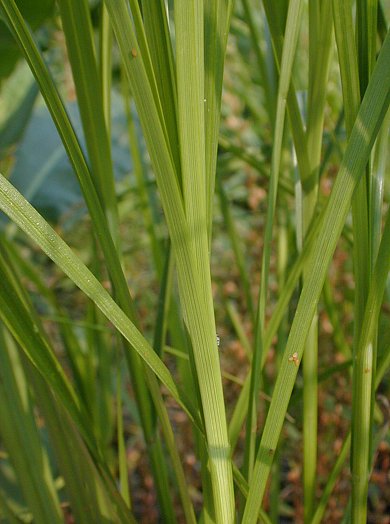
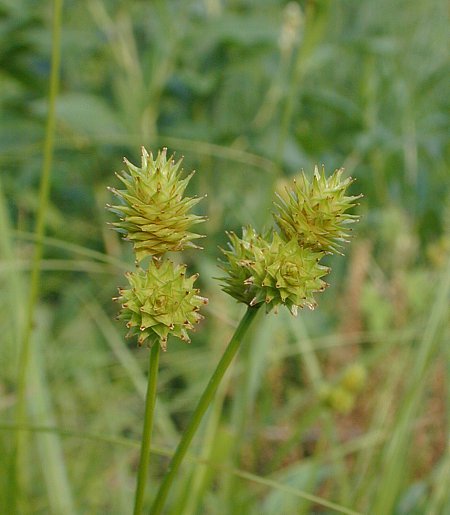
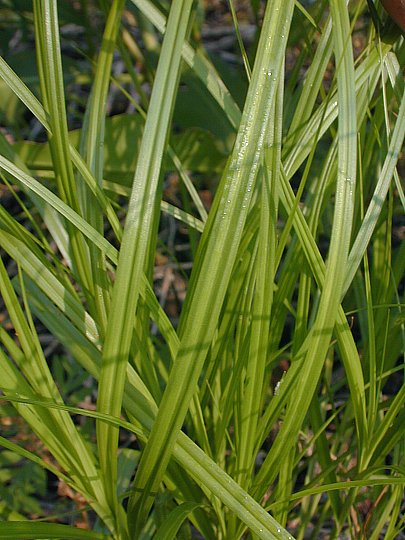
Description: This perennial sedge is 1–2½' tall, consisting of a tuft of leafy culms. Both fertile and infertile shoots are present; the latter have more leaves. Each fertile culm is erect to ascending; it has 2-3 alternate leaves along the lower one-third of its length (also dried remnants of older leaves). The culms are light to medium green, glabrous, 3-angled, and rather stiff. The leaf blades of fertile shoots are about 4-8" long and up to 3 mm. across; the leaf blades of infertile shoots are somewhat longer. These leaf blades are ascending to arching and channeled along their midveins; they are light to medium green, glabrous, and rough-textured (scabrous) along their margins. The leaf sheaths are tight and hairless; the inner side of each sheath is membranous, while the outer 2 sides are light to medium green and longitudinally veined. Each fertile culm terminates in a strongly exerted inflorescence consisting of 2-4 sessile spikelets; these spikelets are clustered closely together (collectively spanning about 1.5–2.5 cm. in length). Individual spikelets are 7-9 mm. long, 6-7 mm. across, and globoid-ovoid in outline; both the bottoms and apices of these spikelets are well-rounded. Each spikelet consists of a dense cluster of widely spreading to ascending perigynia and scales. The beaks of the perigynia provide these spikelets with a prickly appearance. Most florets in a spikelet are female (pistillate), although some florets toward the bottom are male (staminate).
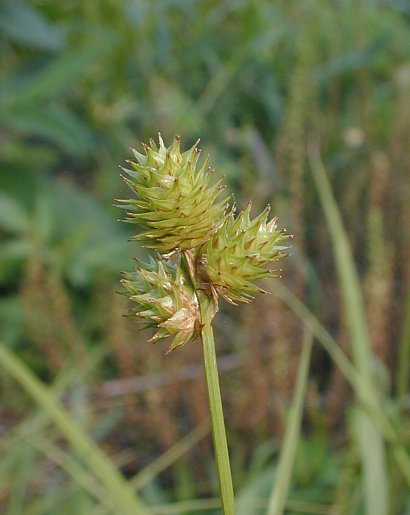
The perigynia are 3.5–4.5 mm. long and 2.0–2.5 mm. across; they are flattened-ovoid with a long beak, rounded at the bottom, narrowly membranous (winged) along their margins, and glabrous. There are several longitudinal veins on the outer surface of each perigynium, while the inner surface has a few fine veins that are difficult to see. Immature perigynia are whitish green, while mature perigynia become brown. The pistillate scales are shorter than the perigynia and lanceolate-oblong in shape; each of these scales is green-veined in the middle and broadly membranous along the margins. The bracts of the inflorescence are scale-like or absent. The blooming period occurs during the late spring, lasting about 1-2 weeks for a colony of plants. The florets are cross-pollinated by the wind. Afterwards, the perigynia disarticulate from their spikelets; they can be blown about by the wind or float on water, distributing the achenes to new locations. The achenes are about 1.5 mm. long, 1.0 mm. across, ovoid in shape, and somewhat flattened; their bottoms are usually apiculate (ending abruptly to a small distinct point). The root system is fibrous and rhizomatous.
Cultivation:
The preference is full to partial sun, wet to mesic conditions,
and soil containing loam or clay-loam. In open situations with exposed
topsoil, this sedge is slightly aggressive and weedy.
Range & Habitat:
The native Troublesome Sedge is common in central and northern
Illinois, while in southern areas of the state it is occasional or
absent (see Distribution
Map).
This sedge adapts to a wide variety of habitats, however it is more
commonly found in wetland habitats. These habitats include wet to
dry-mesic prairies, open woodlands, swamps, thickets, abandoned fields,
wet depressions in sunny areas, degraded seasonal wetlands, and
roadside ditches. This sedge is often found in habitats with a history
of disturbance.
Faunal
Associations:
Several species of butterflies, skippers, and moths feed on wetland Carex
spp. (sedges); the Lepidoptera Table lists many of
these species. Other insects also feed on these sedges, including
semi-aquatic leaf beetles, billbugs, seed bugs, aphids, leafhoppers,
stem-boring larvae of flies, and sedge grasshoppers (see the Insect
Table for a listing of these species). Wetland sedges are
sources of food to many vertebrate animals. Waterfowl, rails, and other
wetland birds eat the seeds of these sedges (see Bird Table),
and sometimes these sedges are a minor source of food to turtles,
including Chelydra serpentina (Snapping
Turtle) and Kinosternum subrubrum (Eastern Mud
Turtle). Muskrats eat the culms and rootstocks occasionally, while
Black Bears and hoofed mammalian herbivores (deer, cattle, horses,
etc.) eat the foliage and seedheads when other sources of food are less
available.
Photographic Location:
A seasonal wetland at Judge Webber Park in Urbana, Illinois.
Comments: Notwithstanding its strange name, this is an attractive sedge with tufts of slender leaves and prickly-appearing seedheads. It resembles several other Carex spp. (sedges) in the Ovales section, which can be difficult to identify. In general, Troublesome Sedge (Carex molesta) has the following set of key characteristics: 1) It has only 2-4 spikelets (rarely 5) that are clustered closely together, 2) these spikelets are nearly globoid in shape and they have well-rounded bottoms, 3) the typical perigynium is about 4 mm. long and 2.0–2.5 mm. across, and 4) the leaf blades are less than 3.5 mm. across. Other similar sedges include Carex normalis, Carex cristatella, Carex brevior, and Carex festucacea. Two of these species, Carex normalis and Carex cristatella, have wider leaf blades (up to 6 mm. across) and more spikelets per inflorescence (about 4-12). The sedge Carex brevior also has more spikelets per inflorescence (about 4-8), slightly wider leaf blades (up to 4 mm. across), and slighter wider perigynia (2.5–3.5 mm. across). The remaining sedge, Carex festucacea, often has a similar number of spikelets per inflorescence, but they are less densely clustered together than the spikelets of Troublesome Sedge. Also, the perigynia of Carex festucacea are a little shorter (typically about 3 mm. in length).