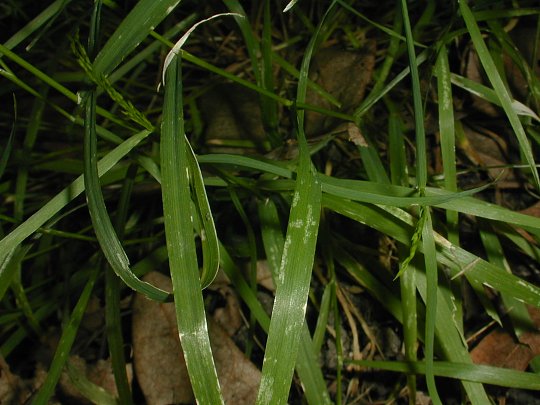
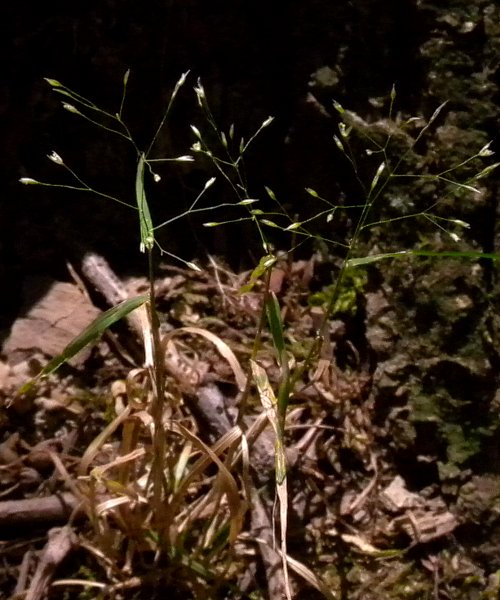
Description: This is a perennial grass about ½–2½' tall that develops either individually or in loose tufts of unbranched leafy culms. In sunny habitats with fertile soil, this grass is taller and more stout, while in shaded habitats with poor soil it is shorter and more delicate. The culms are light green, terete, slender, and glabrous. About 4-8 alternate leaves occur along the length of each culm (some lower leaves may be withered away). The longer blades of lower leaves have a tendency to droop, while the shorter blades of upper leaves are more stiff and straight. The leaf blades are 1-6 mm. across and 2-10" long; they are medium green or grayish green, flat, and hairless. The leaf sheaths are medium green or grayish green, hairless, and open. The ligules at the junctions of leaf blades and sheaths are white and short-membranous. The nodes along each culm are green and swollen.
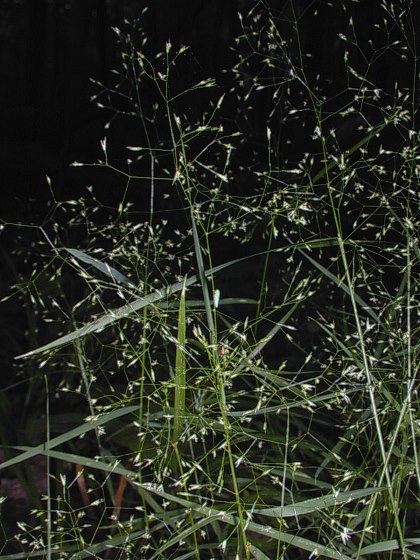
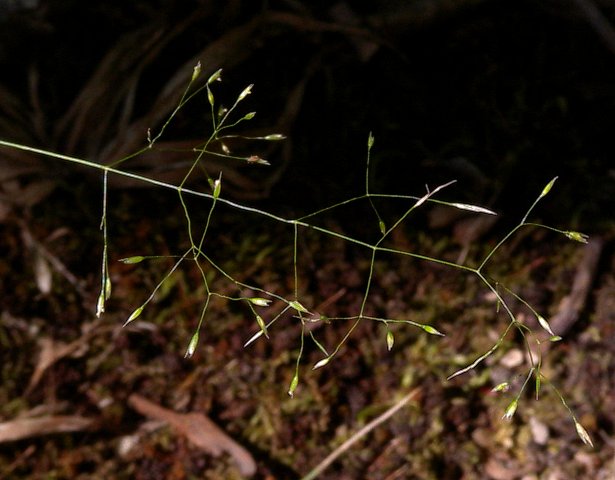
The culm of each fertile shoot terminates in an inflorescence that is 2-10" long and about one-half as much across; this inflorescence is about one-third of the length of the shoot. It consists of an airy panicle of spikelets that is much branched. The rachis (or central axis) of this panicle is slender and hairless; it is either straight or zigzags slightly along its length between whorls of 2-3 branches. Terminal branchlets with spikelets develop toward both the middle and tips of lateral branches; these branches and branchlets are usually quite divergent. Each spikelet consists of a pair of glumes and a single lemma with a perfect floret; the inner palea is absent or insignificant. The glumes are 2-3 mm. long, light green, lanceolate, and strongly keeled; one glume is slightly larger than the other. The lemma is 1-2 mm. long, light green, and oblong-elliptic in shape; it is shorter than the glumes. In each spikelet, the prominent glumes resemble a pair of tiny claws. The blooming period usually occurs during the late summer or early fall. Cross-pollination of the florets is by wind. The inflorescence turns tan when the grains ripen. The root system is fibrous. Sometimes, this grass forms small colonies by reseeding itself.
Cultivation:
This grass can adapt to a fairly broad range of growing conditions. It
tolerates full sun to medium shade, moist to dry conditions, and soil
containing loam, clay loam, and rocky material. For a cool-season grass
with a C3 metabolism, it is slow to develop as most vegetative growth
occurs during the summer, rather than the spring.
Range & Habitat:
The native Upland Bent is common in southern Illinois, occasional in
central Illinois, and uncommon or absent in the northern part of the
state (see Distribution
Map). Habitats include rocky upland woodlands,
dry-mesic woodlands, thinly wooded bluffs, wooded slopes, open
woodlands, woodland openings, small prairie swales, dolomite prairies
(in NE Illinois), shaded gravelly seeps, and trampled ground in picnic
areas underneath trees. In woodlands, Upland Bent is often found on
decayed tree stumps or around the trunks of deciduous trees, especially
in semi-open areas where the soil quality is poor and ground vegetation
is scant. In sunny habitats, where it is less common, this grass
prefers areas with more ground moisture.
Faunal Associations: Larvae of the leaf-mining moth Elachista irrorata have been found feeding on Upland Bent (Agrostis perennans); see Needham (1928). The caterpillars of the following skippers are known to feed on the foliage of Bent Grasses (Agrostis spp.), although not exclusively: the Common Roadside Skipper (Amblyscirtes vialis), Leonard's Skipper (Hesperia leonardus), and Fiery Skipper (Hylephila phyleus). Other insects that feed on these grasses include larvae of the leaf-mining moth Elachista illectella, the Black Cutworm (Agrotis ipsilon), the Toothed Flea Beetle (Chaetocnema denticulata), several species of aphids that feed primarily on the roots, adults of the Prairie Spittlebug (Philaenarcys bilineata), and larvae of the gall wasp Tetramesa agrostidis. Bent Grasses are palatable to many mammalian herbivores and they are readily eaten by horses and livestock, especially when their foliage is young.
Photographic
Location:
A decayed tree stump in Busey Woods, Urbana, Illinois, and trampled
ground near trees at a picnic area in east-central Illinois.
Comments:
This is a rather ordinary-looking grass that blooms during the latter
part of the growing season. Upland Bent and other Agrostis
spp. (Bent Grasses) have small delicate spikelets; each one
with 2 prominent glumes and a smaller lemma. The spikelets of some Bent
Grasses have an inner palea near the lemma (which is hard to see),
while Upland Bent lacks this structure. Unlike some other species in
this genus, Upland Bent also lacks awns on its lemmas. Two similar
species, Agrostis hyemalis (Tickle Grass) and Agrostis
scabra (Rough Tickle Grass), have terminal branchlets of
spikelets toward the tips of the larger branches. In contrast, Upland
Bent has some branchlets of spikelets toward the middle of the larger
branches, and the branching pattern of its panicles is often more
divergent. Another common name of Agrostis
perennans is Autumn Bent.