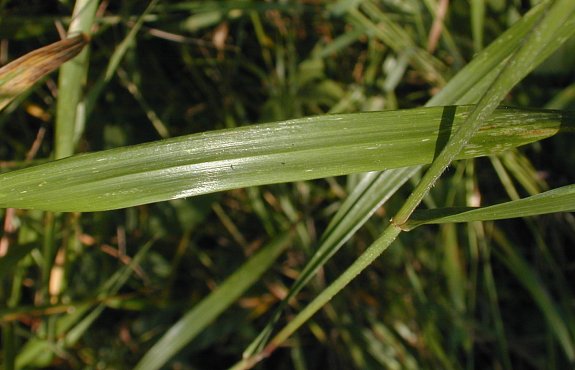
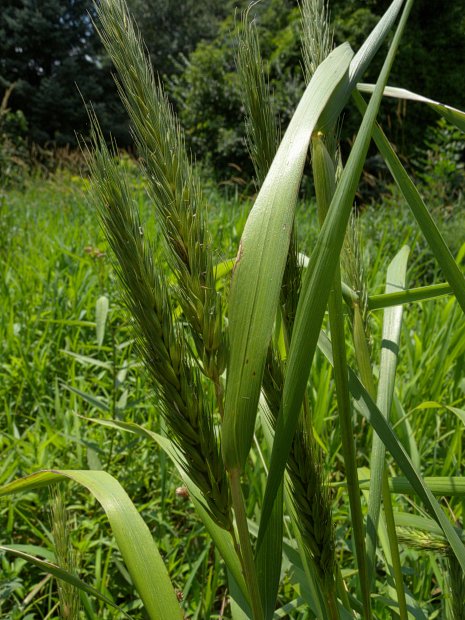
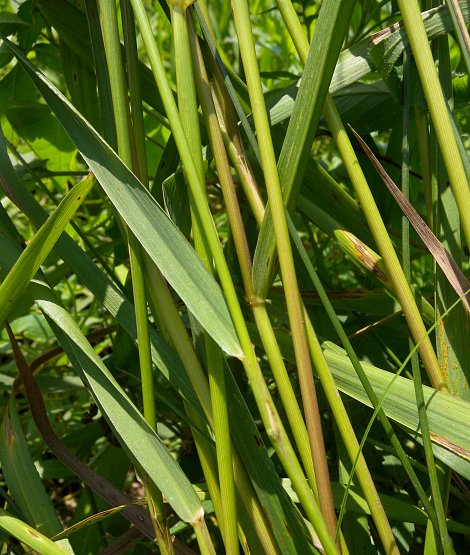
Description: This perennial grass produces both infertile and fertile shoots. Infertile shoots are up to 1' tall and semi-evergreen; they occur throughout the year, consisting of tufts of low leaves. During the spring and summer, fertile shoots develop, consisting of tufts of tall leafy culms about 2½–4' tall that are deciduous. These culms are terete, light green to reddish brown, glabrous, and erect. Several alternate leaves occur along the entire length of each culm. The blades of these leaves are up to 15 mm. across and 12" long; they are medium green, dark green, or bluish green, hairless on both their upper and lower sides, and rather floppy. The bases of these blades are narrowly auricled (with narrow ear-like lobes); these auricles clasp the culms. The leaf sheaths are light green, medium green, yellowish green, or reddish green; they are open toward their apices, hairless to sparsely short-pubescent, longitudinally veined, and often membranous along their margins. The ligules are white-membranous. Each fertile culm terminates in an erect floral spike (or spike-like raceme) about 2½–6" long; this inflorescence is densely covered on all sides with ascending spikelets that are sessile, or nearly so.
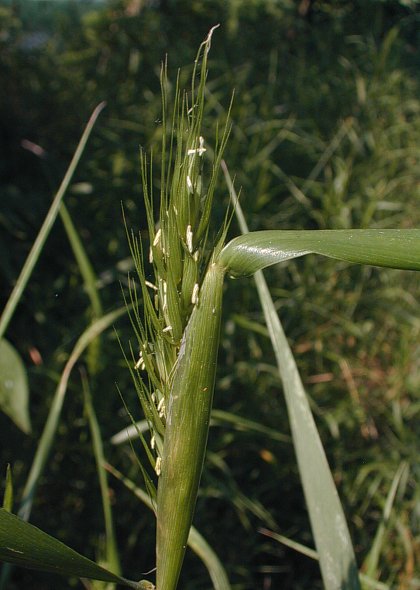
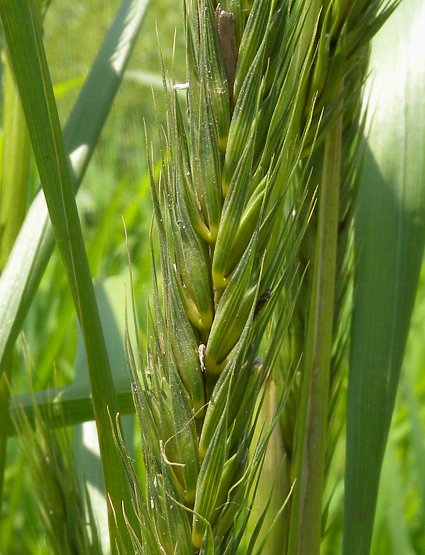
Often, the floral spike is partially enclosed or barely exerted from the uppermost leaf. Each spikelet has a pair of glumes and a cluster of 2-4 lemmas. The glumes are linear-lanceolate, 8-15 mm. in length (excluding their awns), and 1.0–2.5 mm. across near their bases; their straight awns are about ½–1" (10-25 mm.) long. The lemmas are 6-10 mm. in length (excluding their awns) and their straight awns are 6-30 mm. long. When upper lemmas are present in a spikelet, they are a little smaller in size than the lower lemmas and often sterile. The outer surfaces of individual glumes are convex, 3-5 veined, and glabrous, scabrous (rough-textured from minute stiff hairs), or finely short-pubescent. The outer surfaces of individual lemmas are convex, 5-7 veined, and glabrous to finely short-pubescent. The florets of fertile lemmas have 2 stigmas and 3 white or pale yellow anthers. The blooming period occurs during the summer, lasting 1-2 weeks for a colony of plants. The florets are cross-pollinated by the wind. Afterwards, the floral spikes become tan-colored and the leaves of fertile shoots begin to wither away. The florets are replaced by long grains with adherent pericarps (one grain per fertile lemma). The root system is fibrous. This grass can tiller at the base, forming clonal offsets from the root system.
Cultivation:
This grass prefers full sun to light shade, moist conditions, and a
fertile soil containing loam or clay-loam. Plants that grow in
sunlight tend to be more robust and a lighter shade of green than those
that grow in shade. This grass is easy to cultivate if it receives
enough moisture. The seeds require no pretreatment and they germinate
readily. It also possible to start new plants by division of its root
system after tufts of leaves have formed.
Range & Habitat:
The native Virginia Wild Rye is found in every county of Illinois (see Distribution
Map), where it is quite common. Habitats include deciduous
woodlands (especially floodplain woodlands), bluffs, moist savannas and
sandy savannas, rocky glades, moist prairies, edges of marshes, and low
areas along rivers. This grass can tolerate low to moderate levels of
disturbance. While it is often characterized as a prairie grass,
Virginia Wild Rye is also common in wooded areas.
Faunal Associations: Various insects feed on Virginia Wild Rye and other Elymus spp. (Wild Rye grasses). These species include the leafhoppers Dorycephalus platyrhynchus, Elymana acuma, and Sorhoanus orientalis; the aphids Carolinaia howardii, Carolinaia rhois, and Sipha elegans; and such polyphagous stink bugs as Acrosternum hilare (Green Stink Bug), Brochymena quadripustulata (Four-humped Stink Bug), Coenus delius (Coenus Stink Bug), and Euschistus servus (Brown Stink Bug); see DeLong (1948), Blackman & Eastop (2013), and Rider (2009). Other insect feeders include Chaetocnema pulicaria (Corn Flea Beetle), the leaf beetle Chalepus walshii, Sphenophorus minimus (Little Billbug), larvae of Tetramesa elymi (Wild Rye Jointworm) and Tetramesa tritici (Wheat Jointworm), larvae of Mayestiola destructor (Hessian Fly), and larvae of Cephus cinctus (Grass-stem Sawfly); see Clark et al. (2004), Vaurie (1983), and Felt (1917). Caterpillars of the moths Elachista epimicta, Elachista illectella, and Elachista leucofrons mine the leaves of these grasses, and caterpillars of the moth Leucania pseudargyria (False Wainscot) also eat the leaves; see Needham (1928), Microleps website (2010), and Covell (1984/2005).
Vertebrate animals also use
these grasses as a source of food. When Virginia Wild Rye grows near
wetlands, the seedheads are sometimes eaten by the Mallard, Lesser
Scaup, and other ducks, while Canada Geese feed on the foliage (Havera,
1999, personal observation). The White-Footed Mouse, Prairie Deer
Mouse, and wild House Mouse eat the seeds (Whitaker, 1966). Prior
to the development of its awned seedheads, this grass is also palatable
to horses, cattle, and other livestock. Sometimes the
seedheads become infected with an ergot fungus, making them toxic to
such grazing animals.
Photographic Location:
A restored prairie and low wooded area at Meadowbrook Park in Urbana,
Illinois.
Comments: Virginia Wild Rye (Elymus virginicus) is highly variable and several varieties have been described. The typical variety (var. virginicus) has smaller glumes (8-10 mm. in length) and lemmas (6-8 mm. in length) than var. glabriflorus; the latter variety has glumes that are 10-15 mm. in length and lemmas that are 8-10 mm. in length. The awns of var. glabriflorus also tend to be longer than those of var. virginicus. Another variety of Virginia Wild Rye, var. submuticus, differs from the preceding varieties by having glumes and lemmas that lack awns or they have very short awns (0-4 mm. in length). The leaf blades of var. submuticus tend to be less wide (up to 8 mm. across) than those of the preceding varieties. Additional varieties of Virginia Wild Rye have been described on the basis of the presence or absence of hair on the glumes and lemmas by some authors. Of the 3 varieties that have been described here, var. virginicus is the most common and var. submuticus is the least common in Illinois. Virginia Wild Rye can be distinguished from other Elymus spp. (Wild Rye grasses) by its erect spikelets with straight awns, the lack of significant hair on its foliage, and the width of its glumes (about 1 mm. across). Naturally occurring hybrids between Elymus virginicus glabriflorus and Elymus hystrix (Bottlebrush Grass) have been found within the state, which prompted the reclassification of the latter species into the Elymus genus.