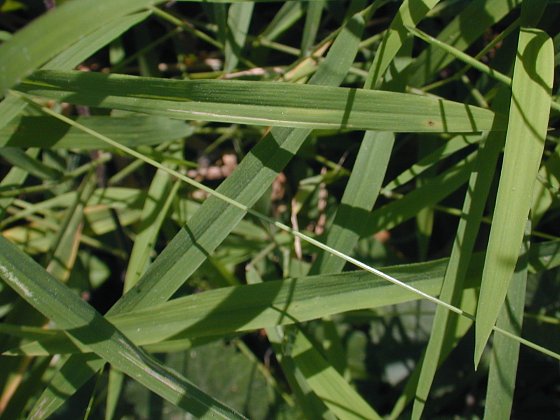
Description: This perennial grass is 1-3' tall, branching occasionally. The culms of this grass are erect to sprawling; they are light green, terete, and glabrous. Several alternate leaves occur along the entire length of each culm; their blades are widely spreading and either flat or indented along the middle. The leaf blades are up to 6" long and 12 mm. across; they are linear-lanceolate, light-medium green, mostly hairless, and dull (not shiny). The leaf sheaths are light-medium green, mostly hairless, and dull (not shiny). The nodes of the culms are pubescent, while the ligules are white-membranous. Each culm terminates in a panicle of spikelets up to 8" long and about one-half as much across. The lateral branches occur individually along the rachis (central stalk) of this panicle; they are erect to widely spreading and relatively few in number. Both the rachis and lateral branches are light green, glabrous, slightly wiry, and stiff.
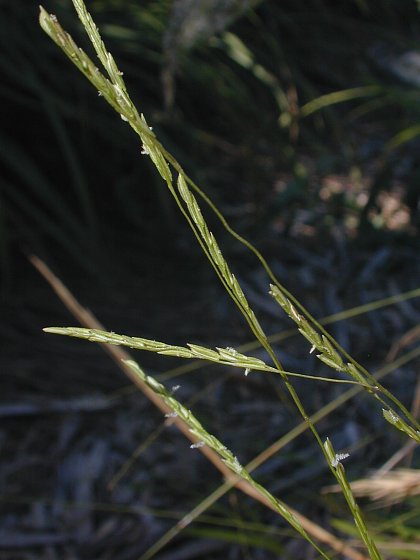
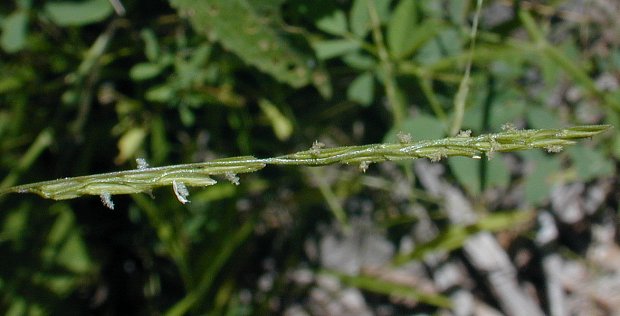
About 5-10 appressed spikelets occur along the upper half of each lateral branch, while the lower half is naked; these spikelets also occur at the apex of the rachis. These spikelets are arranged together in rows on short pedicels. The spikelets are 3-3.5 mm. long, 1-1.5 mm. across, light green, flattened-oblongoid in shape, and either glabrous or sparsely white-mealy. Each spikelet consists of a fertile lemma, a palea, and a perfect floret; there are no glumes. Individual lemmas are the same length as the spikelets, 5-veined, and strongly keeled; both the margins and keel of each lemma are often finely ciliate. The paleas are the same length as the spikelets; along with the lemmas, they enclose the florets. Each floret has 2 white anthers, 2 white plumose stigmas, and an ovary. The blooming period occurs from mid-summer to early autumn, lasting 1-2 weeks for a colony of plants. The florets are cross-pollinated by the wind. Afterwards, mature spikelets fall to the ground in their entirety; each spikelet contains a single narrow grain. The root system has scaly rhizomes and fibrous roots. This grass often forms clonal colonies from its rhizomes.
Cultivation:
The
preference is light shade to partial sun, moist to mesic conditions,
and fertile loamy soil with abundant organic matter.
Range & Habitat:
White Grass is occasional to locally common throughout Illinois (see Distribution
Map),
where it is native. Habitats include moist to mesic deciduous
woodlands, woodland openings, moist meadows in wooded areas, powerline
clearances in wooded areas, edges of woodland paths, partially shaded
low-lying areas along ponds and streams, swamps, marshes, and hillside
seeps. This grass is usually found in moist woodlands or partially
shaded areas of wetlands. It tolerates, or even prefers, low to
moderate levels of disturbance in these areas.
Faunal Associations:
Insects that feed on White Grass include caterpillars of a butterfly, Enodia
anthedon (Northern Pearly Eye), and the aphid Colopha graminis
(Barnes, 1999; Blackman & Eastop, 2013). Aside from this,
little is known about floral-faunal relationships for this species.
Photographic
Location:
A moist deciduous woodlands in Urbana, Illinois.
Comments:
White Grass (Leersia
virginica) is a good example of the kinds of grasses that
grow in wooded areas. Such grasses usually have delicate thin-textured
foliage and their panicles or racemes are slender and lanky with small
spikelets. As a general rule, they are not very showy. White Grass is
fairly easy to identify because its spikelets are appressed together to
form a single row along the upper one-half of each lateral branch. Each
perfect floret of White Grass produces only 2 anthers; this is unusual,
because most grasses produce 3 anthers per floret. Other cutgrasses (Leersia
spp.) in Illinois are found primarily in sunny wetlands and
they are less delicate. One of them, Rice Cutgrass (Leersia
oryzoides),
is exceptionally harsh with sawtooth margins along its leaf blades and
stiff bristly hairs everywhere else. The spikelets of these other
cutgrasses are larger in size (4 mm. or more in length) than those of
White Grass.