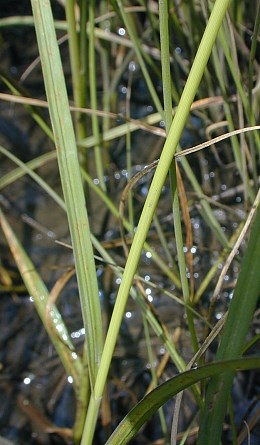
Description: This perennial plant is about 1½–3' tall, forming tight tufts of leaves and flowering culms. The slender culms are light green, 3-angled, rather stiff, and rough beneath the inflorescence. The alternate leaves are restricted to the lower half of the culms. The leaf blades are up to 20" long and 5 mm. (1/5") across; they are light green, glabrous, narrowly linear in shape, and rough along the margins. The narrow leaf blades typically arch outward; they are often channeled in the middle. The leaf sheaths are light green and glabrous, adhering tightly to the culm. The ligules are short-membranous. The inflorescence occurs at the apex of each culm; it is up to 3" long, consisting of a narrow panicle of 8-20 spikelets. At the base of each spikelet, there is often a linear bract up to 1" long (although it is usually much shorter or absent).
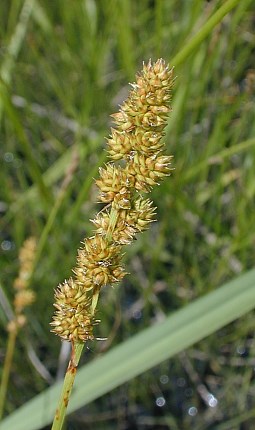
Each spikelet
consists of a tight cluster of pistillate and staminate florets and
their scales; the staminate florets are located at the apex of each
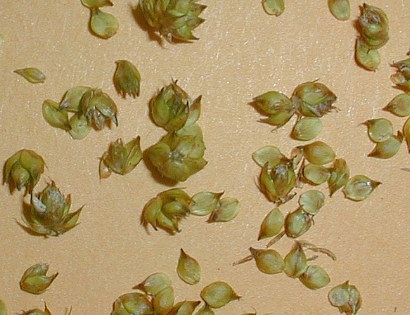
spikelet and they are relatively inconspicuous. The perigynia of
the pistillate florets are about 3 mm. long and 2 mm. across, or a
little smaller. Each perigynium is broadly ovate, somewhat rounded at
the base, and tapering to a short narrow beak; it is slightly convex on
one side and flat on the other (plano-convex). As they become mature,
the perigynia become golden yellow. The pistillate scales are
lanceolate or lanceolate-ovate, tapering to a short awned tip; they are
about the same length as the perigynia. The blooming period occurs
during late spring or early summer, lasting 1-2 weeks. The florets are
cross-pollinated by the wind. Mature achenes are quite small (about
1.0–1.5 mm. in length); they are flattened-ovoid in shape and glabrous.
The root system consists of short rhizomes and
fibrous roots.
Cultivation:
The preference is full to partial sun, wet to moist conditions, and
various kinds of soil, including loam and clay-loam. A mesic location
is tolerated where there is some protection from the afternoon sun.
Range &
Habitat:
Yellow Fox Sedge is occasional throughout Illinois (see Distribution
Map), where it is native. Habitats include wet to moist
prairies, prairie swales,
swamps, fens and seeps, borders of ponds, ditches, and abandoned
fields. This species can be found at both disturbed and higher quality
sites.
Faunal Associations:
Because the florets of the spikelets are wind-pollinated, they do not
attract many insects. The
caterpillars of various butterflies, skippers, and moths feed on
wetland sedges (Carex
spp.); see the Lepidoptera Table
for a listing
of these species. Other insects feeding on these sedges include sedge
grasshoppers (Stethophyma
spp.), semi-aquatic leaf beetles (Donacia
spp., Plateumaris
spp.), larvae of billbugs (Sphenophorus spp.),
larvae
of miscellaneous flies, larvae of sawflies, seed bugs, plant bugs,
aphids (Allaphis spp.,
Iziphya spp.,
Rhopalosiphum spp.,
Subsaltusaphis
spp.), and leafhoppers (Cosmotettix spp.).
The seeds of wetland sedges are a significant source of food to
various waterfowl and other wetland
birds; see the Bird
Table for a listing of these species.
Photographic Location:
A roadside ditch in Savoy, Illinois.
Comments: Yellow Fox Sedge is reasonably attractive because of its yellow spikelets and compact tufts of narrow leaves. It is very similar in appearance to the common Brown Fox Sedge (Carex vulpinoidea). However, the spikelets of Brown Fox Sedge are more brown when they become mature. Other differences between these two species include: 1) the leaf blades of Yellow Fox Sedge are shorter than the flowering culms, while the leaf blades of Brown Fox Sedge are often longer than the flowering culms, 2) the perigynia of Yellow Fox Sedge are usually a little larger in size than those of Brown Fox Sedge, and they are more round in shape with shorter beaks, 3) the inflorescence of Yellow Fox Sedge is 3" or less, while the inflorescence of Brown Fox Sedge is occasionally longer than this, and 4) the floral bracts of Yellow Fox Sedge are smaller in size and less conspicuous. Mohlenbrock (1999, 2003) refers to Yellow Fox Sedge as Carex brachyglossa (which is the name that has been adapted here), while other authorities refer to this species as Carex annectens, Carex annectens xanthocarpa, and Carex xanthocarpa. According to Mohlenbrock, Carex annectens annectens is synonymous with Brown Fox Sedge.