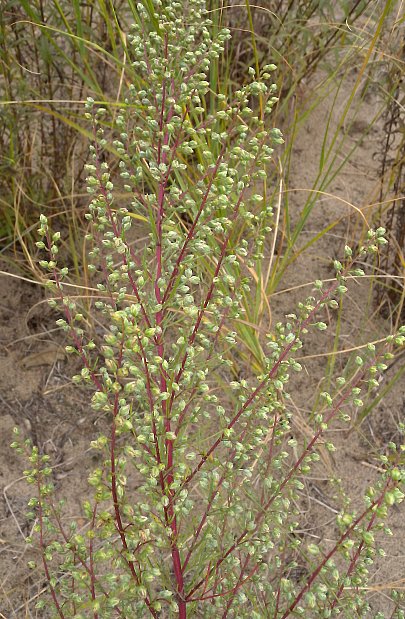
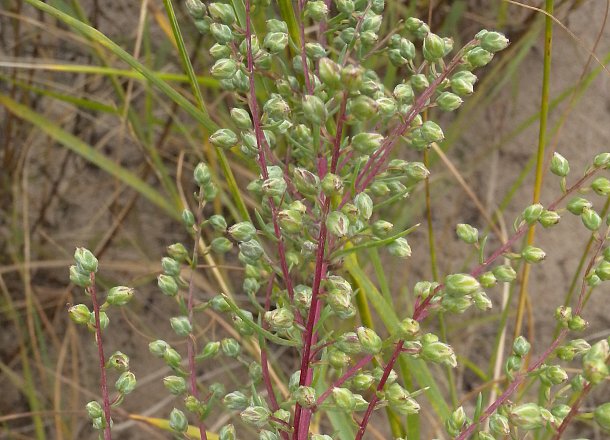
The central stem (and upper lateral stems, if any) terminates in a panicle of flowerheads that is about 4-18" long and about one-half as much across. Leafy linear bracts occur along the rachis (central stalk) and lateral branches of this panicle. The rachis and lateral branches are light green to dark red and glabrous to canescent. The rachis of the panicle is more or less erect, while its primary lateral branches are ascending. Individual flowerheads are whitish green or yellowish green and 2-4 mm. long and similarly across. Each flowerhead has 8-30 inner disk florets that are perfect and 5-20 outer disk florets that are pistillate. Each inner floret consists of a narrow tubular corolla with 5 teeth along its upper rim, some fertile stamens, and an abortive ovary that is sterile. Each outer floret consists of a narrow tubular corolla with 2-3 teeth along its upper rim and a fertile ovary with a divided style. The base of each flowerhead is surrounded by appressed overlapping bracts (phyllaries); individual bracts are lanceolate to ovate, mostly green, and up to 2 mm. long. At maturity, the flowerheads droop from short pedicels. The blooming period occurs from mid-summer to early autumn, lasting about 2-3 weeks. The florets are cross-pollinated primarily by the wind. Afterwards, the outer florets of the flowerheads are replaced by bullet-shaped achenes that are up to 1.0 mm. in length. These achenes are without tufts of hair or a crown of scales; they are usually distributed only a short distance from the mother plant by the wind. The root system consists of a woody taproot or caudex with fibrous roots. This plant reproduces by reseeding itself.
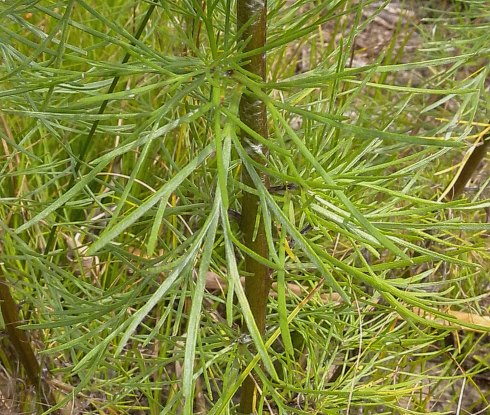
Cultivation: The preference is full sun, dry conditions, and sandy soil. During hot dry periods, it is not uncommon for the lower leaves to wither away. This plant has some tolerance to road salt.
Range & Habitat: The native Beach Wormwood is occasional in northern Illinois, and it is also occasional in the central section of the state along the Illinois River, otherwise it is rare or absent (see Distribution Map). Only ssp. caudata occurs within the state; the typical subspecies is found in Europe. Habitats include semi-stabilized sand dunes along Lake Michigan, dry areas of beaches, dry sand prairies, openings in sandy savannas, rocky glades, ledges along cliffs, sand bars and gravel bars along major rivers, abandoned sandy fields, and sandy roadsides. Beach Wormwood prefers sandy areas where there has been some disturbance from wind or wildfires.
Faunal Associations: To a limited extent, Beach Wormwood may be cross-pollinated by small bees and flies seeking pollen from the flowerheads. Other insects feed destructively on Beach Wormwood and other wormwood species (Artemisia spp.). Two plant bugs, Europiella bakeri and Lygus atritibialis, have been observed to feed on Beach Wormwood specifically (Knight, 1941). Other insects that feed on wormwood species in open areas include such grasshoppers as Hesperotettix viridis (Snakeweed Grasshopper), Hypochlora alba (Cudweed Grasshopper), and Melanoplus angustipennis (Narrow-winged Sand Grasshopper); see Vickery & Kevan (1985). The caterpillars of several butterflies and moths feed on the foliage and/or flowerheads of these plants, including Vanessa cardui (Painted Lady), Vanessa virginiensis (American Painted Lady), Scrobipalpula artemisiella (Wormseed Webworm), Phaneta argenticostana (Tortricid moth sp.), and Protoschinia nuchalis (Wormseed Flower Moth); see Marcovitch (1916), Marshall (2006), and various internet websites. Several aphids (Macrosiphoniella spp.) suck plant juices from the stems, leaves, and/or flowerheads of wormseed species (Hottes & Frison, 1931; Blackman & Eastop, 2013). Because of the bitter taste of the foliage and its mild toxicity, cattle and other mammalian herbivores in the Midwestern region usually avoid consumption of Beach Wormwood and similar species. However, vertebrate wildlife in the Western region of the United States utilize these plants as sources of food to a greater extent (Martin et al., 1951/1961).
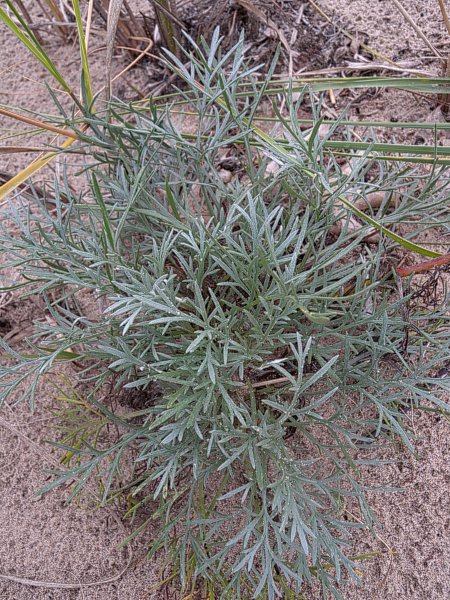
Photographic Location: Sand dunes along Lake Michigan at Indiana Dunes State Park in NW Indiana.
Comments: Beach Wormwood is the primary host of a rare parasitic plant, Orobanche fasciculata (Clustered Broomrape). The pale flowering stalk of this parasitic plant can be observed near Beach Wormwood during late spring or summer. A similar species, Orobanche ludoviciana (Prairie Broomrape), is also parasitic on Beach Wormwood, but this latter species is parasitic on a variety of other species in the Asteraceae. Among the several Artemisia spp. in Illinois, Beach Wormwood can be identified by the toothless linear lobes (less than 3 mm. across) of its deeply divided leaves. It is also unusual in having perfect florets with sterile ovaries, which are normally fertile in other Artemisia spp. Another common name of Artemisia campestris caudata is Field Sagewort. A scientific synonym of this species is Artemisia caudata.