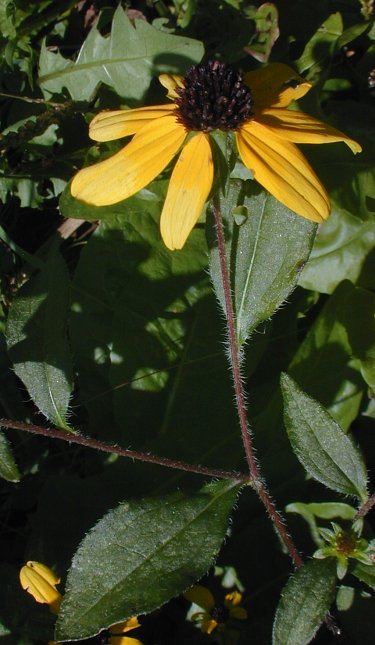
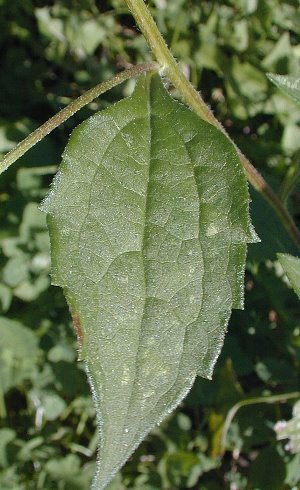
Description: This is a biennial or short-lived perennial plant up to 5' tall. It branches frequently at the leaf axils and its appearance is rather bushy at maturity. The stems are dark red and they have conspicuous white hairs, particularly along the upper half of the plant. The alternate leaves are up to 4" long and 2" across. They are lanceolate to ovate, slightly to coarsely dentate, and rough-textured from minute stiff hairs. Some of the lower leaves are divided into three lobes. Individual upper stems terminate in 1-2 flowerheads. Each flowerhead is about 1½-2" across, consisting of 6-12 ray florets that surround a brown to black flattened cone of numerous disk florets. The petaloid rays of the flowerheads are bright yellow and oblong in shape. The tiny disk florets are narrowly cylindrical. Around the base of each flowerhead, there are inner and outer floral bracts (phyllaries) that are green and ciliate. The flowerheads have little or no scent.
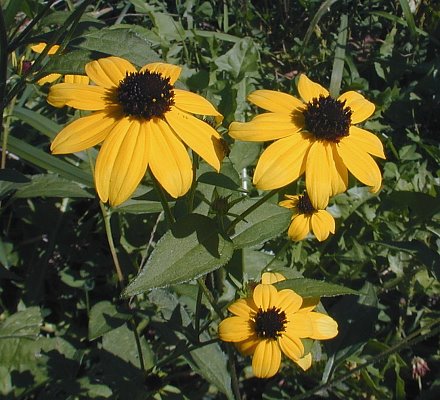
The
blooming period occurs from mid-summer to late summer for about 1-2
months. On robust plants, 6 or more flowerheads are often in bloom at
the same time, creating a showy effect. The small achenes are 4-angled
and have no tufts of hair. The root system is shallow and fibrous.
Cultivation:
The preference is full to partial sun, moist to mesic conditions,
and fertile loamy soil, although soil with some gravel or clay is
tolerated. This plant has moderate drought-tolerance; it may drop some
of its lower leaves or wilt should this occur. After the blooming
season is over, Brown-Eyed Susan can appear rather untidy.
Range & Habitat:
The native Brown-Eyed Susan is a common plant in Illinois, except for
some counties in the southern and NW sections of the state (see Distribution
Map).
Habitats include black soil prairies, prairie remnants along
railroads, thickets, savannas, meadows and openings in wooded areas,
riverbanks, edges of fens, roadsides, vacant lots, and abandoned
fields. Areas with a history of disturbance are preferred, although
this plant also occurs in high quality natural areas.
Faunal Associations: Brown-Eyed Susan is often self-pollinated, but it nonetheless attracts numerous nectar-seeking and pollen-seeking insects to its flowers. These visitors include bumblebees, little carpenter bees (Ceratina spp.), digger bees (Melissodes spp.), cuckoo bees (Triepeolus spp., Coelioxys spp.), leaf-cutting bees (Megachile spp.), Andrenid bees (Andrena spp., Heterosarus spp.), and Halictid bees (including green metallic bees). One of these bees, Andrena rudbeckiae, is a specialist pollinator (oligolege) of Rudbeckia and Ratibida coneflowers. Other floral visitors include Sphecid wasps, Vespid wasps, Syrphid flies, bee flies, thick-headed flies, Tachinid flies, small to medium-sized butterflies, and the common Chauliognathus pennsylvanicus (Goldenrod Soldier Beetle). Other insects feed destructively on Brown-Eyed Susan and other Rudbeckia spp. These insects include the leaf beetles Brachypnoea clypealis and Sumitrosis inaequalis, the aphids Uroleucon ambrosiae and Uroleucon rudbeckiae, and caterpillars of the Tortricid moths Epiblema carolinana (feeding on roots), Epiblema tandana (feeding on roots), and Epiblema triparitana (feeding on flowerheads & stems). The foliage is sometimes browsed by deer, rabbits, groundhogs, and other mammalian herbivores.
Photographic
Location:
The photographs were taken of plants growing in a wildflower
garden at Crystal Lake Park, Urbana, Illinois.
Comments:
Brown-Eyed Susan can be distinguished from similar species by the
smaller size of its flowerheads and the smaller number of ray florets
per flowerhead. It is usually more tall and bushy than Rudbeckia hirta
(Black-Eyed Susan), but it is shorter with fewer lobed leaves than Rudbeckia laciniata
(Cutleaf Coneflower). Brown-Eyed Susan is often observed in the eastern
range of the tallgrass prairie, but it tends to retreat to wetland or
woodland areas further to the west where rainfall amounts are lower and
summer temperatures are more extreme.