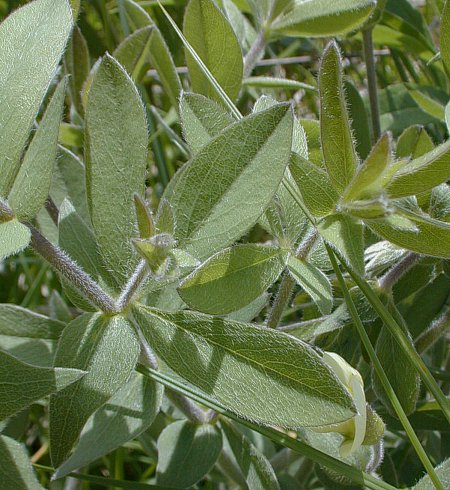
Description: This perennial plant is up to 1½' tall and 3' across. One or more stems originate from the root system of each plant; these stems branch occasionally and they are ascending to widely spreading. The stems are light green to light purple and terete; for var. bracteata they are either pubescent or hairy, while for var. glabrescens they are glabrous. Alternate trifoliate leaves occur at intervals along these stems. Individual leaflets are 1–3" long and ½–1" across; they are usually oblanceolate in shape, but sometimes they are broadly elliptic or rhombic-elliptic. Leaf margins are smooth (entire). The leaf surfaces are grayish green; for var. bracteata they are appressed-hairy, while for var. glabrescens they are glabrous (Mohlenbrock, 2002). Leaf venation is pinnate. The trifoliate leaves are usually sessile or nearly so; less often, they have pedicels up to 1½" long. At the base of each trifoliate leaf (or its pedicel), there is a pair of leafy stipules; sometimes these stipules are early-deciduous and absent. These stipules can be highly variable in size (less than ¼" to 1½" long); they are sessile and usually lanceolate in shape with smooth margins. Like the leaflets, the stipules are grayish green and appressed hairy to glabrous, depending on the variety. The upper and outer stems of this plant often terminate in racemes of flowers about 3-9" long. These racemes are widely spreading and they are either held above the ground or they sprawl across it. The pedicellate flowers of these racemes face upward toward the light.
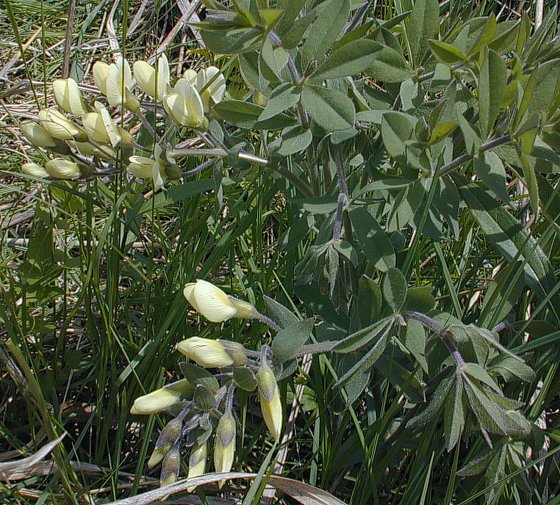
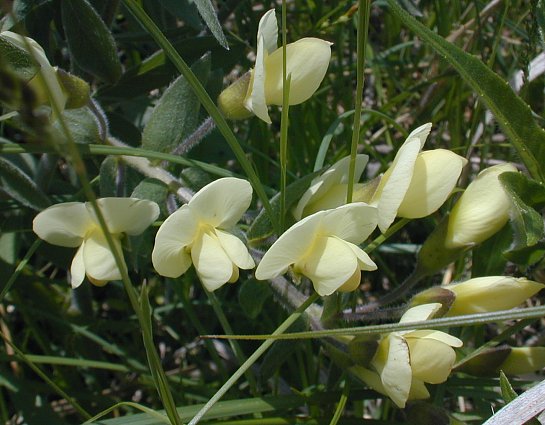
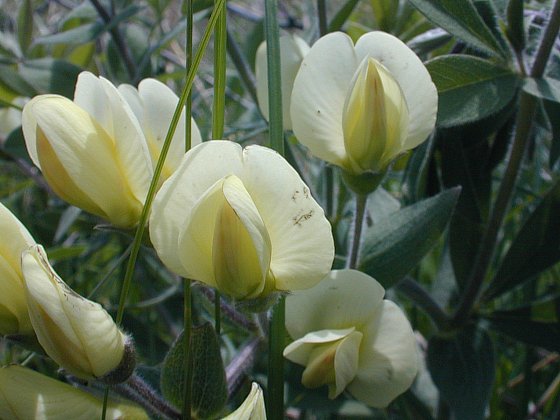
Individual flowers are about 1" long and a little less across; they have a typical pea-like floral structure consisting of an upright banner (1 petal) and a pair of wings (2 petals) that enclose the keel (2 petals). These petals are white to pale yellow (more or less cream-colored) and hairless. In addition to a corolla consisting of 5 petals, each flower has a short-tubular calyx with 4-5 triangular teeth, 10 stamens, and a pistil with a single style. The calyx is light green to light purple and less than ½" long; depending on the variety of this plant, it is either appressed-hairy or glabrous. The pedicels of the flowers are about ¾–1½" long, light green to light purple, and either hairy or glabrous. At the bases of these pedicels, there occurs solitary floral bracts that are about ½–1" long, lanceolate in shape, smooth along their margins, and sessile; they are similar to the stipules. The blooming period occurs during mid- to late spring for about 3 weeks. Afterwards, fertile flowers are replaced by seedpods that are 1-2" long, short-oblongoid in shape, slightly flattened, and mostly hollow inside. These seedpods have conspicuous beaks at their tips. Immature seedpods are light green and short-pubescent to glabrous; they become black at maturity. Later in the year, an entire plant may break off at its base, and roll around in the wind as a means of dispersing its seeds. Each seedpod divides into 2 parts to release its seeds; typically there are 5-20 seeds per seedpod. Individual seeds are about 4 mm. long, light brown to black, reniform (kidney-shaped), and glabrous. The root system consists of a stout taproot.
Cultivation:
The preference is full sun, mesic to dry conditions, and soil
containing some sand or loam. Cream Wild Indigo prefers open areas
where there is reduced competition from taller vegetation. While it is
possible to cultivate this plant in the garden using seeds or
transplants, it develops slowly as most vegetative growth occurs
during the cool weather of spring after the danger of hard frost has
passed. Mature plants can be difficult to transplant because of their
deep taproots.
Range & Habitat:
The native Cream Wild Indigo occurs in scattered locations throughout
Illinois (see Distribution
Map), but it is uncommon, except at high
quality sites. The typical variety, Baptisia bracteata bracteata,
is more common in Illinois than Baptisia
bracteata glabrescens. Natural habitats include mesic to
dry black soil
prairies, sand prairies, cemetery prairies, railroad prairies, open
rocky woodlands, and sandy savannas. Occasional wildfires are
beneficial in maintaining populations of this plant.
Faunal Associations: This plant is cross-pollinated primarily by queen bumblebees after they emerge from hibernation during the spring. Worker bumblebees appear somewhat later. Other long-tongued bees that have been observed to visit the flowers include a digger bee (Synhalonia speciosa) and mason bee (Osmia bucephala bucephala). These insects usually seek nectar from the flowers, although they sometimes collect pollen (Robertson, 1929). Other insects feed on the leaves, seeds, and other parts of Cream Wild Indigo and other Baptisia spp. These species include the larvae of such skippers as the Wild Indigo Duskywing (Erynnis baptisiae) and Hoary Edge (Achalarus lyciades), the larvae of such moths as the Three-lined Grapholita (Grapholita tristrigana) and Black-spotted Prominent (Dasylophia anguina), and the larvae of such butterflies as the Frosted Elfin (Callophrys irus), Orange Sulphur (Colias eurytheme), and Marine Blue (Leptotes marina); see Bouseman et al. (2006), Miller (1987), Wagner (2005), and Bouseman & Sternburg (2001). Another insect feeder is the Wild Indigo Weevil (Apion rostrum); the adults feed destructively on the flowers and leaves, while the larvae feed on the seeds (Sauer, 2005). Other insects that use Cream Wild Indigo and other Baptisia spp. as host plants include a leaf beetle (Pachybrachis luridus), seed-eating broad-headed bugs (Alydus spp.), oligophagous thrips (Neohydatothrips baptisiae), Keeler's Grasshopper (Melanoplus keeleri luridus), and other grasshoppers (Melanoplus spp., etc.); see Clark et al. (2004), Schaefer (1980), Stannard (1968), and Campbell et al. (1974). Cream Wild Indigo is not normally bothered by mammalian herbivores because its foliage is toxic. When horses and cattle eat sufficient quantities of this plant, as well as other Baptisia spp. that may be present, they can become seriously poisoned.
Photographic
Location:
The photographs were taken at the Loda Cemetery Prairie in Iroquois
County, Illinois. The photographed plants are the typical variety of
Cream Wild Indigo.
Comments:
This is one of the earliest plants to bloom in the prairie, and it is
quite showy and attractive. With the exception of the Blue Wild Indigo (Baptisia australis),
other Baptisia spp.
that occur in Illinois bloom later in the year. This latter species is
rare in natural areas of the state, although it is relatively common in
cultivation because of the showy blue flowers. Another species, White
Wild Indigo (Baptisia
alba macrophylla),
is a taller plant with white flowers. It differs from Cream Wild Indigo
by having erect racemes of flowers, rather than racemes that are widely
spreading or sprawl across the ground. The foliage of this latter
species is glabrous. Yellow Wild Indigo (Baptisia tinctoria)
is also rare in natural areas of the state, occurring in sand prairies
and sandy savannas in Kankakee County. This species is about the same
height as Cream Wild Indigo, but its flowers are smaller in size and
more yellow, while its foliage is glabrous. Unlike the preceding
species of this genus, Yellow Wild Indigo doesn't produce flowers in
elongated racemes. Another scientific name of Cream Wild Indigo is Baptisia leucophaea.