 Description:
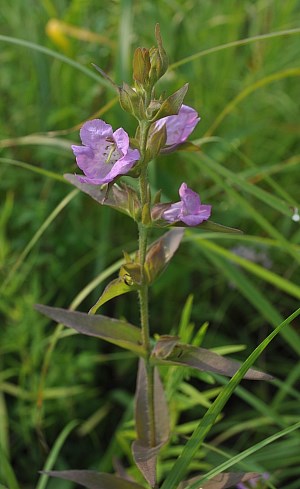
This annual plant is about ½–2½' tall and unbranched. The
central stem is round and has numerous white hairs. The opposite leaves
are about 2" long and ¾" across. They are broadly lanceolate and
sessile against the stem, with smooth margins and fine white hairs
covering the upper and lower surfaces. Each of the upper leaves usually
have two small lobes at the base, which resemble ears. The
inflorescence consists of a spike of flowers in the upper half of the
plant. These flowers are purple, pinkish purple, or lavender. Each
tubular flower is about ¾" long, with 5 short lobes that flare outward.
Sometimes there are purple dots inside the corolla. The reproductive
parts consist of 4 stamens and 1 stigma near the upper inner surface of
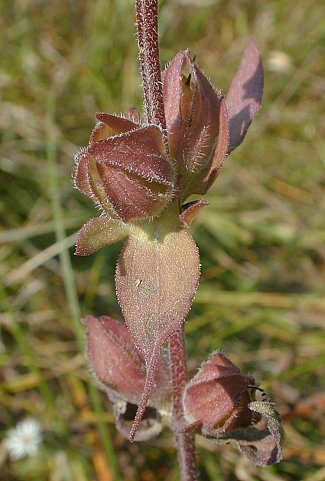
the corolla. Each flower is subtended by a large green calyx that is
hairy and divided into 5 triangular parts. The blooming period occurs
during late summer and lasts about 3 weeks. A fruit develops within
each calyx that contains numerous small seeds. At this time, the entire
plant becomes reddish brown. These seeds are probably distributed by
the wind to some extent. The root system consists of a central taproot
and secondary roots – the latter are often parasitic on the roots of
other plants. However, in
the absence of a suitable host, Ear-Leaved False Foxglove can meet its
own needs adequately through photosynthesis.
Description:
This annual plant is about ½–2½' tall and unbranched. The
central stem is round and has numerous white hairs. The opposite leaves
are about 2" long and ¾" across. They are broadly lanceolate and
sessile against the stem, with smooth margins and fine white hairs
covering the upper and lower surfaces. Each of the upper leaves usually
have two small lobes at the base, which resemble ears. The
inflorescence consists of a spike of flowers in the upper half of the
plant. These flowers are purple, pinkish purple, or lavender. Each
tubular flower is about ¾" long, with 5 short lobes that flare outward.
Sometimes there are purple dots inside the corolla. The reproductive
parts consist of 4 stamens and 1 stigma near the upper inner surface of
the corolla. Each flower is subtended by a large green calyx that is
hairy and divided into 5 triangular parts. The blooming period occurs
during late summer and lasts about 3 weeks. A fruit develops within
each calyx that contains numerous small seeds. At this time, the entire
plant becomes reddish brown. These seeds are probably distributed by
the wind to some extent. The root system consists of a central taproot
and secondary roots – the latter are often parasitic on the roots of
other plants. However, in
the absence of a suitable host, Ear-Leaved False Foxglove can meet its
own needs adequately through photosynthesis.
Cultivation:
The preference is full or partial sun and mesic conditions. This plant
typically grows in rich, loamy soil. It appears to have few problems
with disease. The seeds can be slow to germinate; it is possible that a
heat treatment simulating the effects of a wildfire may be beneficial
in this regard.
Range & Habitat:
Ear-Leaved False Foxglove is a rare plant that occurs in scattered
counties throughout most of Illinois, except the extreme south (see Distribution
Map). It is a native plant that is state-listed as
'threatened.' Habitats
include mesic black soil prairies, thickets containing grasses and
occasional shrubs, savannas, woodland borders, abandoned fields, and
areas along railroads (particularly where remnant prairies occur). This
plant is found in both high quality habitats and somewhat disturbed
areas. It is intolerant of frequent mowing or grazing; however an
occasional wildfire may improve germination of the seeds, as well as
reducing competition from shrubs and other kinds of plants.
Faunal Associations:
Bumblebees are the most important pollinators of the flowers, where
they seek nectar. Other long-tongued bees also visit the flowers,
including miner bees and leaf-cutting bees. Little information is
available about this plant's relationship to mammalian herbivores;
because the foliage is not known to be toxic, it is probably consumed
by them occasionally.
Photographic
Location:
The photograph of the plant in flower was taken by Lisa Culp (Copyright
© 2009) at a nature preserve in Cook County, Illinois, while the lower
photograph was taken by the webmaster at a prairie remnant along a
railroad in Iroquois County, Illinois.
Comments:
This wildflower is easy to identify because of the small basal lobes on
some of its leaves. It is closely related to the
purple-flowered Agalinis spp., which are also
partially parasitic on other plants. In addition to its peculiar basal
lobes, Ear-Leaved False Foxglove has wider leaves than the latter
species.