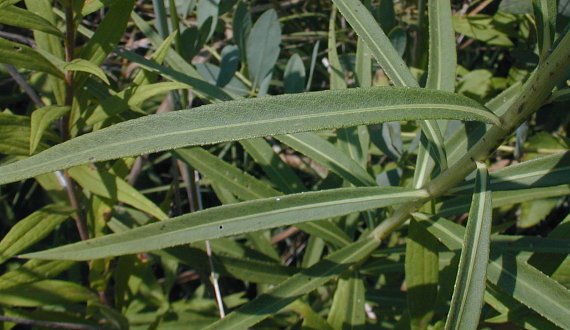
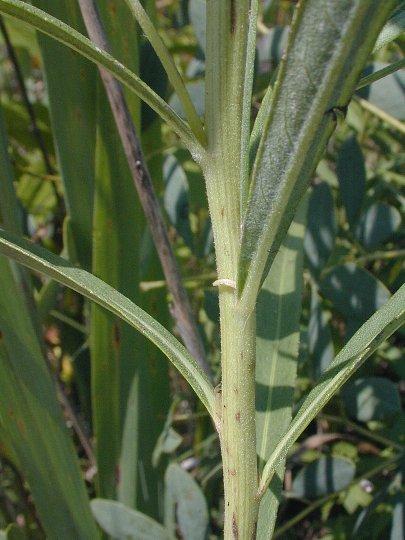
Description: This perennial plant is 2½–5' tall and unbranched, except near the apex where the inflorescence occurs. The central stem is light green, terete, slightly short-pubescent, and stiffly erect. Alternate leaves occur along the entire length of the stem; they are ascending to widely spreading. The leaves are 3-6" long and ¼–¾" across; they are linear to linear-elliptic in shape, sessile or short-petiolate, and either entire (toothless) or sparsely and minutely toothed along their margins. The leaves have prominent central veins that are light-colored. The upper leaf surface is medium to dark green and glabrous to rough-textured from minute stiff hairs. The lower leaf surface is light green and glabrous to sparsely short-pubescent, except along central vein, where it is pubescent. The central stem and lateral upper stems terminate in clusters of flowerheads that are somewhat flat-topped. The branches and peduncles of the flowerheads are light green, sparsely short-pubescent, and terete; the peduncles are 1½–5" long.
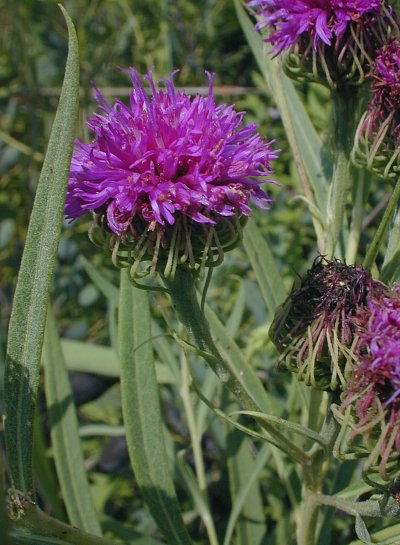
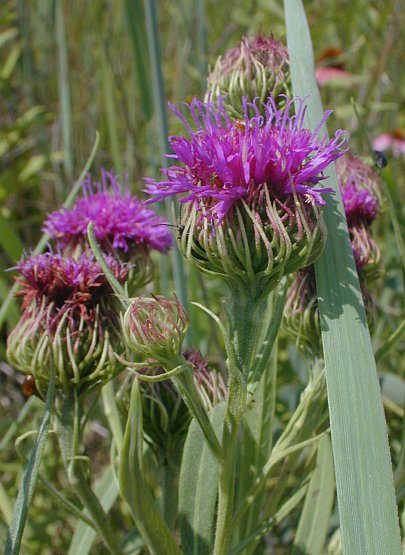
Each flowerhead is ¾–1¼" across, consisting of a dense head of 50-100 disk florets and no ray florets. The corollas of the disk florets are magenta (reddish purple), narrowly tubular in shape, and 5-lobed; the corolla lobes of these florets are narrowly lanceolate in shape and ascending. Bifurcated styles are exserted from these corollas; these styles are magenta. Surrounding the base of each flowerhead, there are numerous phyllaries in several series; they are loosely overlapping. Individual phyllaries are ½–1" long; their bases are linear-lanceolate in shape, tapering into long filiform tips that are more or less incurved. These phyllaries are mostly light green, except toward their tips, where they are often white to magenta; they are sparsely short-pubescent. The blooming period occurs from late summer to early autumn, lasting about 1 month for a colony of plants. There is no noticeable floral scent. Afterwards, the florets are replaced by achenes with small tufts of bristly hair at their apices; these hairs are light brown or pale purple. The achenes are 3-5 mm. long and bullet-shaped with vertical pubescent ribs; they are distributed to some extent by the wind. The root system consists of stout short rhizomes, from which clonal offsets are produced.
Cultivation:
In
Illinois, this plant occurs at sites with full sun, mesic conditions,
and a loam or clay-loam soil.
Range & Habitat:
Great Ironweed is a very rare plant in Illinois; it has been collected
only in Champaign County in the east-central portion of the state
during 1957-1958 (see Distribution
Map).
These specimens are located in the herbarium of the Illinois State
Museum. Apparently, the population of plants at the original collection
site was destroyed and the species was thought to be extirpated from
the state. However, during the late summer of 2005 the webmaster
discovered several plants of Great Ironweed at Meadowbrook Park in
Urbana, Illinois (also in Champaign County). The status of this
ironweed as a native or adventive species in Illinois is uncertain.
Habitats of this rare species in Champaign County include roadside
fencerows and prairies. Great Ironweed is more common in areas that lie
to the southwest of Illinois (e.g., Missouri and Arkansas). It is often
found in rocky glades in these areas.
Faunal Associations: The flowerheads of ironweeds (Vernonia spp.) attract bumblebees, little carpenter bees (Ceratina spp.), cuckoo bees (Triepeolus spp.), digger bees (Melissodes spp., Svastra spp.), leaf-cutting bees (Megachile spp.), Halictid bees (including green metallic bees), bee flies (Bombyliidae), butterflies (Papilio spp. & others), and skippers (Polites spp. & others); see Robertson (1929) and Reed (1993). The bee visitors are attracted to the nectar and pollen of the flowerheads, while the remaining insects feed on the nectar. Two digger bees, Melissodes vernoniae and Melissodes denticulata, are specialist pollinators (oligoleges) of ironweeds. Other insects feed on the leaves, bore through the stems or roots, suck plant juices, or feed destructively on the flowerheads of these plants. Examples of such insects include the Thirteen-spotted Billbug (Rhodobaenus tredecimpunctatus), larvae of the Ironweed Bud Midge (Asphondylia vernoniae), larvae of the Ironweed Blossum Midge (Youngomyia podophyllae), larvae of the Ironweed Borer Moth (Papaipema cerussata), larvae of the Parthenice Tiger Moth (Grammia parthenice), the Ironweed Aphid (Aphis vernoniae), Four-humped Stink Bug (Brochymena quadripustulata), Little Pasture Grasshopper (Melanoplus confusus), Four-spotted Tree Cricket (Oecanthus quadripunctatus), and Short-winged Meadow Katydid (Conocephalus brevipennis). The Insect Table provides a more complete list of insects that feed on ironweeds. Vertebrate animals appear to have little use for these plants, as their seeds are little-used by birds and their bitter foliage is usually avoided by mammalian herbivores.
Photographic
Location:
A prairie at Meadowbrook Park in Urbana, Illinois, where a population
of this ironweed has persisted for several years.
Comments:
This is one of the easier ironweeds (Vernonia spp.)
to identify because of the distinctive appearance of the phyllaries
(floral bracts) – long and thread-like. No other ironweed has
this kind of phyllary
at the base of its flowerheads. Great Ironweed (Vernonia arkansana)
also differs from other ironweeds by its narrow leaves and the large
number of disk florets
(50-100) in each flowerhead. Other species in this genus have
flowerheads with
fewer disk florets (20-50) and their flowerheads are less wide. Other
common names of Vernonia arkansana that are
occasionally used include 'Ozark Ironweed' and 'Curlytop Ironweed.' An
alternative scientific name for this species is Vernonia
crinita. I am happy to see this wonderful wildflower back in
the state again.