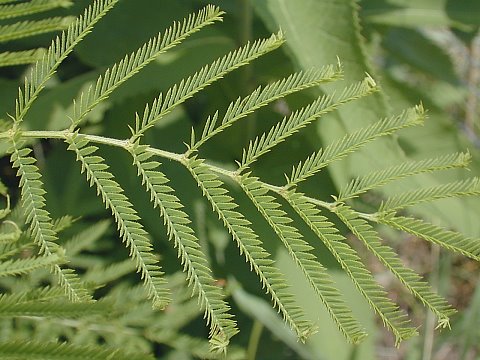
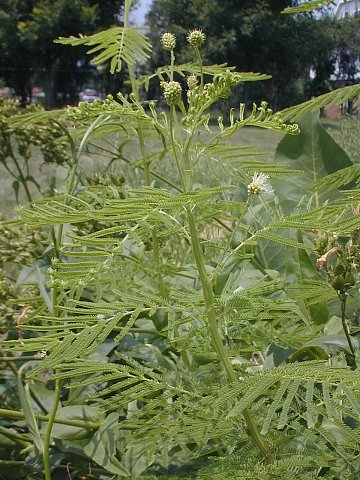
Description: This is a herbaceous perennial plant about 2-4' tall that is either unbranched or sparingly so. The central stem is light green, grooved, and either glabrous or sparsely pubescent. The alternate compound leaves are bipinnate and up to 8" long; they have a ferny appearance. Each compound leaf has 8-12 pairs of even-pinnate leaflets; each even-pinnate leaflet consists of 20-40 pairs of closely spaced subleaflets. Individual subleaflets are about 1/8" (3 mm.) long and about one-third as much across; they are light to medium green, lanceolate-oblong in shape, ciliate along their margins, and sessile (or nearly so). The rachises (central stalks) of the compound leaves are whitish green from fine hairs and they are grooved along their upper sides.
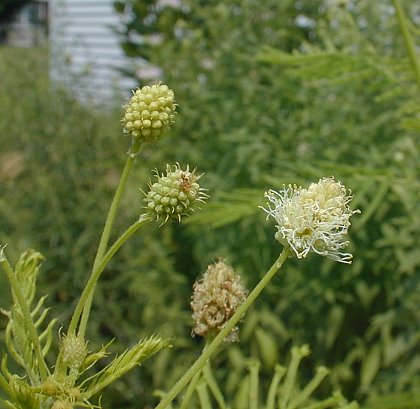
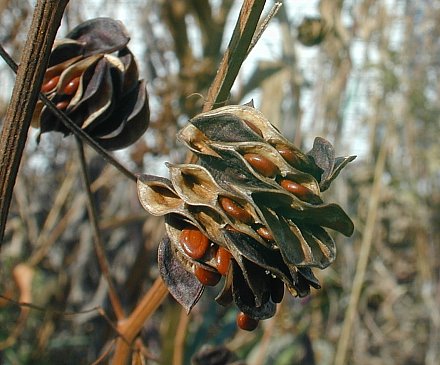
Small white flowerheads occur individually from the axils of the upper leaves on slender peduncles up to 3" long. The peduncles are glabrous to sparsely hairy. Each flowerhead is up to ½" across and ovoid-globoid in shape; it consists of a dense head of 25-50 florets that are oriented in nearly all directions. Each floret consists of a short-campanulate calyx with 5 teeth (less than 1 mm. in length), 5 white petals (about 1 mm. in length), an ovary with a single style, and 5 strongly exerted stamens. The stamens have white filaments and pale yellow anthers. When they are fully developed, these flowerheads have a starburst appearance that is typical of compound flowers in the Mimosa family, but they appear more lumpy than spherical because the florets bloom from the bottom to the top gradually, rather than all at once. The blooming period lasts 1-2 months during the summer. There is no noticeable floral scent. Afterwards, the flowerheads are replaced by clusters of 5-15 seedpods that become dark brown at maturity. Individual seedpods are about ½" in length and two-valved; they are curved and flattened. Each seedpod splits open along its valves, releasing 2-5 seeds. The seeds are reddish brown, ovoid-reniform in shape, somewhat flattened, and shiny. This plant spreads by reseeding itself.
Cultivation:
The
preference is full to partial sun and moist to mesic conditions.
Some drought is tolerated, but the leaflets on the lower stems of the
plant may fall off, and the buds of compound flowers may abort and turn
brown. Growth is best in fertile loam, but other kinds of soil are
readily tolerated. This plant fixes nitrogen in the soil. Foliar
disease is rarely a problem.
Range & Habitat:
The native Illinois Bundleflower occurs primarily in NE Illinois, along
the
Illinois River valley in central Illinois, and along the Mississippi
River valley in SW
Illinois, favoring loamy or sandy alluvial soils. This plant is
occasional in
these areas, while in other areas of the state it is uncommon or absent
(see Distribution
Map). Habitats include black soil prairies,
moist meadows near rivers, openings in woodlands, limestone glades,
areas along railroads, and
areas along levees. Because of the relatively high protein content of
its foliage, Illinois Bundleflower has been planted in pastures to feed
cattle,
and it can be used in prairie restorations to improve worn-out soil.
However, it
recovers poorly from wildfires. Relatively open areas with a history of
disturbance are preferred.
Faunal
Associations:
The flowerheads are occasionally visited by small bees and flies that
seek nectar and pollen. The medium-sized seeds are
consumed by various upland gamebirds, including the Ring-Necked
Pheasant, Bobwhite Quail, and Greater Prairie Chicken. The foliage of
this plant is highly
palatable to mammalian herbivores because of its high protein content.
It
may have trouble surviving in areas where there is a surplus population
of these animals and a shortage of predators.
Photographic Location:
Photographs were taken at the webmaster's wildflower garden in Urbana,
Illinois.
Comments: The primary attraction of Illinois Bundleflower is the refined appearance of its fern-like foliage. The subleaflets of the compound leaves fold together at night, and they close partially during hot sunny days in order to reduce moisture loss. During the morning and evening, when sunlight is less intense, the compound leaves orient themselves in the direction of the sun in order to maximize the reception of its light. The small white flowerheads are short-lived and not particularly showy. Illinois Bundleflower is one of two members of the Mimosa family that occur in prairies in Illinois. The other plant, Schrankia uncinata (Sensitive Brier), is a sprawling vine that has pink starburst flowerheads and prickles along its stems and compound leaves.