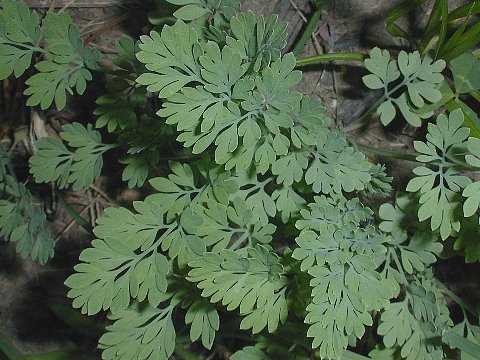
Description: This plant is a winter annual (less often, a spring annual) about 1' tall. It consists of a rosette of basal leaves up to 6" across, from which one or flowering stalks develop. The basal leaves are bipinnate to pinnate-pinnatifid; they have long slender petioles. Simple leaflets are divided into 3 or more deep lobes that are oblong-oblanceolate in shape. Compound leaflets are divided into 3 or more subleaflets; individual subleaflets are divided into 3 or more deep lobes that are oblong-oblanceolate in shape. The petiolules (basal stalklets) of the leaflets and subleaflets are very slender and short. The foliage of Large-Bracted Corydalis (both leaves and petioles) is greyish green and glabrous.
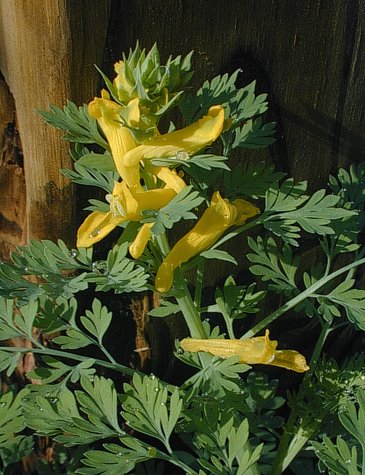
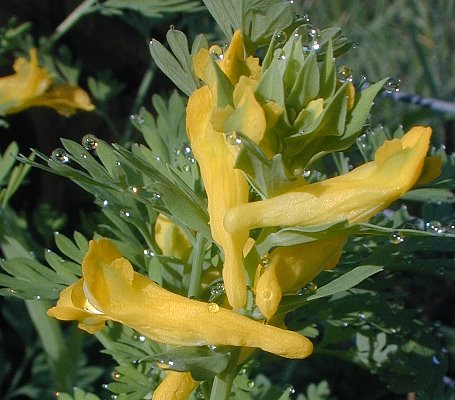
The flowering stalks are sprawling, ascending, or erect, reaching up to 1¼' in length. Normally, they are unbranched, although occasionally a flowering stalk will branch and develop lateral flowering stalks. These stalks are greyish green and glabrous. Each stalk terminates in a spike-like raceme of several flowers. Each flower has a yellow corolla about ¾" long that is tubular-conical in shape (broader in front than in the back); this corolla consists of 2 outer petals and 2 inner petals. The upper outer petal forms a short upper lip in front that curls upward, and it has a rather long blunt spur in back. The lower outer petal forms a rounded lower lip that functions as a landing pad for visiting insects. The two inner petals are largely hidden by the outer petals, although they can be seen as a white lining within the throat of the corolla. Behind the upper lip of the upper petal, there is a crested protuberance that is greenish yellow to yellow. There is a similar protuberance underneath the lower lip of the lower petal. The sepals of the flowers are small and insignificant. Underneath each flower, there is a single bract about ½" long. This bract is greyish green, glabrous, and either ovate or divided into lobes with short blunt tips. A typical raceme will have some flower buds toward its apex, about 2-8 flowers in bloom near the middle, and developing seedpods below.
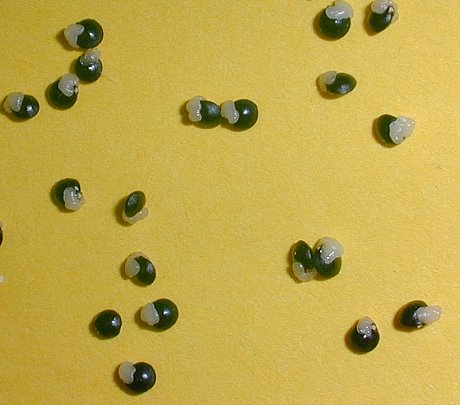
The blooming
period for plants that are winter annuals occurs during late spring,
while plants that are spring annuals bloom during mid-summer. A typical
plant will remain in bloom for up to a month. Each seedpod is about 1"
long,
greyish green, glabrous, cylindrical in shape, and slightly
flattened, terminating in a slender beak at its tip; it contains about
6-12 seeds. Relative to the axis of the spike-like raceme, the seedpods
are erect to ascending, often bending upward slightly. The small seeds
are black, shiny, globoid, and somewhat flattened. Each seed
has a dull white elaisome (food appendage) that is laterally
attached; the elaisome darkens and withers away with age. The root
system consists of a
taproot. This plant spreads by reseeding itself.
Cultivation:
The preference is full or partial sun, mesic to dry conditions, and
sandy soil. Large-Bracted Corydalis also grows readily in gravelly or
loamy soil; if
it is grown in moist loamy soil, taller and more aggressive plant
species should be kept away from it. Foliar disease and insects are not
normally troublesome. The seeds will germinate after a short dormancy
period; they can be planted during the fall or early spring.
Range & Habitat: The native Large-Bracted Corydalis is an uncommon plant that occurs in a few counties in western Illinois (see Distribution Map). Prior to 1986, it was incorrectly identified as another species of Corydalis. Recently, several large populations of Large-Bracted Corydalis have been discovered, therefore it is more common in Illinois than previously believed. However, it is still state-listed as 'threatened.' This species is more common in the south-central states; western Illinois lies at the northeast corner of its range. Habitats include sand prairies, sandy fallow fields, and sandy or gravelly areas along roads and railroads (including the ballast). Disturbed areas are preferred, particularly where ant hills occur. Occasional wildfires, sand blow-outs, and overgrazing by herbivores are probably beneficial in maintaining populations of this plant.
Faunal
Associations:
The flowers are pollinated by bumblebees. The oily appendages of the
seeds (elaisomes) attract ants (particularly Pheidole
bicarinata), which undoubtedly help to disperse the seeds.
The poisonous foliage is avoided by mammalian herbivores.
Photographic Location:
The wildflower garden of the webmaster in Urbana, Illinois.
Comments:
Both the flowers and foliage are quite attractive. Large-Bracted
Corydalis can be distinguished from other Corydalis spp.
by its long yellow flowers (exceeding 2/3" or 15 mm. in length) and
their large leafy bracts (exceeding 1/3" or 8 mm. in
length). Other Corydalis spp. in Illinois
have shorter bracts and/or shorter flowers. Large-Bracted Corydalis
also differs from some Corydalis
spp. by the crested protuberances behind the lips of its
flowers (as opposed to protuberances that lack crests). In
contrast to the seedpods of the similar Corydalis aurea
(Golden Corydalis), the seedpods of Large-Bracted Corydalis are more
erect and they lack constrictions between their seeds (they are not
torulose). There are other varieties of Corydalis curvisiliqua,
but they occur in states that lie southwest of Illinois.