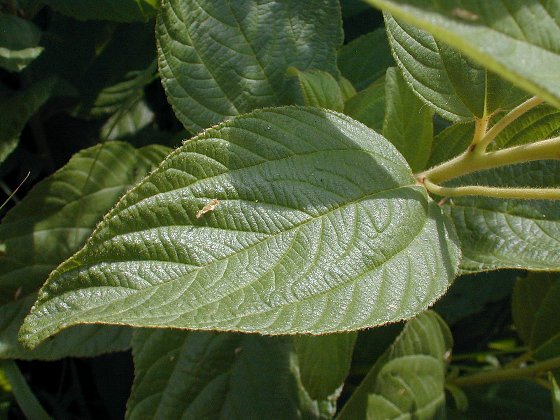
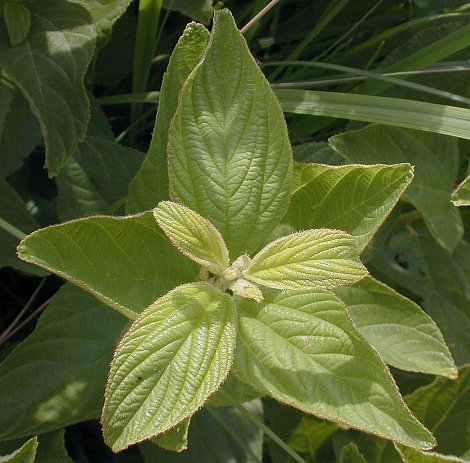
Description: This shrubby perennial is up to 3¼' tall. It tillers at the base, sending up multiple stems that are erect to ascending. These stems are light green to light yellow, terete, and pubescent or hairy, becoming woody with age in the absence of fire or browsing from animals. The leaves are alternate or opposite; they occur along the entire length of each stem. The leaves are up to 3" long and 2" across; they are ovate in shape and their margins are smooth to finely serrated and slightly ciliate. The upper leaf surface is pale-medium to dark green, and smooth to somewhat rough from minute stiff hairs. The lower leaf surface is pale green and pubescent or hairy; hairs are typically more abundant along the lower sides of the veins. The central vein and two primary lateral veins are palmate, while the remaining veins are pinnate; the upper leaf surface is often wrinkled along these veins. The petioles are short, light green to light yellow, and pubescent or hairy. The upper stems terminate in panicles of flowers; axillary panicles of flowers also develop from the axils of upper leaves. The peduncles (basal stalks) of these panicles are 2-8" long, light green to light yellow, terete, relatively stout, and pubescent or hairy.
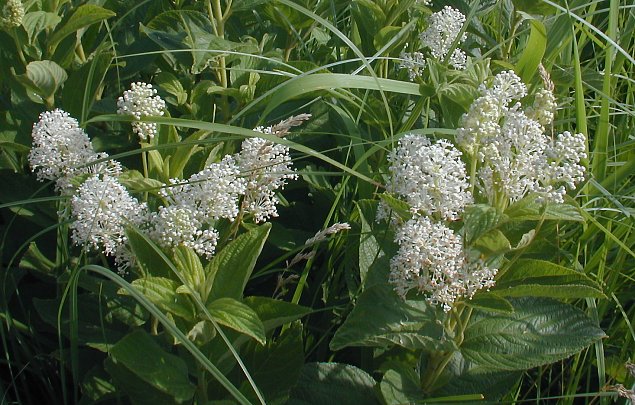
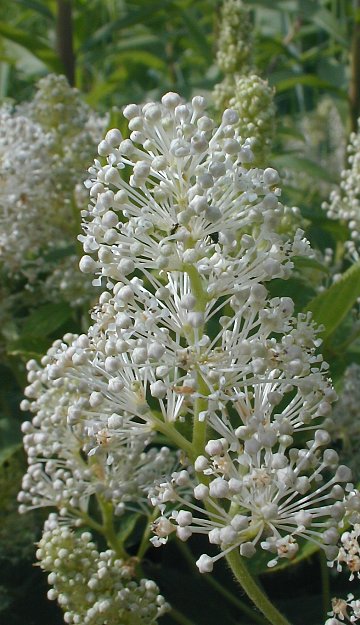
Individual panicles are 2-5" long and 2-3" across; their lateral branches are up to 1½" long and widely spreading to ascending. Both the rachis and lateral branches are light green, terete, relatively stout, and finely hairy. Along the rachis and lateral branches of each panicle are clusters of flowers on slender white pedicels. These pedicels are ¾–1" long. Each flower is up to ¼" across, consisting of 5 white sepals, 5 white petals, 5 stamens, and a pistil. The sepals are triangular-ovate and folded inward, while the petals are widely spreading. The petals have long narrow bases and widened tips; the lateral edges of these tips are folded upward. The blooming period occurs during early to mid-summer, lasting about 3-4 weeks. There is a pleasant floral fragrance. Afterwards, the flowers are replaced by 3-lobed seed capsules up to ¼" across. At maturity, these capsules become dark brown or black, and they split open to mechanically eject their seeds up to several feet. Each capsule contains 3 seeds that are 2-3 mm. in length, brown to dark brown, glossy, and ovoid in shape. The root system consists of a stout taproot.
Cultivation:
The preference is full or partial sun and average to slightly dry
conditions. The soil can contain loam, rocky material, or sand. This
plant adds
some nitrogen to the soil. Germination from seed can be slow and
difficult – exposing them to hot water may be helpful. Transplants are
easier to manage and faster to develop. Drought resistance is very good
– under severe conditions, the leaves will become discolored and
shrivel, but quickly revive when rainfall returns. Foliar disease is
rarely a significant problem.
Range & Habitat:
The native New Jersey Tea occurs throughout Illinois, except for a few
counties in
the southern part of the state (see Distribution
Map). It is occasional to locally common in high quality
habitats, but uncommon elsewhere. Habitats include mesic to dry black
soil prairies, gravel prairies, sand prairies, hill prairies, sandy
savannas,
rocky upland forests, limestone glades, and barrens with scrubby
vegetation. Occasional fire is a beneficial management tool in
promoting the development and
spread of this plant.
Faunal Associations: The nectar and pollen of the flowers attract a variety of insects, especially bees, wasps, flies, and beetles. These floral visitors include Halictid bees (Agapostemon spp., Halictus spp., Lasioglossum spp.), Andrenid bees (Andrena spp.), plasterer bees (Colletes spp.), Sphecid wasps (Oxybelus spp., Cerceris spp., Tachysphex spp.), Vespid wasps (Polistes spp., Stenodynerus spp.), spider wasps (Anoplius spp.), Syrphid flies, thick-headed flies (Conopidae), Tachinid flies, flesh flies (Sarcophagidae), bottle flies (Lucilia spp.), Muscid flies, and miscellaneous beetles (Robertson, 1929). Hairstreak butterflies (Satyrium spp.) also visit the flowers. Other insects feed destructively on the foliage, seeds, and other parts of New Jersey Tea. These species include stem-boring larvae of a long-horned beetle (Calliomoxys sanguinicollis), leaf beetles (Babia quadriguttata, Pachybrachis trinotatus), seed-eating broad-headed bugs (Alydus spp.), and the Angulate Tingid (Gargaphia angulata); see Yanega (1996), Clark et al. (2004), Schaeffer (1980), and Cranshaw (2004). In addition, the larvae of several moths feed on New Jersey Tea, including the Broad-lined Erastria (Erastria coloraria), Sulfur Moth (Hesperymia sulphuraria), and Red-fronted Emerald (Nemoria rubrifrontaria); the caterpillars of a butterfly, the Spring/Summer Azure (Celastrina argiolus), and caterpillars of a skipper, the Mottled Duskywing (Erynnis martialis), also feed on this shrub (Covell, 1984/2005; Bouseman & Sternburg, 2001; and Bouseman et al., 2006).
The foliage and
stems are readily
consumed by various mammalian herbivores, including elk (native in
Illinois at one time), deer, rabbits, and livestock (Martin et al.,
1951/1961). Some upland gamebirds, like the Wild Turkey and Bobwhite
Quail, also use New Jersey Tea as a food source (Van Dersal, 1939).
This can make the
establishment of this plant difficult where there is an overpopulation
of such animals.
Photographic Location:
The photographs were taken at Loda Cemetery Prairie in Iroquois County,
Illinois.
Comments:
This little shrub has a lot going for it from
both horticultural and
ecological perspectives. It was used by colonists during the
Revolutionary War as a substitute for tea (hence the common name), even
though the leaves contain no caffeine. Early pioneers discovered that
the stout roots of New Jersey Tea (Ceanothus
americanus) were a formidable barrier to the
plow. Chemical compounds from this plant have been found to affect the
speed of blood coagulation (Lynch et al., 1958), and they have been
found to have antimicrobial properties on oral pathogens (Li et al.,
1997). The only other species in this genus that occurs in Illinois,
Redroot (Ceanothus ovatus),
differs from New Jersey Tea by having more narrowly shaped
leaves and shorter panicles of flowers.