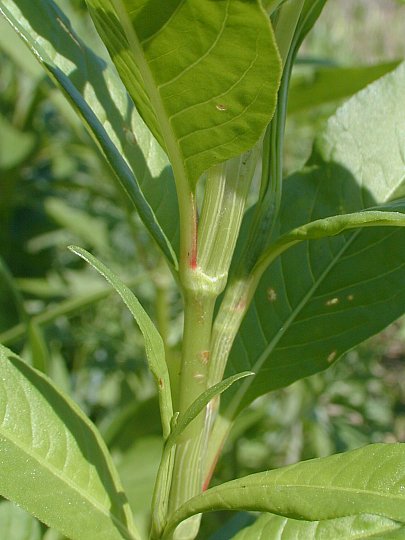
Description: This annual plant is 1-4' tall, branching occasionally. It is more or less erect, often bending toward the light in partially shaded locations. The stems are light green to red, terete, relatively stout, and glabrous; they have a tendency to zigzag between the alternate leaves. The leaves are up to 7" long and 2½" across; they are medium to dark green, glabrous on both the upper and lower sides (for this variety), narrowly lanceolate to lanceolate in shape, and smooth to minutely ciliate along their margins. On rare occasions, the leaves are marked with chevrons that are faintly darkened, otherwise they are unmarked. The petioles are up to 1" long, usually light green, glabrous, and plano-convex (flattened above and convex below). At the bases of petioles, there are ring-like ochrea (membranous sheaths) that surround the stems. These ochrea are ¼–¾" long, light green to light brown (depending on their age), longitudinally veined, and translucent; their upper rims are truncate to asymmetric and devoid of bristles. The upper stems terminate in 1-2 spike-like racemes of flowers that are about ¾-2½" long and cylindrical in appearance; these racemes are usually straight and they are erect to ascending.
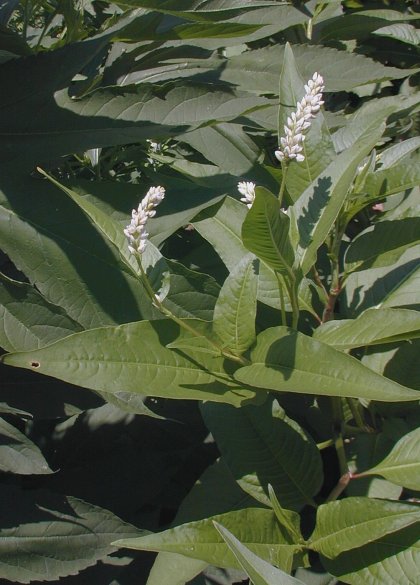
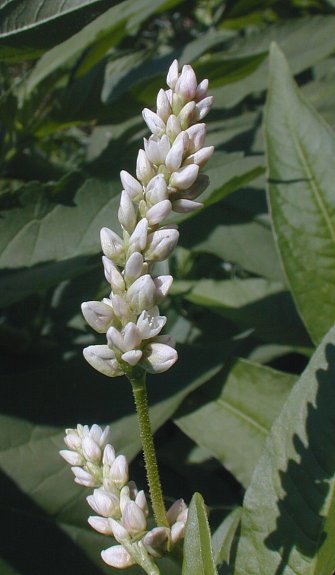
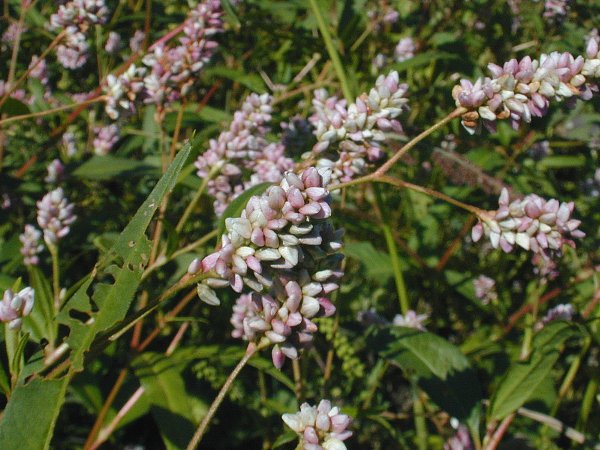
Small flowers and flower buds are densely crowded along the entire length of each raceme, surrounding its rachis (central stalk) in all directions. Along this rachis, are ochreolae (small membranous sheaths) that are spaced at short intervals from each other; several flowers are associated with each ochreola. Each flower is 3-4.5 mm. long (1/8" or slightly longer), consisting of 5 tepals, several stamens, and a pistil. The tepals are white, light pink, or rosy pink; they are joined together along the lower one-half of their length, while their tips are ovate and erect. The anthers are white or pink. The peduncles of the racemes are ¾–3½" long, light green to reddish green, terete, glandular-pubescent, and either unbranched or dichotomously forked. Peduncles that are forked produce 2 racemes of flowers. The blooming period occurs during the summer or early autumn, lasting about 1 month for a colony of plants. There is no noticeable floral scent. Afterwards, the flowers are replaced by achenes (one achene per flower). These achenes are 2-3.5 mm. long and almost as much across; they are dark brown to black, flattened-orbicular in shape, smooth, and shiny. The root system consists of a taproot with smaller and more shallow lateral roots. Colonies of plants are often formed at favorable locations.
Cultivation:
The preference is full or partial sun, moist conditions, and rich loamy
soil. Standing water is tolerated if it is temporary. This robust plant
is rather weedy and easy to grow – it has more tolerance to drought
than many other smartweeds. The leaves are rarely blemished by disease,
although they are sometimes attacked by insects.
Range & Habitat:
The native Pennsylvania Smartweed occurs in every county of Illinois,
where it is common (see Distribution
Map). Habitats include wet prairies, prairie swales, swamps,
low
areas near ponds or rivers, edges of marshes, degraded seasonal
wetlands, abandoned fields, low areas along railroads, roadside
ditches,
vacant lots, fence rows, and waste areas. This annual plant
thrives on the reduced competition resulting from disturbance.
Faunal Associations: The flowers of Pennsylvania Smartweed attract many kinds of insects, including honeybees, bumblebees, cuckoo bees (Epeolus spp., Triepeolus spp.), digger bees (Melissodes spp.), leaf-cutting bees (Megachile spp.), Halictid bees, Andrenid bees, Sphecid wasps, Vespid wasps, spider wasps (Anoplius spp.), Syrphid flies, Tachinid flies, flesh flies (Ravinia spp.), and miscellaneous butterflies and moths (Robertson, 1929). Most of these insects feed on the nectar and they help to cross-pollinate the flowers. Other insects feed on the leaves, roots, plant juices, and other parts of Pennsylvania Smartweed and other smartweeds (Persicaria spp.). These species include Systena frontalis (Red-headed Flea Beetle) and other leaf beetles, larvae and adults of various weevils, Euschistus ictericus (Brown Stink Bug) and other stink bugs, Capitophorus hippophaes (Polygonum Aphid) and other aphids, larvae of Ametastegia glabrata (Dock Sawfly) and other sawflies (Ametastegia spp.), larvae of Orthonama centrostrigaria (Bent-line Carpet) and other moths, larvae of Lycaena hyllus (Bronze Copper) and other butterflies, and Paroxya clavuliger (Olive-green Swamp Grasshopper) and other grasshoppers. See the Insect Table for a listing of these and other species.
Among
vertebrate animals, the
seeds of Pennsylvania Smartweed and other smartweeds are an important
source of food to many bird species, including waterfowl, upland
game birds, and granivorous songbirds (see the Bird Table).
The seeds are also eaten by small rodents, including the White-footed
Mouse and wild House Mouse (Whitaker, 1966). According to Ernst et al.
(1994), several turtles feed on smartweeds (probably the foliage to a
minor extent); this includes such turtles as the Snapping Turtle (Chelydrina serpentina),
Painted Turtle (Chrysemys
picta), Eastern Box Turtle (Terrapene carolina),
and Slider (Trachemys
scripta).
Mammalian herbivores usually avoid the foliage of Pennsylvania
Smartweed and most other smartweeds because their leaves are somewhat
bitter and peppery.
Photographic Location:
The photographs were taken at a vacant lot near Urbana, Illinois, and a
seasonal wetland at Judge Webber Park of the same city.
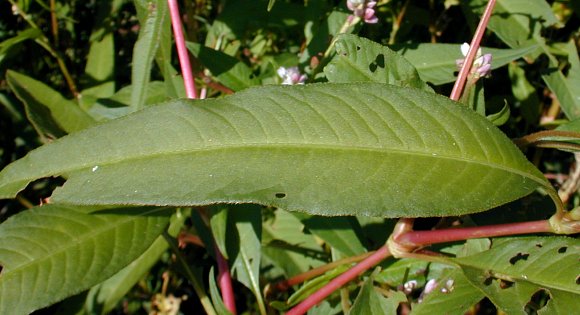
Comments: This native plant, along with other members of the genus, is often undervalued because it is considered too common, and the flowers are not thought to be sufficient large and pretty. In fact, Pennsylvania Smartweed is rather attractive when the flowers are bright pink, and its ecological value to birds, moths, butterflies, and other insects, regardless of the color of the flowers, is quite high. Different varieties of this smartweed have been described by some authors (e.g., Mohlenbrock, 2002); Persicaria pensylvanica laevigata is the most common variety in Illinois, which is distinguished from the others by the glabrous lower surface of its leaves. Distinguishing Pennsylvania Smartweed from other smartweed species (Persicaria spp.) can be difficult, in part because of its variability across different populations of plants. This variability includes such features as the color of flowers (white, light pink, rosy pink), the hairiness of the foliage, and the width of the leaves. Pennsylvania Smartweed has the following features that are sometimes helpful in making a correct identification as to species: 1) the ochrea on its stems lack bristles along their upper rims, 2) the peduncles of its inflorescences are usually glandular pubescent, 3) its spike-like racemes are usually straight and more or less erect, rather than curved and nodding, 4) it usually forms taller plants than most smartweed species and its leaves are more long and wide, and 5) its flattened seeds are usually larger in size. Other common names for this smartweed are 'Pinkweed' and 'Big-seeded Smartweed.' Another scientific name of this plant is Polygonum pensylvanicum laevigatum.