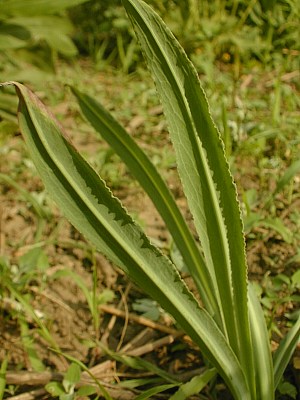
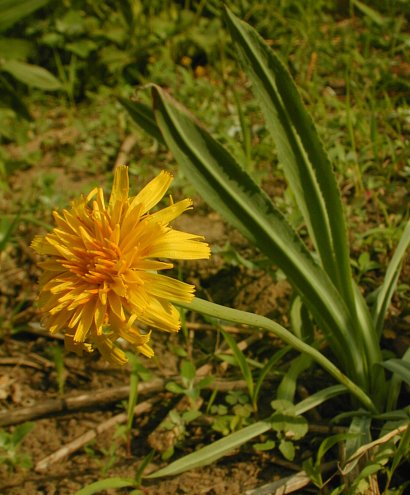
Description: This perennial plant consists of a loose rosette of basal leaves up to 10" across. Each basal leaf is about 4-6" long and ¼" across, although occasionally a larger size is achieved. The basal leaves are semi-erect, linear in shape, and light to medium green; their margins are finely crisped and often downy white. There is a prominent central vein along the length of each basal leaf. From the center of each rosette, there develops one or more leafless stalks about 6-8" tall. These stalks are light green and terete; sometimes they have shallow vertical grooves. Both the basal leaves and flowering stalks are glabrous to slightly pubescent; they contain a white milky latex. Each stalk terminates in a single flowerhead that is about 1-2" across when it is fully open.
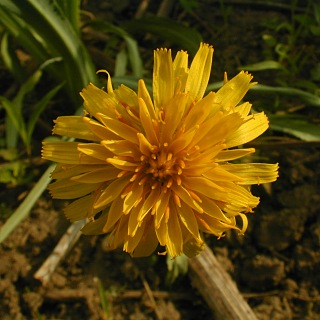
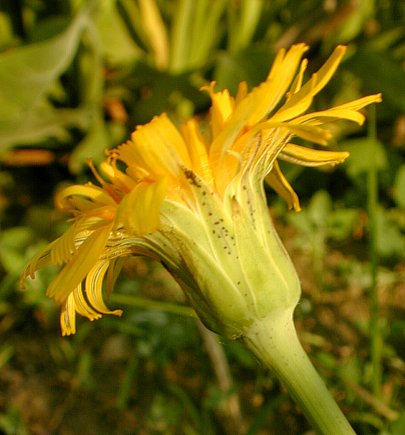
Each flowerhead consists of numerous spreading ray florets and no disk florets. The overlapping petaloid rays of each flowerhead are yellow to golden yellow and linear-oblong in shape; their tips are truncated and 5-toothed. The floral bracts (phyllaries) surrounding the base of each flowerhead are arranged in a single overlapping series, where they are appressed together. These bracts are light green, lanceolate in shape, glabrous, and membranous along their margins. The blooming period occurs from mid- to late spring and lasts about a month. A single plant may produce several flowerheads in succession. The achenes are bullet-shaped with tufts of white hair at their apices. They are distributed by the wind. The root system consists of a stout taproot that is quite large for the size of the plant. This plant spreads by reseeding itself.
Cultivation:
The
preference is full sun and dry conditions. The soil should be gritty in
texture and well-drained, otherwise crown rot may infect the taproot
and the plant will die. Taller and more aggressive plant species should
be prevented from overcrowding this plant, which normally grows on
rocky hilltops and slopes where there is scant ground vegetation.
Range & Habitat:
The native Prairie Dandelion is a rare plant that occurs in the
northern half of
Illinois, especially in the NW quarter of the state (see Distribution
Map). It is state-listed as an endangered species. Some local
populations that have been observed in the past are probably extirpated
as a result of habitat destruction. Illinois lies at the eastern limit
of its distribution; the Prairie Dandelion is more common in states
further to the west. Habitats include dry upland areas of prairies,
hill prairies, and rocky slopes. This conservative species does not
normally occur in disturbed areas.
Faunal
Associations:
Little is known about the floral-faunal relationships of this rare
plant. Various kinds of bees (especially bumblebees) are undoubtedly
the most important pollinators of the flowers, where they seek nectar
and pollen. Moure & Hurd (1987) list a Halictid bee, Halictus rubicundus,
as a floral visitor. A polyphagous aphid, Abstrusomyzus phloxae,
feeds on the closely related Mountain Dandelions (Agoseris spp.) and
probably Prairie Dandelion as well. Rabbits may eat the foliage,
although
I have not observed this. Early pioneers ate the roots as a source of
emergency food, even though they were undoubtedly bitter-tasting.
Photographic Location:
The webmaster's wildflower garden in Urbana, Illinois.
Comments: This is one of many species in the Chicory tribe of the Aster family that have dandelion-like flowerheads and foliage with a milky latex. The most familiar member of this group is the introduced Taraxacum officinale (Dandelion), which is a common lawn weed. The Prairie Dandelion can be distinguished from similar species by considering the following characteristics: 1) this is a perennial plant, rather than a biennial or annual, 2) stems with cauline leaves are never produced, 3) there is only one flowerhead per leafless stalk, 4) the flowerheads are at least 1" across, 5) the basal leaves are linear in shape, and 6) the margins of the leaves are usually finely crisped and/or downy white. Other members of the Chicory tribe in Illinois usually lack one or more of these features. The closely related Agoseris spp. (Mountain Dandelions) of the western states have many of these features, but their achenes are conspicuously constricted below their apices. The achenes of the Prairie Dandelion are unconstricted or only slightly constricted below their apices. Other scientific names are occasionally used to refer to the Prairie Dandelion, including Agoseris cuspidata and Microseris cuspidata.