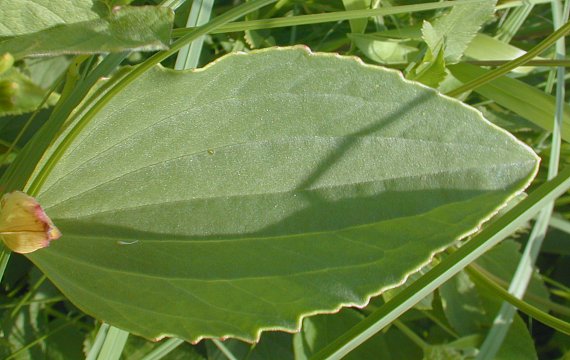
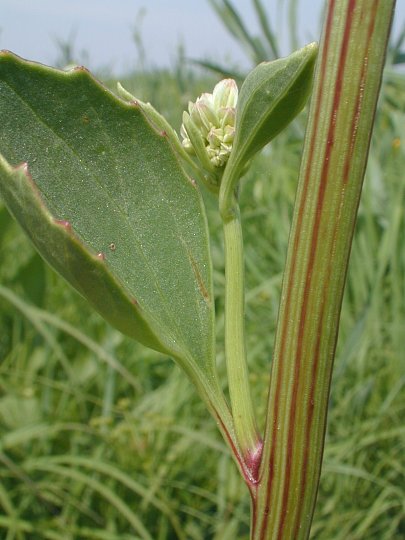
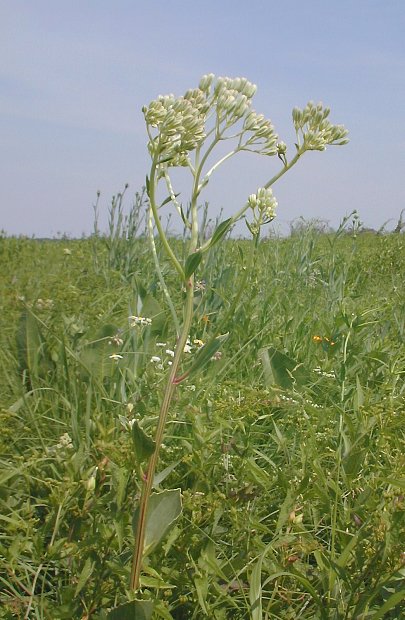
Description: This perennial plant initially forms a tuft of low basal leaves. The basal leaves are very similar in appearance to the lower cauline leaves (to be described shortly), except their petioles are somewhat longer. During the spring, this plant bolts, becoming 3-4' tall and unbranched, except near the inflorescence. The stout central stem is light green, terete, and glabrous; it has conspicuous longitudinal veins that are red. The cauline leaves are alternate, becoming smaller and less abundant as they ascend the central stem. The lower cauline leaves are up to 7" long and 4" across; they are broadly elliptic in shape and their margins are smooth to coarsely dentate. The upper cauline leaves are up to 4" long and 3" across; they are broadly ovate to elliptic in shape and their margins are smooth to coarsely dentate. The leaves are medium green, except along their margins, where they are often greenish white to reddish green. The leaves are glabrous and their texture is somewhat succulent (thick and rubbery); their primary veins are usually parallel. The petioles of the leaves are stout, glabrous, and greenish white to reddish green. The petioles of basal leaves are up to 4" long, while the petioles of cauline leaves are up to 2" long, becoming shorter as they ascend the central stem. The uppermost cauline leaves are often sessile.
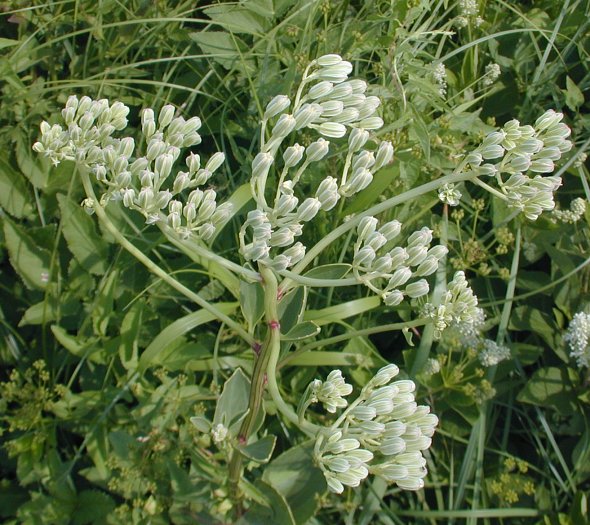
The central stem terminates in a flat-headed panicle of flowerheads spanning 3-10" across. The structure of this panicle is relatively irregular and loose. The branches of the panicle are greenish white to white, more or less terete, glabrous, and sometimes glaucous. At maturity, these flowerheads are about 8-10 mm. long, 4-5 mm. across, broadly oblongoid-ellipsoid, and 5-keeled. The sides of each flowerhead consist of 5 phyllaries (floral bracts) in a single series; these phyllaries are greenish white to white, broadly elliptic in shape, glabrous, and strongly keeled. The keels of these phyllaries have white-membranous wings. Within the interior of each flowerhead, there are 5 perfect disk florets; these florets are slightly exserted from the phyllaries. The corollas of these disk florets are greenish white to reddish white, narrowly cylindrical in shape, and 5-lobed. The corolla lobes are linear-lanceolate and strongly recurved. The blooming period occurs from early to mid-summer, lasting about 3-4 weeks for a colony of plants. There is no noticeable floral scent. Afterwards, the florets are replaced by achenes about 4-5 mm. long that are dark brown, narrowly bullet-shaped, and longitudinally ribbed. At their apices, these achenes have spreading tufts of white hair; they are distributed to some extent by the wind. The root system consists of a shallow crown with coarse fibrous roots. This plant spreads by reseeding itself.
Cultivation:
The preference is full to partial sun, moist conditions, and soil
containing some decaying organic matter. This plant tolerates
occasional periods of standing water. Soil with either a high or low pH
is tolerated. Foliar disease doesn't appear to be troublesome.
Range & Habitat:
This uncommon plant occurs primarily in NE Illinois, and scattered
counties elsewhere (see Distribution
Map),
where it is native. At one time, large populations of Prairie Indian
Plantain occurred in wetland areas, particularly in the Chicago region,
but they have been largely destroyed by modern development. This plant
still occurs in such habitats as moist black soil prairies, dolomite
prairies, moist meadows along rivers, savannas, thickets, marshes,
fens, remnant bogs, and calcareous seeps. In developed areas, it may
occur along ditches near railroads and roadsides. This is an indicator
plant of high quality habitat.
Faunal Associations: The flowers of Prairie Indian Plantain appear to attract only a few insect visitors. Those that have been observed include the parasitoid Halictid bee Sphecodes dichrous, Myzinum quinquecinctum (Five-banded Tiphiid Wasp), the butterfly Lycaena hyllus (Bronze Copper), and Lygaeus turcicus (False Milkweed Bug). These insects were feeding on nectar (Robertson, 1929). Both the adults and larvae of an oligophagous Lizard beetle, Languria bicolor, feed destructively on species of Indian Plantain (Arnoglossum); the adults chew holes in the leaves, while the larvae live in the stems (Vaurie, 1948). The larvae of a Gracillariid moth, Phyllocnistis insignis, form serpentine mines in the leaves of Indian Plantain and other genera in the Aster family (Microleps website, 2010). At the present time, information about this plant's relationships to vertebrate animals is unavailable.
Photographic
Location:
The photographs were taken at Loda Cemetery Prairie in Iroquois County,
Illinois.
Comments:
While the flowerheads are not particularly showy, the thick rubbery
leaves provide Prairie Indian Plantain with a presence that is quite
interesting and different. This is the only Arnoglossum
species in Illinois that has basal leaves and lower cauline leaves
that are shaped like the leaves of broad-leaved plantains (e.g., Plantago major
and Plantago rugelii).
Other species of this genus have
basal leaves and lower cauline leaves that are more broad and more
deeply lobed or toothed – this is probably an accommodation to the
lower
light levels of the woodland habitats in which they are more likely to
occur. While Prairie Indian Plantain is often regarded as a wetland
species, it also occurs in moist meadows and prairies.