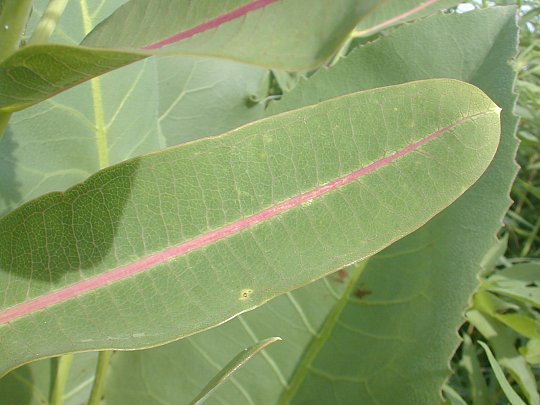
Description: This perennial herbaceous plant is 2-3' tall and unbranched. The erect central stem is relatively stout, terete, light green, and glabrous. Pairs of opposite leaves occur along the entire length of the stem; they are widely spreading to ascending (usually the latter). These leaves are 3-6" long and 1½–3" across; they are broadly oblong to ovate-oblong in shape, entire (toothless) and sometimes wavy along their margins, and either sessile or short-pedicellate. The leaf bases are rounded, while the tips of leaves are round or obtuse, tapering abruptly to a short narrow point. The upper and lower surfaces of the leaves are light-medium green and glabrous; the leaf texture is slightly fleshy. Leaf venation is pinnate; the prominent central veins are light green, pink, or purple. Each fertile plant develops 1-3 umbels of flowers (rarely more) from the apex of the central stem and the axils of the uppermost leaves. These umbels span 2–3½" across and they are slightly dome-shaped, consisting of 15-25 flowers each (rarely more).
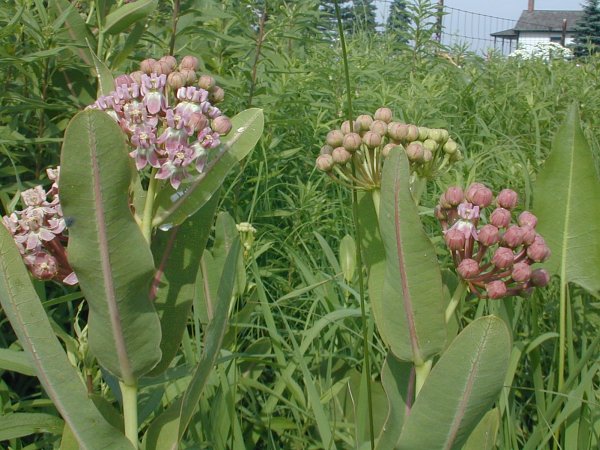
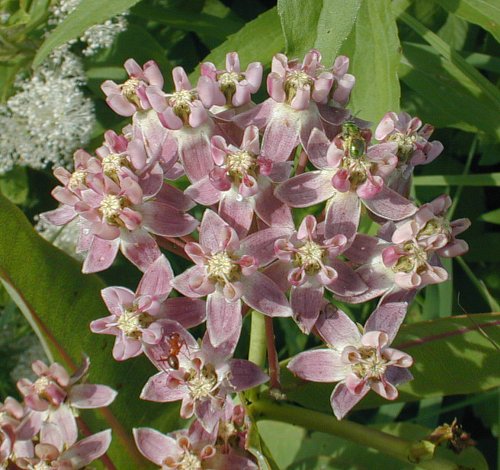
Each flower is
about ½" across and ¾" long, or slightly smaller
in size, consisting of 5 sepals, 5 petals, 5 hoods with horns, and a
central reproductive column that is whitish. The sepals are light green
to pinkish purple, lanceolate-ovate in shape, and glabrous. The petals
are mostly pink to purplish pink (although white at their bases),
lanceolate in shape, and declined (bent downward). The hoods are erect,
open-tubular in shape, and pink to purplish pink. Each hood has an
exserted horn that is sickle-shaped and incurved. The pedicels of the
flowers are 1–1½" long, light green to reddish purple, and glabrous.
The peduncles of the umbels are ½–3" long, light green, and terete. The
blooming period occurs during early to mid-summer, lasting about 1
month. The flowers have a pleasant fragrance. Afterwards,
cross-fertilized flowers (if any) are replaced by erect to ascending
follicles (seedpods that open along one side) that are 3-4" long and
1–1¼" across at maturity. These follicles are light green (while
immature), lanceoloid in shape, and smooth to bluntly warty. At
maturity, the follicles split open to release their seeds to the wind.
The seeds are brown, flattened-ovate in shape, and narrowly
winged along their margins; they have large tufts of white hair at
their apices. The root system is fleshy and rhizomatous, occasionally
producing clonal offsets.
Cultivation:
The preference is full sunlight, moist to mesic conditions, and a
rich loamy soil. While it can spread by means of its rhizomes, this
plant is far less aggressive than Common
Milkweed (Asclepias
syriaca). During dry weather, some of the lower leaves may
turn yellow and
fall off the plant. This also happens when the seedpods develop, which
is quite normal. Active growth occurs during the late spring and early
summer.
Range &
Habitat:
The native Prairie Milkweed is uncommon to occasional in the majority
of counties in
Illinois, but it is rare or absent in many counties of southern and NW
Illinois (see Distribution
Map).
Habitats include black soil prairies, cemetery prairies, prairie
remnants along railroads, moist meadows along rivers or near woodlands,
thickets, and roadside ditches. Prairie Milkweed is an indicator plant
of average to high quality prairies.
Faunal Associations:
Various insects visit the flowers of Prairie Milkweed for nectar,
including bumblebees, cuckoo bees (Epeolus
spp.), leaf-cutting bees (Megachile spp.),
Halictid bees (including green metallic bees), Halictid cuckoo bees (Sphecodes spp.),
sand wasps (Bembix spp.),
Sphecid wasps, Ichneumonid wasps, thick-headed flies (Conopidae),
Tachinid flies, flesh flies (Sarcophagidae), butterflies, skippers,
moths, and ants (Robertson, 1929). The Ruby-throated Hummingbird also
visits the flowers
for nectar. Among the various visitors, bumblebees and other
long-tongued bees are the most effective in cross-pollinating the
flowers. Other insects feed on the roots, stems, leaves, flowers, and
seedpods of Prairie Milkweed and other milkweeds (Asclepias spp.).
The larvae of one species, the Milkweed Leaf-miner Fly (Liriomyza asclepiadis),
tunnels through the leaves of Prairie Milkweed (Betz et al., 1997).
Other insects that feed on milkweeds include long-horned beetles (Tetraopes spp.),
the Swamp Milkweed Leaf Beetle (Labidomera
clivicollis), the Milkweed Stem Weevil (Rhyssomatus lineaticollis),
the Small Milkweed Bug (Lygaeus
kalmii), the Large Milkweed Bug (Oncopeltus fasciatus),
the Oleander Aphid (Aphis
nerii) and other aphids, caterpillars of a moth, the
Delicate Cycnia (Cycnia
tenera), and caterpillars of a butterfly, the Monarch (Danaus plexippus).
The Insect Table
provides additional information about these species. Because the
foliage of Prairie Milkweed contains a white latex that is
bitter-tasting and toxic, mammalian herbivores avoid consumption of
this plant.
Photographic
Location: The
photographs were taken at the Loda Cemetery Prairie in Iroquois County,
Illinois.
Comments:
Prairie Milkweed (Asclepias
sullivantii) somewhat resembles Common Milkweed (Asclepias syriaca)
in appearance, but
the former species has flowers that are slightly larger in size and its
leaves are hairless on their undersides. Prairie Milkweed is usually a
shorter plant than Common Milkweed, and it produces fewer umbels of
flowers from the axils of its leaves. Another similar species is Purple
Milkweed (Asclepias
purpurascens). This latter species differs by having
seedpods that are always smooth (rather than bluntly warty) and it has
short
hairs on the undersides of its leaves. In addition, the flowers of
Purple Milkweed are slightly smaller in size than those of Prairie
Milkweed, and they are usually more purple. Sometimes Prairie Milkweed
has difficulty in forming seedpods because many flower-visiting insects
are
not very effective in removing and transferring pollinia from one plant
to
another. In addition, it is not uncommon for some of these insects to
become
entrapped on the flowers and unable to escape. Another common name of
this plant is Sullivant's Milkweed.