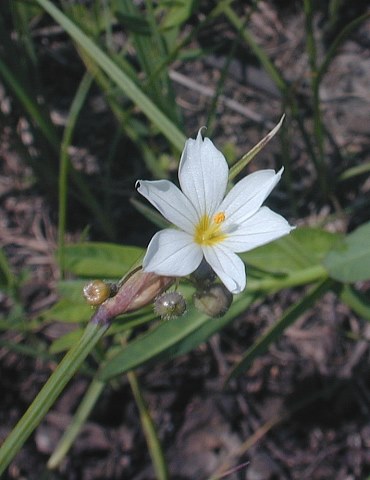
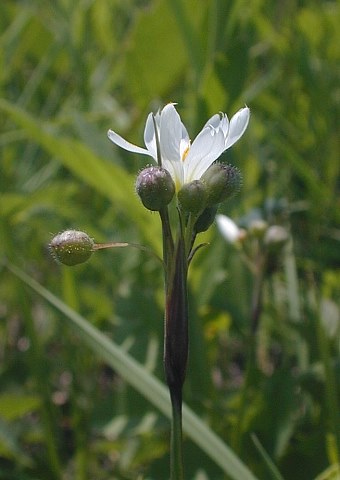
Description: This perennial plant is ½–1' tall, forming a a tuft of linear basal leaves with smooth margins. The basal leaves are 2-3 mm. across, flattened, pale green, and glabrous. One or more flowering stalks develop from among the basal leaves; these stalks are about the same length or somewhat taller than the leaves. The linear stalks are 1-2 mm. across, pale green, and glabrous; each stalk has a stiff raised ridge that runs along the flattened sides of its length. Each stalk produces a pair of sessile claw-like bracts (or spathe) near its apex, between which a single umbel of flowers occurs. The outer bract is ¾-1" long, while the inner bract is ½-¾" in length (sometimes the inner bract isn't distinct from the flowering stalk during the early stage of its development). Both bracts are some shade of pale green, pinkish purple, or brownish purple; they are linear-lanceolate in shape, slightly curved, and usually glabrous. The outer bract is somewhat swollen at its base. Each umbel has 3-6 flowers on slender pedicels that are about the same length as the bracts. The flower buds are hairy and nodding, while flowers in bloom are held more erect. Each flowers is up to ½" across, consisting of 6 tepals that are blue-violet, light blue, or white, and a yellow spike-like structure in its center that contains the reproductive organs. Near the center of the flower, the tepals are yellow. The tepals are oblong-elliptic in shape and they taper abruptly into short narrow tips. The blooming period occurs from late spring to early summer, lasting about 3 weeks. There is no noticeable floral scent. The flowers are replaced by 3-celled seed capsules. At maturity, these capsules are about 3 mm. long, ovoid-globoid in shape, and glabrous. Eventually, each capsule splits open into 3 sections to release the small dark seeds. The seeds are small enough to be dispersed a limited distance by gusts of wind. The root system is coarsely fibrous, and new plants can develop vegetatively from adjacent offsets.
Cultivation:
The
preference is full sun and mesic to dry conditions. The soil can
contain significant amounts of loam, rocky material, or sand. This
species of Blue-Eyed Grass is more drought-resistant than most of the
others. Foliar disease is rarely a problem. While this plant can slowly
spread by forming larger clumps, it is not aggressive.
Range & Habitat:
Prairie Blue-Eyed Grass occurs primarily in western and northern
Illinois, where it is fairly uncommon; in other parts of the state,
this plant is rare or absent (see Distribution
Map).
Habitats include
mesic to dry black soil prairies, sand prairies, hill
prairies, savannas, limestone glades, sandy meadows in wooded areas,
abandoned fields, and areas along railroads. This plant is usually
found in high quality habitats.
Faunal Associations:
The flowers are visited primarily by short-tongued bees, including
Halictid bees and masked bees (Hylaeus
spp.), where they seek nectar
and pollen. Syrphid flies also visit the flowers, where they feed
primarily on stray pollen. The Wild Turkey and Greater Prairie Chicken
eat the seed capsules and/or foliage to a limited extent.
Photographic
Location:
The photographs were taken at Prospect Cemetery Prairie in Ford County,
Illinois.
Comments:
It can be difficult to distinguish the different species of Blue-Eyed
Grass. The white form of Prairie Blue-Eyed Grass (as illustrated in the
photographs) is quite similar in appearance to Sisyrinchium
albidum (White Blue-Eyed Grass). Like most Sisyrinchium spp.,
Prairie Blue-Eyed Grass produces a single umbel of flowers between a
pair of bracts on each flowering stalk, while White Blue-Eyed Grass
produces 2 pairs of bracts with 2 umbels of flowers on each flowering
stalk. White Blue-Eyed Grass also has slightly larger seed capsules and
slightly wider leaves and flowering stalks. When Prairie Blue-Eyed
Grass has blue-violet flowers, it can be confused with other Sisyrinchium
spp. Generally, Prairie Blue-Eyed Grass has leaves
and flowering stalks that are no wider than those of other species, and
it never
produces secondary flowering stalks from the primary flowering stalks
that originate from among the basal leaves. The common name for this
genus, Blue-Eyed Grass, is something of a misnomer because the flowers,
whether white or blue-violet, have yellow centers.