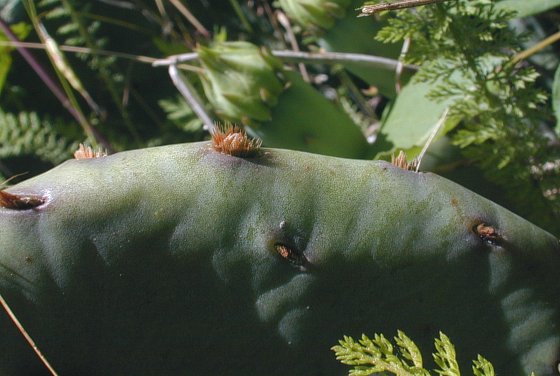
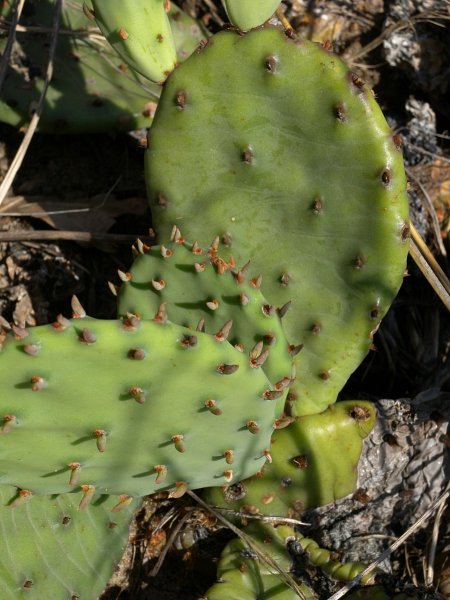
Description: This perennial plant is ¾–2' tall. It consists of a single pad (swollen stem) that is partially inserted in the ground, from which 1-2 additional sessile pads may develop from its upper curved margin. These fleshy pads are usually erect or ascending, although sometimes they sprawl horizontally. Individual pads are 2-7" long, 1½–5" across, and ½–1¼" thick; they are obovoid in shape and somewhat flattened. The pad surfaces are medium green or bluish green, shiny or dull, and hairless (excluding the woolly hair, bristles, and spines of areoles). The pads are evergreen during the winter, although they often become slightly yellowish and wrinkled at this time. Areoles (air pores) are scattered across the surface of each pad in diagonal rows; they often have a brownish appearance. Areoles have small tufts of fine sharp bristles (glochids) up to 3 mm. long that are embedded in woolly hairs. In addition, 0-2 hardened spines develop from each areole. The spines are light gray to light brown, straight, and variable in length (½–4" long). There are also small leaves near the areoles (one leaf per areole); these leaves are green or pale brown, about 3-6 mm. long, awl-shaped (subulate), and early-deciduous.

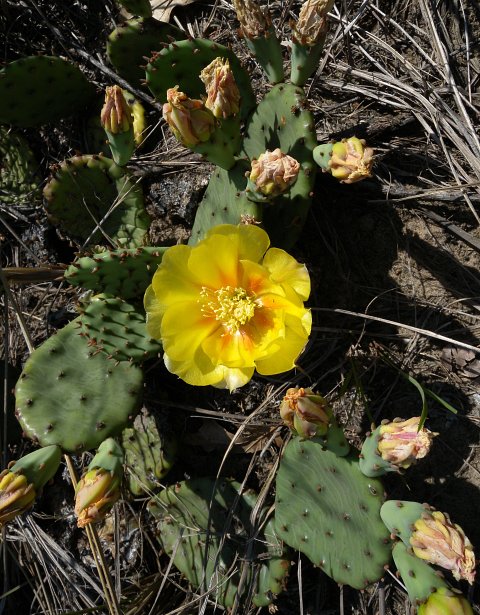
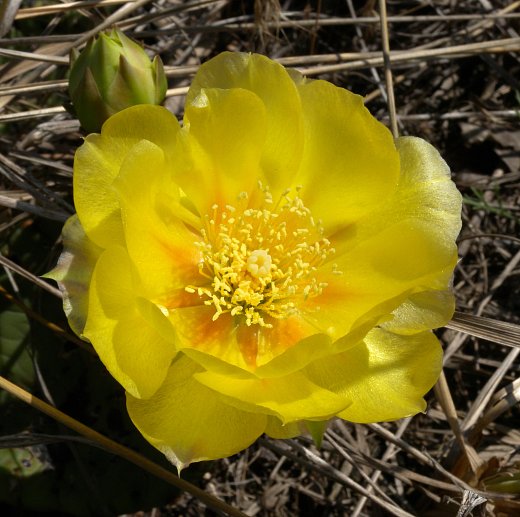
One or more flower buds can develop along the upper curved margin of each pad. These flower buds are up to 2" long and ¾" across; they are oblanceoloid-oblongoid in shape, greenish, and somewhat fleshy-scaly in appearance. When the flowers are fully open, they are 2-3" across. Each flower several tepals, numerous stamens, and an inferior ovary with a single style. Mature tepals are light yellow to yellow and satiny in appearance. Sometimes, the bases of inner tepals toward the center of each flower are orange-red. The filaments of the stamens are yellow to pale orange, while their anthers are yellow. At the apex of the style, there is a narrow ring of short stigmas; these stigmas are white. to pale yellow. The blooming period occurs during early summer, lasting about 3-4 weeks for a colony of plants. Each flower is diurnal, lasting only a single day. Afterwards, the flowers are replaced by sessile fruits. Mature fruits are 1¼–2" long and ½–¾" across, dull red to reddish brown, and oblanceoloid-oblongoid in shape with concave apices. Each fruit contains several seeds in a fleshy interior. Depending on the local ecotype and stage of ripeness, the flesh of these fruits is green to red and either sour, bland, or sweet.
Individual seeds
are about 4 mm. long, tan to dark
brown, globoid, and somewhat flattened in shape; there is narrow ridge
along at least one-half of the outer margin of each seed. The root
system is fibrous and spreading. Upper pads occasionally break off from
lower pads, falling to the ground. Such detached pads can develop new
roots in the ground, creating new plants that are clonal offsets.
Cultivation:
The preference is full to partial sunlight (at least one-half day of
sun), mesic to dry conditions, and sandy or rocky soil. Soil
containing loam or clay-loam is tolerated if it is well-drained. Older
stems on the ground have a tendency to
become brown and woody with age, which is natural. It is faster and
easier to start new plants using pads, rather than seeds; detached pads
form new
roots in the ground readily. This is the easiest cactus to grow in
Illinois because
of its tolerance of moisture, humidity, and cold winter
weather. It also blooms more reliably than most cacti.
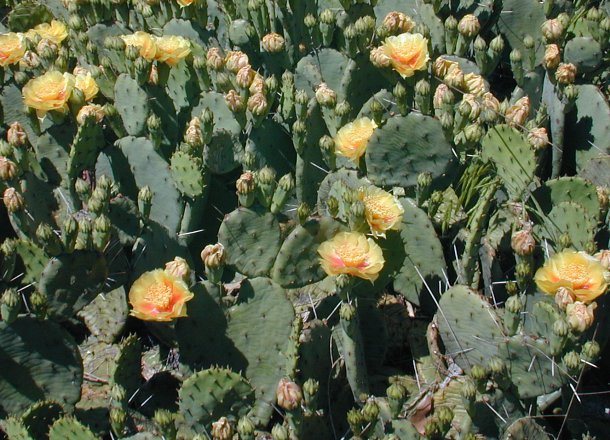
Range & Habitat: The Eastern Prickly Pear occurs occasionally in about one-half of the counties in Illinois (see Distribution Map). It is most likely to be found in sandy or hilly areas along the Mississippi and Illinois rivers, in hilly areas of southern Illinois, and sandy or rocky areas of northern Illinois. This is by far the most common cactus in Illinois. Most populations of this plant are native, although some local populations are the result of restoration efforts or occasional escapes from cultivation. Typical habitats include openings in sandy woodlands, sandy savannas, sand prairies, hill prairies, gravel prairies, barrens and rocky bluffs, sandstone and limestone glades, sand dunes along Lake Michigan and other areas, rocky or sandy slopes along major rivers and lakes, sandy cemeteries, pastures, and sandy or gravelly areas along railroads. The greatest threats to the survival of this plant are the destruction of habitat by modern development and the invasion of its habitat by woody vegetation.
Faunal Associations: Both long-tongued and short-tongued bees visit the flowers, including bumblebees, the Large Carpenter Bee (Xylocopa virginica), digger bees (Melissodes spp.), leaf-cutting bees (Megachile spp.), Halictid bees (including green metallic bees), and plasterer bees (Colletes spp.). Long-tongued bees suck nectar or collect pollen, while short-tongued bees collect pollen only; the larger bees are more likely to cause cross-pollination (Mitchell, 1960/1962; Kevan & Aiello, 2002). Some insects feed on the pads of Eastern Prickly Pear and other prickly pears (Opuntia spp.). These species include larvae of the Eastern Cactus-boring Moth (Melitara prodenialis); larvae of a polyphagous moth, Julia's Dicymolomia (Dicymolomia julianalis); larvae of another polyphagous moth, the Arge Tiger Moth (Grammia arge); and larvae of a Syrphid fly, Copestylum vittatum. Other insects suck plant juices from the pads or fruits of these plants. These species include the Prickly Pear Cactus Bug (Chelinidea vittiger), Pale-margined Stink Bug (Chlorochloa persimilis), and Uhler's Stink Bug (Chlorochroa uhleri). Some of these insects are found in the Great Plains region and SE United States, but not in the Midwest. See Needham et al. (1928), Covell (1984/2005), Hart & Gleason (1907), Froeschner (1942), Vestal (1913), and Rider (2009) for more information.
In the Eastern states, the relationships of prickly pears with vertebrate wildlife are less well-known than in western United States. From studies in these western areas, the fruits and seeds of these plants are eaten occasionally by the Wild Turkey and Thirteen-lined Ground Squirrel. Both the fruits and pads are eaten occasionally by the Coyote, Gray Fox, Cottontail Rabbit, Striped Skunk, and White-tailed Deer, notwithstanding the presence of bristles and occasional spines (Martin et al., 1951/1961). The fruits and pads are also eaten by the Ornate Box Turtle (Ernst et al., 1994); this turtle is often found in sand prairies. All of these vertebrate animals occur in Illinois at the present time. Domesticated animals, such as cattle, horses, and sheep, normally avoid the consumption of the fruits and pads of the Eastern Prickly Pear because of its spines and bristles. However, when these plants are eaten by such animals, the spines and bristles can irritate and damage both their mouth parts and digestive tracts (Georgia, 1913). When White-tailed Deer (and probably other vertebrate animals) eat the fruits, they help to spread the seeds to new locations (Myers et al., 2004). The relatively large pads of Eastern Prickly Pear provide nesting habitat for the Bobwhite Quail (Hernandez et al., 2003), and protective cover for snakes and other kinds of wildlife.
Photographic
Location:
The photographs were taken at a sandy meadow near Kickapoo State Park
in Vermilion County, Illinois, and at a sand prairie of the Indiana
Dunes National Lakeshore in NW Indiana.
Comments:
The Eastern Prickly Pear (Opuntia
humifusa) is a striking plant with large beautiful
flowers. It has fewer spines than many western species of prickly pear (Opuntia spp.),
but they are still fairly formidable. The fine bristles near the
areoles can easily penetrate the skin, causing irritation should the
pads of this cactus be carelessly handled or brushed against. While
Eastern Prickly Pear normally occurs as scattered individual plants or
in small colonies, sometimes this cactus can form impressively
large colonies if it persists at the same location for a sufficiently
long period of time. The only other cactus with a similar size and
appearance in Illinois is the less common Big-rooted Prickly Pear (Opuntia
macrorhiza).
This latter species differs from the Eastern Prickly Pear by its thick
tuberous root and the greater abundance of spines on its pads. While
Eastern Prickly Pear develops 0-2 spines per areole, Big-rooted Prickly
Pear develops 2 or more spines per areole. Other scientific names that
refer to Eastern Prickly Pear include Opuntia
compressa and Opuntia rafinesquei.