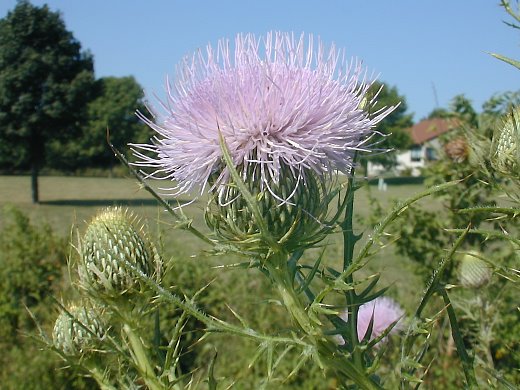
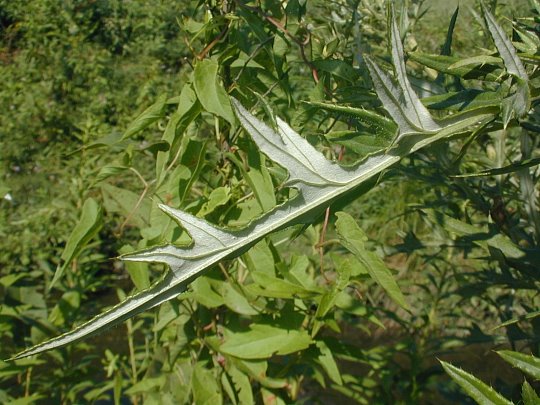
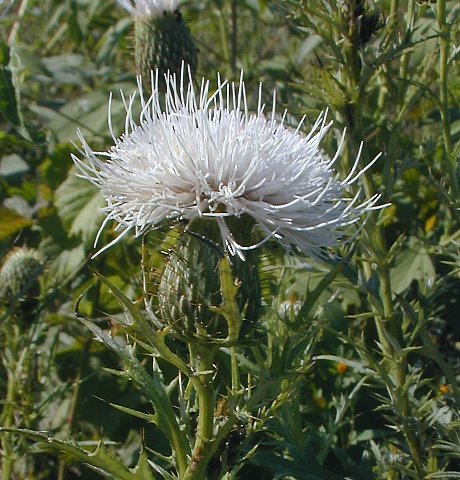
Description: This biennial or short-lived perennial plant initially forms a low rosette of spiny basal leaves up to 1' across. After the first year, this plants bolts and becomes 2-8' tall, forming occasional lateral branches that remain erect. The light green stems have white hairs, but they are without spines. The alternate leaves are quite spiny, pinnately lobed, and up to 9" long and 3" across. They are green on the upper surface, but powdery white on the lower surface because of minute fine hairs. Flowerheads with little or no scent occur individually on erect flowering stems in the upper part of the plant. These flowerheads are about 2" across and light pink (rarely white), consisting of numerous disk florets. At the base of each flowerhead, there are overlapping floral bracts (phyllaries) that are light green with white central veins; they resemble fish scales. Each floral bract has a single golden spine that is slender, but sharp. Underneath the base of each flowerhead, there are a few leafy bracts that resemble the alternate leaves, but they are smaller in size and more ascending. The blooming period is from late summer to fall, lasting about a month for individual plants. The achenes develop with tufts of white hair, which facilitates their dispersal by wind. The root system consists of a central taproot and some coarse secondary roots. Vegetative spread by rhizomes does not occur.
Cultivation:
The
preference is full sun, soil containing loam or clay-loam, and mesic
levels of moisture. During summer droughts, there is a tendency for the
lower leaves to turn yellow and fall off the plant. This is an easy
plant to grow, but it has a tendency to appear rather the worse for
wear as the growing season progresses. Pasture Thistle is short-lived,
but reseeds itself readily.
Range & Habitat:
This native plant occurs in virtually every county in Illinois (see Distribution
Map); it is common within the state. Habitats include moist
to dry prairies,
openings in woodland areas, moist meadows near rivers, limestone
glades, pastures and abandoned fields, open areas along railroads and
roadsides, and waste areas. This plant is more abundant in disturbed
areas, including degraded prairies, but also occurs in higher quality
habitats.
Faunal Associations: The most important pollinators of the flowers are bumblebees, digger bees (Melissodes spp.), leaf-cutting bees (Megachile spp.), and butterflies. One of these bees, Melissodes desponsa, is an oligolege (specialist pollinator) of Cirsium spp. Among the butterflies, are such floral visitors as Monarchs, Fritillaries, Painted Ladies, Swallowtails, and Sulfurs. Sphinx moths and bee flies also visit the flowers for nectar. The caterpillars of the butterfly Vanessa cardui (Painted Lady) feed on the foliage, while the caterpillars of several moths feed on the foliage and other parts of this and other thistles (see Moth Table). Other insect feeders include Cassida rubiginosa (Thistle Tortoise Beetle), Euphoria inda (Bumble Flower Beetle), Brachycaudus cardui (Thistle Aphid) and Capitophorus elaeagni (Artichoke Aphid), Melanoplus borealis (Northern Grasshopper), and many others. Among vertebrate animals, the Eastern Goldfinch eats the seeds and uses the tufts of hair as lining material in its nests. The Ruby-Throated Hummingbird has been known to visit the flowers of thistles for nectar. Mammalian herbivores avoid this plant because of the spines.
Photographic
Location:
The photographs were taken near Kaufman Lake Park in Champaign,
Illinois.
Comments:
This native plant can be distinguished from the non-native Cirsium
vulgare (Bull Thistle) by the white undersides of its leaves.
Also, the floral bracts subtending the flowerheads of Bull Thistle have
thick coarse spines, whereas the bracts of the Pasture Thistle have
slender golden spines.. Otherwise, they are similar in appearance.
Sometimes this plant can be aggressive in disturbed areas, but not to
the same extent as the Bull Thistle. It is possible to boil the young
leaves and stems and serve them as edible greens. During the month of
August, when other forbs are less likely to flower, this plant produces
some patches of pink color, making the prairie more interesting during
this time of year.