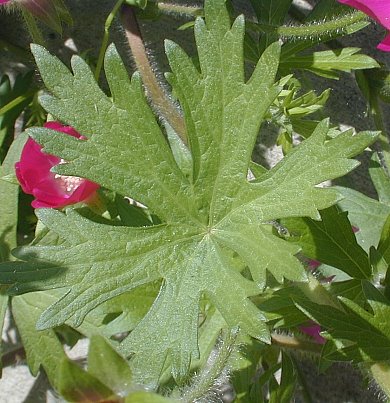
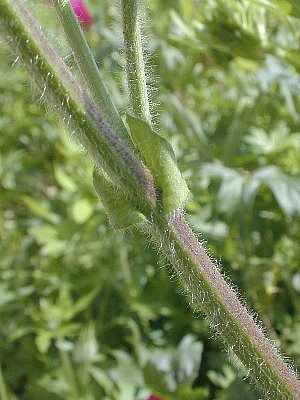
Description: This perennial wildflower is up to 1' tall and sprawls across the ground, producing several vine-like stems up to 4' long from a central taproot. These angular stems are light green to dull reddish purple and covered with spreading white hairs. The alternate leaves are up to 4" long, 4" across, and more or less orbicular in outline; they are palmate, usually with 5 major lobes that are cleft (sharply divided), as well as some secondary lobes and margins with coarse teeth. The leaves have hairy petioles that can easily exceed 4" in length. A pair of conspicuous green stipules are located at the base of each petiole. Each stipule has a shape that is half-ovate.
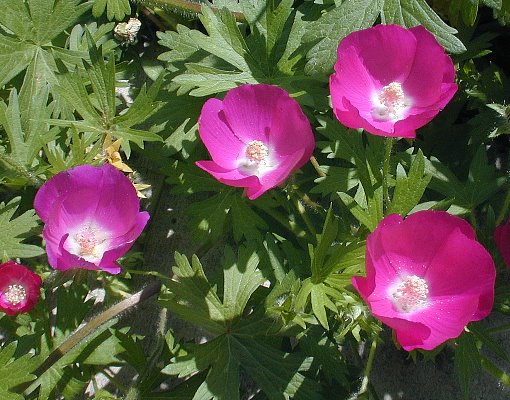
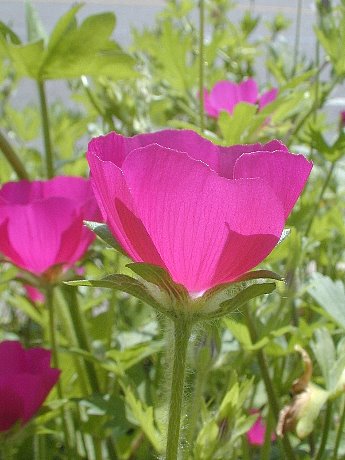
From the axils of the leaves, individual flowers develop from pedicels up to 6" long. The flowers are about 1½–2½" across, consisting of 5 broad magenta petals, a columnar reproductive structure, and a whitish green to reddish green calyx. At maturity, the columnar structure expands outward slightly, revealing numerous white stamens and pinkish style-branches. The petals often become white near the center of the flower. The calyx is divided into 5 lanceolate lobes that have light-colored ridges and are quite hairy; these lobes are shorter than the petals. Underneath the calyx, there are 3 floral bracts that are similar in appearance to the calyx lobes. The blooming period occurs from late spring to late summer and lasts about 1-2½ months. There is no noticeable floral scent. The flowers are replaced by carpels that are arranged together like a ring. These carpels are flattened and reniform (kidney-shaped) with short hairy beaks. The flattened sides of the carpels are reticulated, rather than smooth. Each carpel contains a single seed. This wildflower spreads by reseeding itself.
Cultivation:
The
preference is full sun and mesic to dry conditions. In Illinois, this
plant often grows in poor soil that contains sand, gravel, or clay. In
rich cultivated soil, it will become longer than it normally does in
the wild. After mid-summer, this plant gradually withers away.
Range & Habitat:
This non-native wildflower has naturalized in only a few scattered
counties in the northern two-thirds of Illinois (see Distribution
Map),
where it is uncommon. It is adventive from areas further to the
west or southwest of the state. Habitats include dry prairies, areas
along railroads and roadsides, and abandoned fields. In these habitats,
the ground vegetation is relatively low and sparse. In Illinois,
Purple Poppy Mallow is often planted in flower gardens
because of its attractive flowers.
Faunal
Associations:
The flowers are cross-pollinated primarily by bees. The caterpillars of
Pyrgus communis
(Checkered Skipper) sometimes feed on Callirhoe spp.
(Poppy Mallows). The foliage is readily consumed by mammalian
herbivores, including groundhogs, deer, rabbits, and livestock. This
could make the survival of local populations of this plant difficult
where there is a preponderance of such animals. The taproot is edible
and can be used as emergency food by humans, which means that it is
probably edible to pocket gophers and other small rodents as well.
Photographic Location:
A flower garden in Urbana, Illinois.
Comments: Purple Poppy Mallow has attractive foliage and very showy flowers that bloom for a fairly long period of time. It can be distinguished from other Callirhoe spp. in Illinois by the shape of its leaves, sprawling hairy stems, and the color of its flowers. For example, Callirhoe alceoides (Pink Poppy Mallow) has smaller flowers that are pink, rather than magenta. Another species, Callirhoe triangulata (Clustered Poppy Mallow), has leaves with a more triangular shape. A third species that is occasionally found within the state, Callirhoe digitata (Fringed Poppy Mallow), has a more erect habit with hairless stems and leaves. It is also useful to examine the carpels: While the flattened sides of the carpels of Purple Poppy Mallow have a reticulated surface, the sides of the carpels of other species in this genus are often smooth.