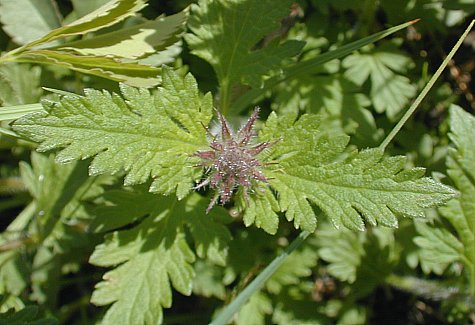
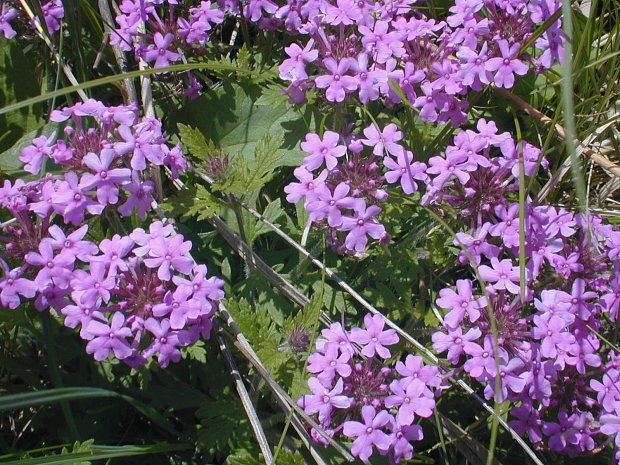
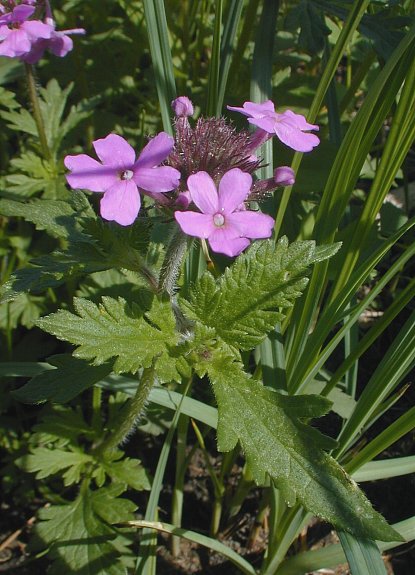
Description: This herbaceous perennial plant is ½–2' tall, often tillering at the base with multiple erect to sprawling stems. The stems are green to purplish green, terete, and hairy, branching occasionally. At intervals along the entire length of each stem, there are pairs of opposite leaves. The leaves are 1½–3" long and ¾–3" across, becoming more narrow and slightly shorter as they ascend the stems. The leaves are pinnatifid and ovate to lanceolate in outline; the lower leaves are often deeply divided (cleft) into 3 primary lobes (1 terminal lobe and 2 lateral lobes), while the upper leaves are shallowly to moderately divided (cleft) into 3 or more primary lobes. The primary lobes of these leaves, in turn, are shallowly divided (cleft) into smaller secondary lobes and coarse dentate teeth. The tips of these lobes are bluntly acute. The leaf margins are slightly ciliate. The upper leaf surface is medium green and sparsely short-pubescent, while the lower leaf surface is more hairy, especially along the lower sides of the veins. Leaf venation is pinnate; the upper leaf surface is slightly wrinkled along these veins. Upper stems terminate in individual spikes of flowers that are 1-6" long. Initially these floral spikes are quite short, but they become elongated with age. A dome-shaped cluster of 10-25 flowers up to 2½" across is produced at the apex of each spike, while the ascending calyces of withered flowers persist below.
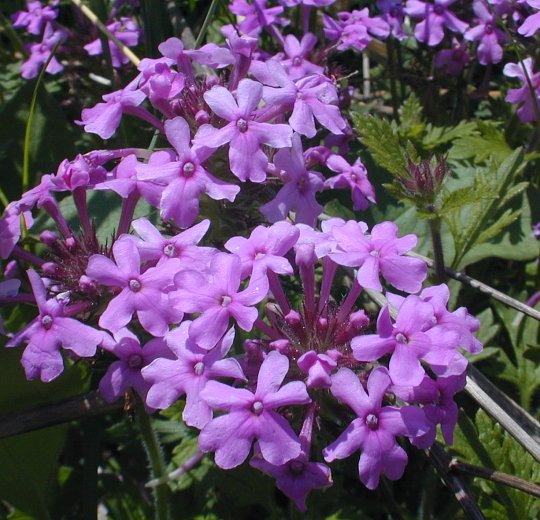
Each flower is about ¾" long and ½" across, consisting of narrowly tubular corolla with 4-5 spreading lobes, a short-tubular calyx with 4-5 long narrow teeth, 4 stamens, and a pistil. The corollas are pink, rosy pink, lavender, or rarely white; their lobes are obovate to oblanceolate in shape and sometimes notched at their tips. The calyces are a little less than ½" long (including the teeth), medium green to reddish purple, and hairy; their teeth are linear-lanceolate in shape and ciliate. The erect to ascending peduncles of the floral spikes are 1-4" long, medium green to purplish green, terete, relatively stout, and hairy. The blooming period occurs from late spring to mid-summer, lasting about 2 months. Some plants may bloom later and longer, but this is an exception to the rule. The flowers may, or may not, have a pleasant floral fragrance. Afterwards, the flowers are replaced by nutlets (4 per flower). Mature nutlets are about 3 mm. long, narrowly angular-cylindrical in shape, and black. The root system consists of a woody caudex with fibrous roots. In addition, when they lie on moist ground, the lower nodes of the stems sometimes develop secondary plants with rootlets. As a result, clonal colonies of plants are produced.
Cultivation:
The preference is full to partial sun and mesic to dry conditions. The
soil can contain rocky material, gravel, sand, loam, or clay-loam,
although less fertile soil is preferred in the wild as a result of
reduced competition from other ground vegetation. Northern ecotypes of
this plant are hardy to Zone 5, while southern ecotypes are more prone
to winter die-off.
Range & Habitat:
Rose Vervain occurs in scattered counties of Illinois (see Distribution
Map),
where it is native to many areas of southern and central Illinois, but
probably adventive elsewhere. Illinois lies along the northern range
limit of this plant, where it is uncommon (outside of cultivation).
Some local populations in the wild are undoubtedly plants that have
escaped cultivation. Habitats include mesic to dry black soil prairies,
sand prairies, hill prairies, pioneer cemeteries, thinly wooded
slopes, openings in rocky upland woodlands, thinly wooded bluffs,
limestone and sandstone glades, pastures, abandoned fields,
and
roadside embankments. Native populations of Rose Vervain in Illinois
are usually found in high quality habitats, while adventive populations
are more likely to be found in disturbed areas.
Faunal
Associations:
The structure of the flowers indicates that they are designed to
attract such pollinators as nectar-seeking long-tongued bees,
butterflies, and skippers. Two aphids feed destructively on Rose
Vervain. One aphid, Aphis
aubletia, feeds on the above-ground parts of this plant,
while the other aphid, Aphis
middletonii (Erigeron Root Aphid), feeds on the roots
(Patch, 1919; Blackman & Eastop, 2013). Mammalian
herbivores are unlikely to consume this plant because of the bitterness
of the leaves.
Photographic Location:
The photographs were taken at the Loda Cemetery Prairie in Iroquois
County, Illinois.
Comments: This is a beautiful plant with flowers that are similar to those of phlox species (Phlox spp.). However, the ragged appearance of the leaves makes it easy to distinguish from these latter species. Because of the attractive and long-blooming flowers, several cultivars of Rose Vervain (Glandularia canadensis) have been introduced that offer a greater range of floral colors than what is normally encountered in the wild. Some of these cultivars are not winter-hardy in Illinois, however. Compared to the Verbena spp. in Illinois that are either native or naturalized, Rose Vervain has showier flowers that form dome-shaped clusters. There are other Glandularia spp. with some resemblance to Rose Vervain, however they don't occur in Illinois. Most of these species are found in the Great Plains and western regions of the United States, or they occur in Central and South America. An example is Dakota Mock Vervain (Glandularia bipinnatifida). The flowers of this latter species are very similar to those of Rose Vervain, but it has more narrowly lobed leaves that are bipinnatifid. An older scientific name of Rose Vervain is Verbena canadensis.