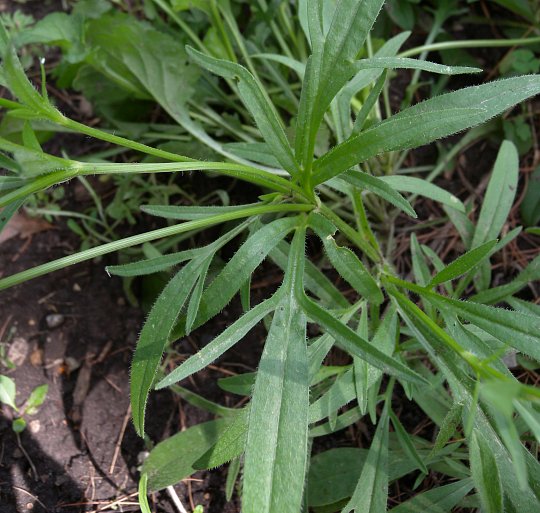
Description: Fertile shoots of this perennial plant are 1½–3' tall, while infertile shoots consist of tufted basal leaves. The basal leaves are erect, ascending, or widely spreading; they are 3-6" long, ½–1" across, elliptic or elliptic-oblanceolate in shape, and entire (toothless) along their margins. The slender petioles of basal leaves are 1-4" long. The upper and lower surfaces of basal leaves are light-medium green and either glabrous (var. lanceolata) or irregularly covered with white hairs (var. villosa). Fertile shoots produce one or more stems from the base of each plant; these stems are ascending to erect, although their bases may rest on the ground. The stems are light-medium green, terete, and either glabrous (var. lanceolata) or irregularly covered with white hairs (var. villosa). Pairs of sessile opposite leaves occur primarily along the lower one-half of each plant.
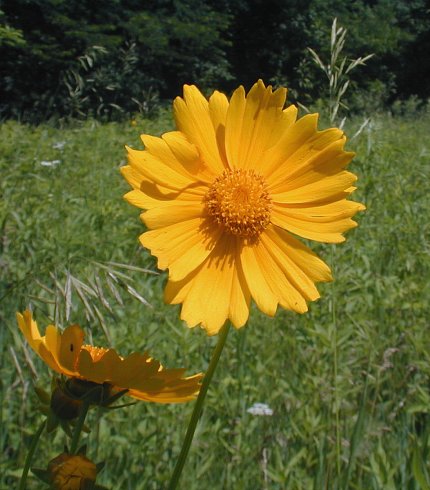
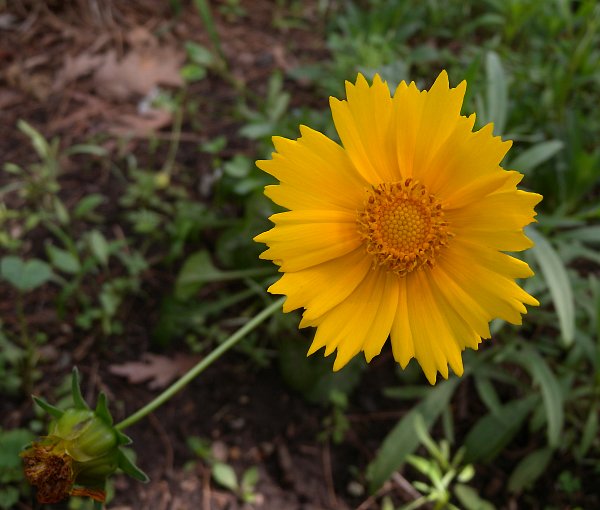
Individual opposite leaves are either unlobed, or they may have 1-4 basal/lateral lobes and a terminal lobe. Unlobed opposite leaves are 1-4" long, linear-elliptic to elliptic in shape, and entire along their margins. Other opposite leaves have lobes that are ½–3" long, linear-elliptic to elliptic in shape, and entire along their margins. Some opposite leaves may have 1-2 short basal lobes, while other opposite leaves may have 2 basal lobes and 2 lateral lobes that are longer. The upper and lower surfaces of opposite leaves are light-medium green and either glabrous (var. lanceolata) or irregularly covered with white hairs (var. villosa). The stems terminate in solitary flowerheads on long naked peduncles (flowering stalks) up to 12" long. Each flowerhead spans 2-3" across, consisting of about 8 sterile ray florets that surround a dense head of numerous fertile disk florets. The petaloid rays of the flowerhead are yellow, oblanceolate to obovate in shape, and 4-lobed along their tips. In addition to the 4 primary lobes, some secondary lobes may be present, providing the tips of the petaloid rays with a ragged appearance.
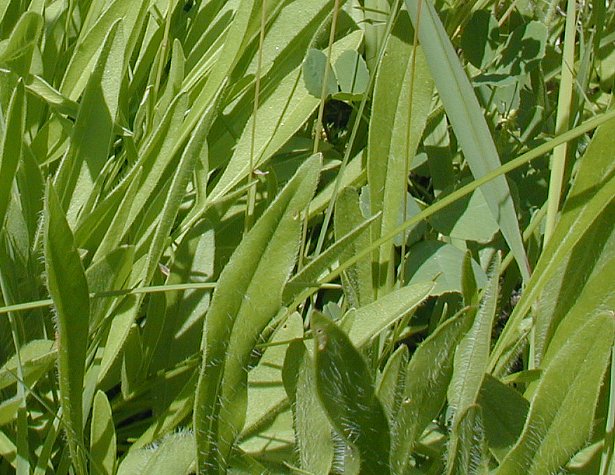
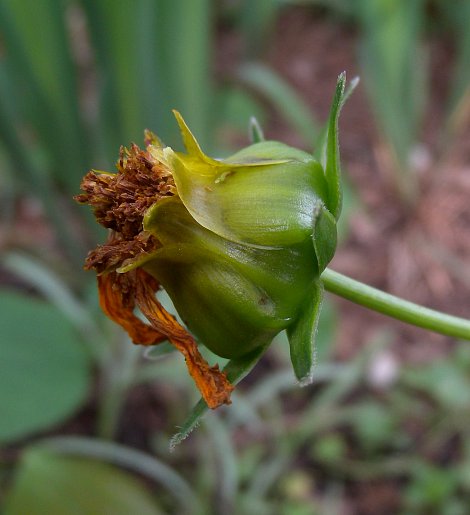
The corollas of the disk florets are about 6 mm. (¼") in length, yellow, tubular in shape, and 4-5 lobed. At the base of each flowerhead, there is a single series of about 8 phyllaries (inner floral bracts). These phyllaries are about 8-10 mm. long, yellowish green to yellowish brown, and deltate-oval in shape; they are appressed along the bases of the petals when the flowerhead is in bloom. Slightly below the base of the flowerhead, there is a single series of 8 outer bracts that are similar to the phyllaries, except they are more green and lanceolate-ovate in shape. The blooming period occurs from late spring to mid-summer, lasting about 1 month for a colony of plants. Afterwards, the disk florets are replaced by achenes that are about 3 mm. long, 3 mm. across (including the membranous wings), brown, and flattened (slightly convex on one side and slightly concave on the other side). The tips of these achenes soon become truncate because their paired awns are early-deciduous. The root system is fibrous and rhizomatous, often forming colonies of clonal plants.
Cultivation:
The
preference is full sun, mesic to dry conditions, and poor soil
containing sandy or rocky material. This plant will adapt to soil
containing fertile loam if it is well-drained and taller plants are
kept away from it. This plant is easy to grow from
transplants. In open areas with exposed ground, it may spread
aggressively.
Range & Habitat:
The native Sand Coreopsis occurs in NE Illinois, counties
along the Illinois
River, SW Illinois, and scattered counties elsewhere within
the state (see Distribution
Map).
In Illinois, it is an uncommon plant. Habitats include mesic to dry
sand prairies, gravel prairies, hill prairies,
limestone glades, thinly wooded bluffs, areas along railroads, and
roadsides. Some local populations, particularly in heavily populated NE
Illinois, may be
plants that have escaped cultivation. In addition, some populations
within the state are the result
of habitat restoration efforts.
Faunal Associations: The nectar and pollen of the flowers attract many kinds of insect visitors, including long-tongued bees, short-tongued bees, wasps, flies, butterflies, skippers, day-flying moths, and beetles. A long-tongued bee, Melissodes coreopsis) is an oligolege (specialist pollinator) of Coreopsis spp. Some insects feed destructively on the plant juices, flowerheads, and other parts of Sand Coreopsis and other Coreopsis spp. These species include the Ragweed Leaf Beetle (Calligrapha bidenticola) and Coreopsis Leaf Beetle (Calligrapha californica coreopsivora), the Red-spotted Aster Mirid (Polymerus basalis), an aphid (Uroleucon reynoldense), and the larvae of such moths as the Dimorphic Gray (Tornos scolopacinarius), Wavy-lined Emerald (Synchlora aerata), and Common Tan Wave (Pleuroprucha insulsaria); see Clark et al. (2004), Knight (1941), Blackman & Eastop (2013), Covell (1984/2005), and Wagner (2005) for more information. The larvae of the latter two moths feed on the flowerheads. Mammalian herbivores occasionally browse on the foliage of Coreopsis spp., including rabbits, groundhogs, deer, horses, and livestock.
Photographic
Location:
The photographs were taken at a sand prairie of Kickapoo State Park in
Vermilion County, Illinois, and at a flower garden in Urbana, Illinois.
Comments:
Another common name for this plant is Lance-leaved Coreopsis, even
though the leaves are usually more broad toward their tips than near
their bases. Sand Coreopsis (Coreopsis
lanceolata) can be distinguished from other Coreopsis spp.
primarily by the lack of lobes on its basal leaves and some of its
opposite leaves. Different populations of Sand Coreopsis can vary
significantly in the hairiness of the stems and leaves, ranging from
glabrous (var. lanceolata)
to conspicuously hairy (var.
villosa). It has been suggested that the hairy variety may
be the result of a naturally occurring hybrid of Coreopsis lanceolata
with Coreopsis pubescens,
or that it should be considered a distinct species (see Flora of North America,
Vol. 21, at: www.efloras.org). Sand Coreopsis is often grown
in flower gardens because of its showy flowerheads. As a result, many
cultivars have been developed, including those that are double-flowered
and bicolored.