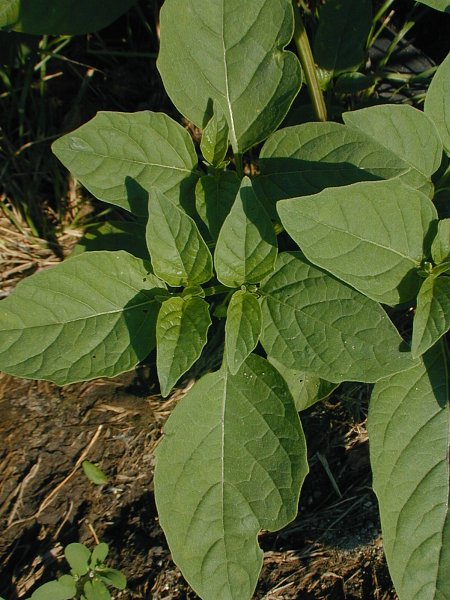
Description: This perennial herbaceous plant is up to 3½' tall, but it is usually only 1¼–2½' tall. Smooth Ground Cherry branches frequently, creating a bushy appearance. Some of the lower branches may sprawl along the ground, otherwise they are ascending. The stems are light green or light purplish green, more or less angular, and glabrous to sparsely short-pubescent. Leaves occur throughout the length of these stems; they are alternate to nearly opposite. The leaves are up to 5" long and 3" across, although they are usually closer to one-half of this size; they are yellowish green to dark green and broadly lanceolate to oval-ovate in shape. The leaf margins are entire (toothless) and often slightly undulate; sometimes they have 1-2 shallow rounded lobes. The leaf bases are rounded and often oblique (one-half of a leaf base extending lower than the other). The upper leaf surface is glabrous or nearly so. The lower leaf surface is also glabrous or nearly so, except along the undersides of the major veins, where it is short-pubescent. Leaf venation is pinnate with slightly incurved lateral veins. The petioles are ¼–¾" long, light green, and glabrous to sparsely short-pubescent. Solitary drooping flowers develop from the axils of the middle to upper leaves, especially where the stems dichotomously branch. The slender pedicels of these flowers are ¾–1" long, light green to light purplish green, and sparsely short-pubescent.
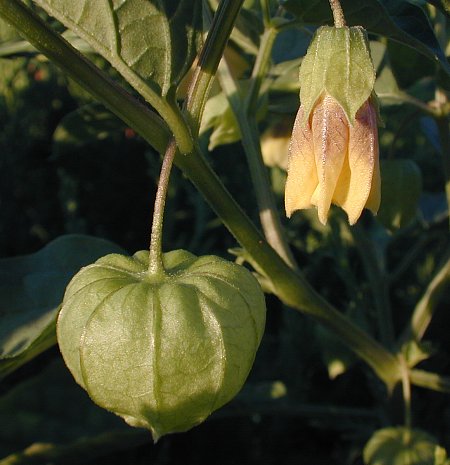
Each flower is about ¾"
long and
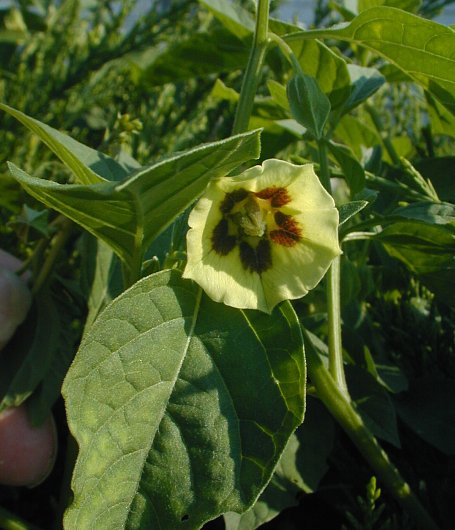
similarly across when it is fully open, consisting of a pale yellow
corolla with 5 very shallow lobes, a green calyx with 5 deltate-cordate
teeth, 5 stamens with yellow or purplish yellow anthers, and a pistil.
The interior of the
corolla has 5 purplish brown patches that surround the reproductive
organs. The calyx has 5 vertical ridges that are sparsely
short-pubescent, otherwise it is glabrous. Each lobe of the corolla is
slightly pointed in the middle. The blooming period occurs from
mid-summer to early
autumn, lasting about 1½ months. Buds, flowers, and fruits can be found
simultaneously on mature plants. The flowers are replaced
by husked fruits that are about 1" long, 1" across or a little
less, and obcordoid-globoid in shape. The husks of these fruits are
initially light green, but they
later become tan-colored and papery; each husk has 10 fine vertical
ridges that are light green to purple. The husks are rounded and
slightly indented where they join the pedicels, while their tips are
pointed. Each husk contains a single berry. At maturity, the
berries are about ½" across, yellow, smooth, and globoid in shape; they
have fleshy interiors that contain many seeds. The small flattened
seeds are 1.5–2 mm. long and a little less across; they are pale yellow
and short-reniform in shape. The root system is
rhizomatous, from which clonal offsets develop.
Cultivation:
The
preference is full to partial sun, moist to mesic conditions, and soil
consisting of fertile loam. The lower leaves may turn yellow, or the
entire plant may droop, in conditions that are too dry. This weedy
species is easy to grow and sometimes it becomes aggressive.
Range & Habitat:
The native Smooth Ground Cherry is common in most counties of Illinois,
but it is uncommon or absent in parts of southern Illinois (see Distribution
Map). Habitats include disturbed areas of black soil
prairies, weedy meadows, disturbed open woodlands, thickets,
areas along railroads, roadsides, abandoned fields and
pastures, gardens and yards, and waste ground. Areas with a history of
disturbance are preferred.
Faunal Associations: Halictid bees (including green metallic bees), plasterer bees (Colletes spp.) and other short-tongued bees visit the flowers for nectar and pollen (Robertson, 1929). Some of these bees are specialist pollinators (oligoleges) of ground cherries (Physalis spp.); they include two plasterer bees, Colletes latitarsis and Colletes willistoni, and a dagger bee, Perdita halictoides. Other insects feed destructively on these plants. These insect feeders consist primarily of various leaf beetles (Chrysomelidae), including Lemma daturaphila (Three-lined Potato Beetle), Lema trivittata (Three-striped Potato Beetle), Leptinotarsa decemlineata (Colorado Potato Beetle), Leptinotarsa juncta (False Potato Beetle), Plagiometriona clavata (Clavate Tortoise Beetle), Epitrix cucumeris (Potato Flea Beetle), Epitrix fuscula (Eggplant Flea Beetle), Epitrix hirtipennis (Tobacco Flea Beetle), and other Epitrix spp. (flea beetles) that are attracted to the Solanaceae (Clark et al., 2004). Generally, the adults of these beetles feed on foliage, while the larvae feed on either roots or foliage. The larvae of some moths also feed on ground cherries. The larvae of a Noctuid moth, Heliothis subflexus (Subflexus Straw), feed on the fruits of these plants, while the larvae of Heliothis virescens (Tobacco Budworm) feed on the buds, flowers, and fruits. The larvae of two Sphinx moths, Manduca quinquemaculata (Tomato Hornworm) and Manduca sexta (Tobacco Hornworm), feed primarily on the foliage of these plants, while the larvae of a Gelechiid moth, Aristotelia physaliella, are leaf-miners (Covell, 1984/2005; Wagner, 2005; Needham et al., 1928). Some vertebrate animals eat the fruits of ground cherries, helping to spread the seeds of these plants to new locations. These fruit-eating animals include the Bobwhite Quail, Wild Turkey, Opossum, Striped Skunk, Spotted Skunk, Pine Mouse, White-footed Mouse, Eastern Box Turtle, and Ornate Box Turtle (Martin et al., 1951/1961; Ernst et al., 1994). Like other species in the Nightshade family (Solanaceae), ground cherries have foliage that is bitter-tasting and toxic. As a result, mammalian herbivores avoid its consumption.
Photographic
Location:
The photographs were taken at the webmaster's apartment complex in
Urbana, Illinois.
Comments:
The various ground cherries (Physalis
spp.) can be difficult to distinguish and their taxonomy
is somewhat unstable. Smooth Ground Cherry (Physalis subglabrata)
is sometimes classified as a distinct species (Mohlenbrock, 2002), and
sometimes it is classified as a variety of Physalis virginiana
or Physalis longifolia
(usually the latter). Compared to other ground cherries, Smooth Ground
Cherry has wider leaves that are not significantly lobed and it tends
to be a larger plant. It also has less hairy leaves and
stems than many ground cherries. After their husks have been removed,
the berries of wild ground cherries resemble cherry tomatoes that are
yellow or red. One species, the Tomatillo (Physalis philadelphica),
is sometimes cultivated as an ingredient in Mexican cuisine. In
Illinois, this annual species is sometimes cultivated in gardens, from
which it rarely escapes and naturalizes into uncultivated areas.
Compared
to Smooth Ground Cherry, Tomatillo has slightly larger and showier
flowers; the anthers of Tomatillo's flowers are purplish white, rather
than yellow or purplish yellow. In addition, the leaves of Tomatillo
usually have sharply pointed lobes, while those of Smooth
Ground Cherry either lack lobes or their lobes are rounded and
shallow.