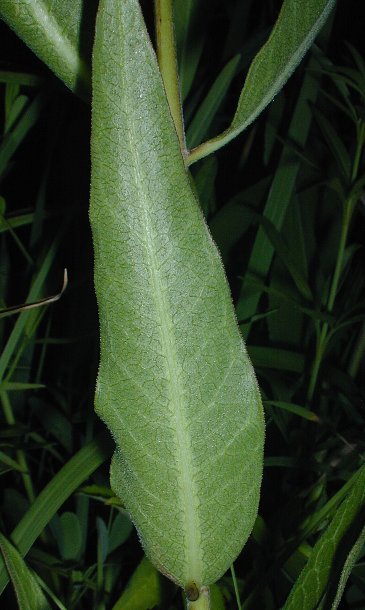
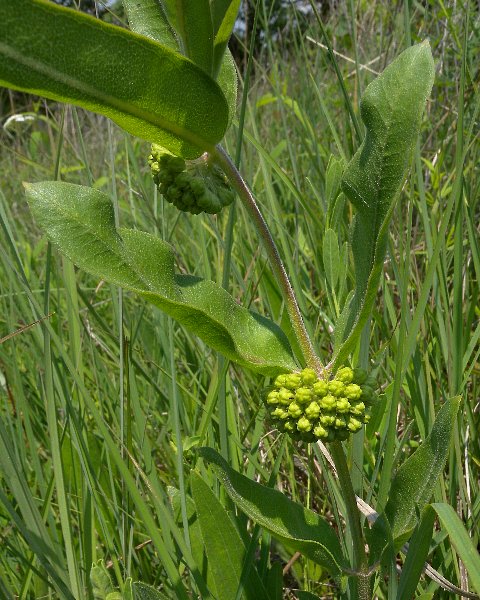
Description: This perennial plant is 1½–2' tall and unbranched. The central stem is light green to light purplish green and more or less pubescent. Several pairs of opposite leaves occur along the entire length of the stem; they are more or less ascending. The leaves are often folded upward along their margins, where they are often wavy (up and down). Individual leaves are up to 5" long and 1½" across; they are linear-lanceolate to lanceolate in shape and smooth (entire) along their margins. The upper leaf surface is medium green, while the lower leaf surface is light green; both surfaces are short-pubescent to nearly glabrous. The petioles are about 3 mm. (1/8") long, light green to light reddish green, and pubescent. The primary veins of the leaves are pinnate, while their secondary veins form a reticulated network that is visible on their undersides. From the axils of middle to upper leaves, there are nodding umbels of flowers spanning 1–1¾" across (only one umbel per pair of leaves). These umbels have short pubescent peduncles up to 6 mm. (¼") long. A typical plant will have 1-4 umbels; each umbel has 15-45 flowers on hairy pedicels about ½" long. Individual umbels are broadly obconic to half-globoid in shape and dome-shaped in front, rather than flat-headed.
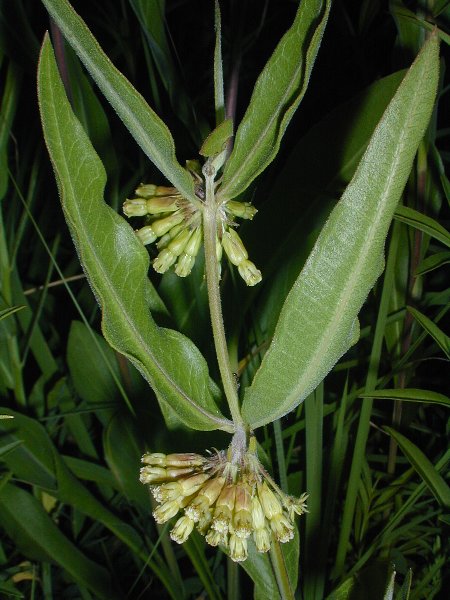
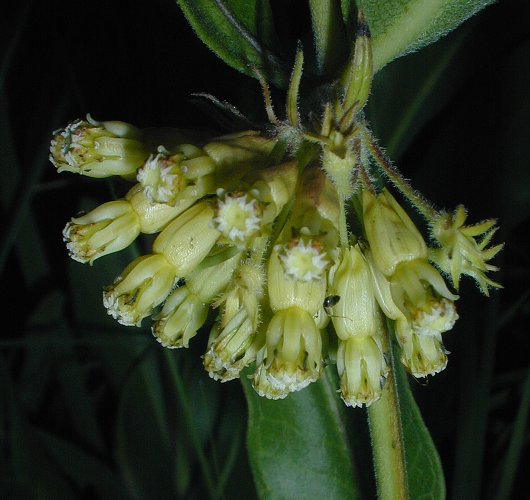
Each flower is about 8 mm. long and 3 mm. across, consisting of 5 erect hoods, 5 deflexed petals, 5 deflexed sepals, and the reproductive organs. The flowers are light green to green, becoming yellowish green or purplish green as they age. Individual hoods are lanceolate-oblong in shape; they are without horns. The hoods surround a central reproductive column on all sides; this column contains masses of winged pollinia (packets of pollen). The deflexed petals are lanceolate in shape; when the flower is fully open, they hide the shorter sepals. The sepals are linear-lanceolate in shape, light green to purplish green, and hairy. The blooming period occurs during early summer, lasting about 3 weeks. Afterwards, the flowers that have been cross-pollinated successfully (if any) are replaced by follicles (seedpods that open along one side). The follicles are up to 3½–5" long and ½–¾" across; they are narrowly lanceoloid and usually short-pubescent. During the autumn, these follicles split open to release their seeds. The seeds are dark brown, flattened-ovoid in shape, and winged along their margins. At their apices, the seeds have tufts of white hair; they are distributed by the wind. The root system consists of a central taproot. This plant usually occurs as scattered individuals, rarely forming colonies.
Cultivation:
The
preference is full sun and dry-mesic to dry conditions. This
plant will also
tolerate partial sun and mesic conditions. If anything,
poor soil
is preferred, containing gravelly or sandy material, as this
reduces competition from taller plants. However, rich loam is
tolerated if it is well-drained. After the blooming period and during
the development of
seedpods, this plant gradually deteriorates.
Range & Habitat:
The native Short Green Milkweed is widely distributed in Illinois, but
it is absent
from some eastern and central counties (see Distribution
Map).
In areas where it occurs, this plant is rare to occasional.
Habitats include openings in upland forests that are rocky or
sandy; upland black soil prairies, sand prairies, gravel
prairies, and hill prairies; barrens, limestone glades, and sand dunes;
and abandoned fields. Short Green Milkweed usually occurs in high
quality habitats, rather than degraded areas. Occasional wildfires are
probably beneficial by reducing competition from woody vegetation.
Faunal Associations: The nectar of the flowers attracts primarily bumblebees, which are the primary pollinators (Robertson, 1929). Ants are also attracted to the nectar, but they are not effective at cross-pollination. Some insects feed destructively on Short Green Milkweed and other milkweeds (Asclepias spp.). For example, larvae of a long-horned beetle, Tetraopes texanus (Texas Milkweed Beetle), bore through the stems of Short Green Milkweed, while caterpillars of a butterfly, Danaus plexippus (Monarch), occasionally feed on the leaves. Other insects that feed on milkweeds are listed in the Insect Table. Mammalian herbivores avoid consumption of the foliage because its milky latex contains toxic cardiac glycosides and it is bitter-tasting. Because caterpillars of the Monarch butterfly are able to sequester these toxic chemicals, the adults of this insect are usually avoided by birds.
Photographic
Location:
The photographs were taken at the Prospect Cemetery Prairie in Ford
County,
Illinois, and the Coneflower Hill Prairie in Shelby County, Illinois.
Comments:
This non-showy plant is unlikely to receive favor from the mass market
in horticulture, but it is nonetheless quite interesting to examine.
This milkweed species is rather variable across different localities;
there is a variety with narrow leaves that occurs in sandy areas near
Lake Michigan. Short Green Milkweed (Asclepias viridiflora)
can be
distinguished from many species of milkweeds by its nodding umbels of
greenish flowers. The
rare Mead's Milkweed (Asclepias meadii) has this
characteristic, but its flowers are more wide (about 6 mm.
across) and the
hoods of its flowers have horns. Another milkweed species, Tall Green
Milkweed (Asclepias hirtella), produces nodding
umbels of greenish
flowers, but its umbels are more fully globoid in shape, and
its leaves are usually more linear and narrow than those of Short Green
Milkweed.