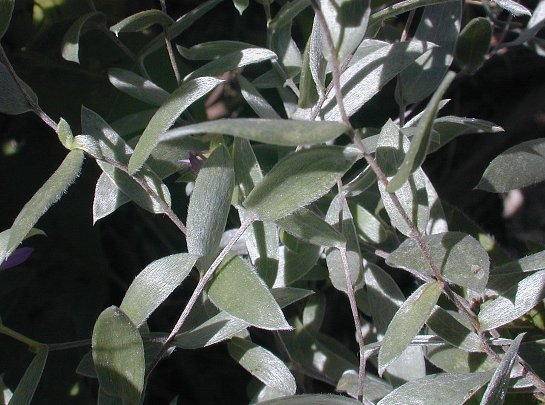
Description: This herbaceous perennial plant is ½–2' tall, producing one or more leafy stems that are erect, ascending, or sprawling. The wiry stems branch sparingly, and they are often curved, arching, or crooked. Young stems are whitish green to silver-colored and terete; they are moderately to densely covered with fine pubescence. Older stems are brown or purple and sparsely to moderately covered with fine pubescence. Alternate leaves occur along the entire length of each stem, becoming slightly smaller in size as they ascend. The leaves are ½–1¼" long and about 4-8 mm. across; they are oblong to elliptic in shape and entire (smooth) along their margins. The bases of leaves are sessile or clasp their stems slightly, while the tips of leaves are short-acute. Both the upper and lower surfaces of leaves are whitish green to silver-colored; they are moderately to densely covered with appressed fine pubescence. The upper stems terminate in one or more flowerheads. On a robust plant, this inflorescence resembles a little-branched open panicle up to ¾' long that has 6-18 flowerheads, otherwise the inflorescence consists of 1-2 short branches with 1-3 flowerheads at their tips or slightly below.
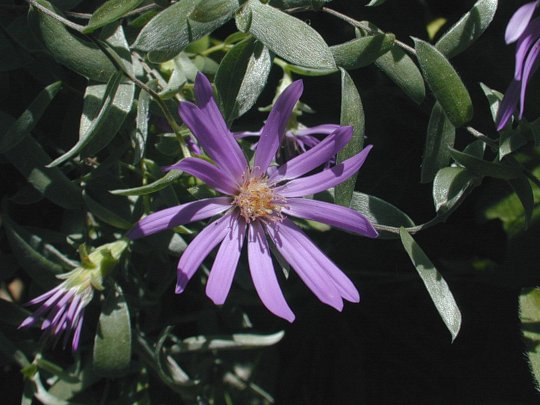
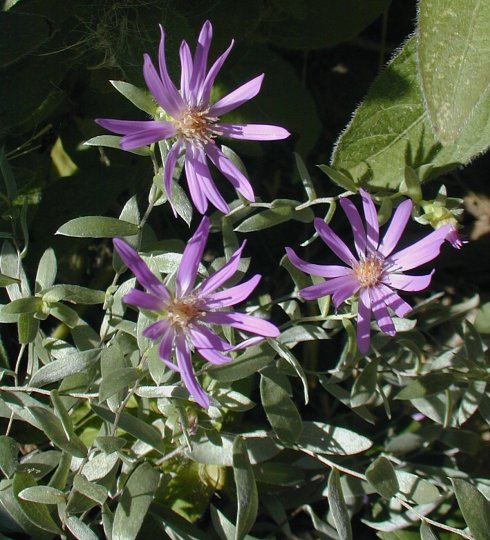
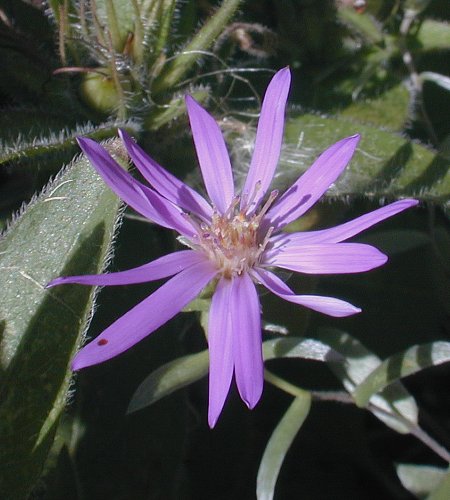
The wiry branches of the inflorescence are terete, whitish green to silver-colored, and moderately to densely covered with fine pubescence. Along the branches of larger inflorescences, there are leafy bracts that resemble the alternate leaves. The daisy-like flowerheads are about 1¼" across, consisting of 10-22 ray florets that surround numerous disk florets. The petaloid rays of the flowerheads are linear-oblong in shape, widely spreading, and lavender, deep lavender, or various shades of purple. The tiny corollas of the disk florets are tubular in shape with 5 lanceolate lobes along their upper rims; these lobes are erect to ascending. During the period of bloom, the corollas of the disk florets are white to pale pinkish purple; their anther tubes are yellow and their stigmas are lavender to purple. The blooming period occurs from late summer into autumn, lasting about 1 month for a colony of plants. Afterwards, the florets are replaced by achenes. These achenes are 2-3 mm. long and bullet-shaped with small tufts of hair at their apices; they are dispersed by the wind. The root system is fibrous and occasionally rhizomatous; older plants form short caudices. Occasionally, clonal offsets are produced from rhizomes.
Cultivation:
The preference is full sun and mesic to dry conditions. Almost any kind
of soil is satisfactory if the site is well-drained, but this plant
typically grows in poor soil that is rocky or sandy. A high pH is
tolerated. Overall, this plant develops more slowly than most perennial
asters (Symphyotrichum
spp.)
and it is a bit more difficult to grow. It doesn't tolerate much
competition from taller ground vegetation. While the
drought tolerance of mature plants is good, some of
the lower leaves will wither away and fall from the stems.
Range & Habitat:
The native Silky Aster occurs primarily in the northern tier of
counties and in many counties along the Illinois and Mississippi
Rivers (see Distribution
Map). It is an uncommon plant that appears to
be declining in abundance as a result of habitat destruction. These
habitats include upland dolomite prairies, gravel
prairies, sand prairies, hill prairies, stabilized sand dunes,
upland sandy savannas, limestone glades, and prairie remnants along
railroads. This is an indicator plant of high quality habitats in dry
open areas.
Faunal Associations: The nectar and pollen of the flowerheads attract bumblebees, leaf-cutting bees (Megachile spp.), green metallic bees (Agapostemon spp.), Syrphid flies, and small- to medium-sized butterflies, including the endangered Karner Blue (Lycaeides melissa samuelis); see Reed (1993) and Swengel & Swengel (2000). Syrphid flies are probably non-pollinating. A plant bug, Psallus astericola, feeds on Silky Aster (Knight, 1941). Other insects that feed of the foliage and other parts of asters (Symphyotrichum spp.) include leaf beetles, the larvae of leaf-mining flies, the larvae of gall flies, other plant bugs, aphids, the larvae of moths, the larvae of butterflies, and grasshoppers. Among mammals, the young foliage of these plants are browsed occasionally by rabbits, deer, groundhogs, cattle, horses, and sheep. However, Silky Aster may be an exception to this rule, as it was found to increase in abundance as a result of grazing (Brudvig et al., 2007). Among birds, the Wild Turkey also browses on the foliage of asters; this upland gamebird and the Tree Sparrow also eat their seeds (Martin et al., 1951/1961).
Photographic
Location:
The photographs were taken at the webmaster's wildflower garden in
Urbana, Illinois.
Comments:
This is a truly beautiful little plant with attractive foliage and
flowerheads. It's an excellent candidate as a wildflower in a sunny
rock garden. In Illinois, Silky Aster (Symphyotrichum sericeum)
can
be distinguished from all other asters (Symphyotrichum spp.)
within
the state by its exceptional foliage, which has a silvery or silky
appearance because of the numerous fine hairs covering its stems and
leaves. It also has larger flowerheads (often exceeding 1" across) than
most native or naturalized species of asters within the state. A
scientific synonym of this plant is Aster sericeus.