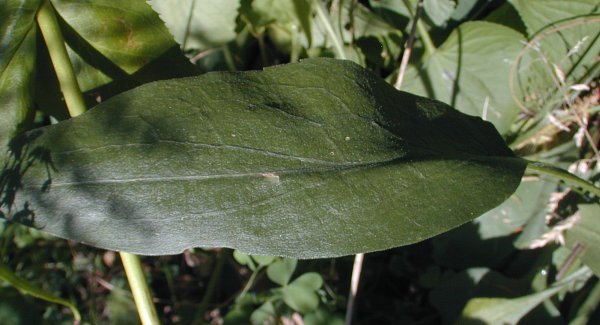
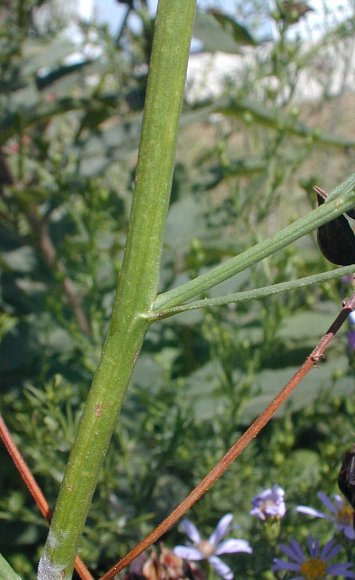
Description: This herbaceous perennial plant is 1½–3' tall and largely unbranched, except near the inflorescence. The central stem is light green, terete, and glabrous to sparsely short-hairy. Alternate leaves occur along the central stem, becoming shorter and more narrow as they ascend. The lower leaves are up to 3" long and 1½" across; they are narrowly oval to ovate in shape and smooth along their margins. The middle leaves are up to 2½" long and ¾" across; they are narrowly lanceolate to lanceolate in shape and smooth along their margins. The upper leaves are up to 1¼" long and ¼" across; they are linear-oblong in shape and smooth along their margins. The upper leaf surfaces are medium to dark green and glabrous or nearly so, while their lower surfaces are light green and glabrous to short-hairy along the major veins. The petioles of these leaves are up to 2" long, becoming shorter as they ascend the stem – however the upper leaves are sessile. The petioles are light green, concave above and convex below, and glabrous to slightly hairy. In addition to the deciduous alternate leaves, this plant also produces a loose tuft of semi-evergreen basal leaves. These basal leaves are similar in appearance to the lower alternate leaves, except they are more broad (oval to oval-cordate in shape) and their margins are sometimes crenate-serrate. The petioles of basal leaves are up to 3" long. The central stem terminates in a panicle of flowerheads that is ½–1½' long and about one-half as much across. When a plant is in bloom, it often leans to one side because of the weight of the inflorescence.
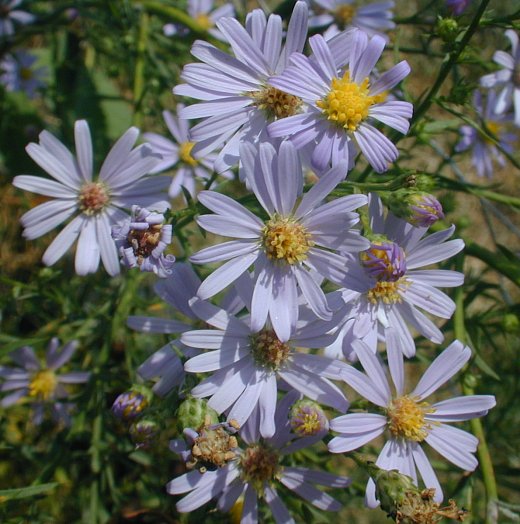
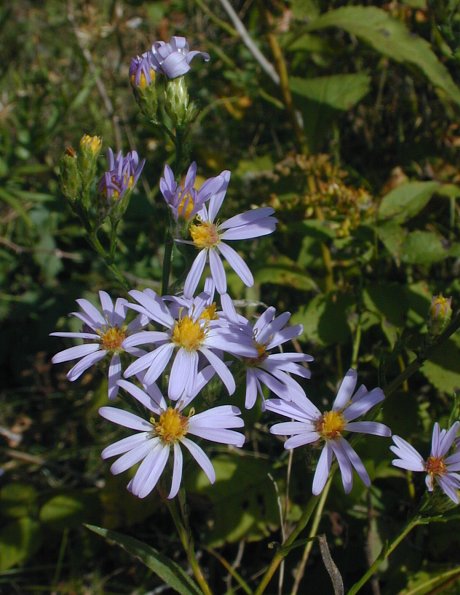
The panicle has a rachis (central stalk) and several ascending primary branches; these branches divide into secondary and tertiary branches that terminate in daisy-like flowerheads. The rachis and branches are light green and glabrous to sparsely short-hairy; scale-like to linear leafy bracts up to ¾" long occur at intervals along these branches. Each flowerhead is about ½" across or slightly larger, consisting of 10-25 ray florets that surround numerous disk florets. The petaloid rays are lavender or light blue (rarely white), linear-oblong in shape, slightly notched at their tips, and widely spreading. The tiny corollas of the disk florets are tubular in shape with 5 ascending to spreading lobes along their upper rims; these corollas are initially yellow, but they later become purplish red and finally brown. Surrounding the base of each flowerhead, there are scale-like bracts (phyllaries) that are arranged in 3-5 series that are appressed together or slightly spreading. These floral bracts are about 2 mm. long, lanceolate in shape, and mostly light green, except toward their tips, where there are dark green patches that are diamond-shaped. The blooming period occurs from late summer into autumn, lasting about 1 month for a colony of plants. Afterwards, the florets are replaced by small bullet-shaped achenes (about 2 mm. in length) that have small tufts of hair at their apices. These achenes are distributed by the wind. The root system is fibrous and rhizomatous; older plants may develop a short caudex.
Cultivation:
The preference is full or partial sun and mesic to dry conditions. This
plant is rather indifferent to soil characteristics – it can flourish
in soil that is loamy, sandy, rocky, or contains clay. This plant is
easy
to grow and drought resistant; the lower leaves are occasionally marred
by powdery mildew and other foliar diseases.
Range & Habitat:
The native Sky Blue Aster occurs occasionally in the northern and
western halves
of Illinois, but it is uncommon or absent elsewhere (see Distribution
Map).
Habitats include mesic to dry prairies, sand prairies, hill
prairies,
rocky upland woodlands, upland savannas, upland sandy savannas,
woodland borders, sandy meadows,
limestone glades, and roadside embankments. This plant is usually found
in higher quality natural areas where the original ground flora is
still intact. Occasional wildfires or other disturbance that reduce
competition from woody vegetation is beneficial in maintaining
populations of this plant.
Faunal Associations: For Sky Blue Aster, the nectar and pollen of the flowerheads attract bumblebees, digger bees (Melissodes spp.), leaf-cutting bees (Megachile spp.), Halictid bees (Agapostemon spp., Halictus spp., Lasioglossum spp.), Andrenid bees, Syrphid flies, bee flies (Bombyliidae), butterflies, skippers, miscellaneous beetles, and other insects (Reed, 1993). Bees that are specialist pollinators (oligoleges) of asters (Symphyotrichum spp.) and closely related composites include Andrena asteris, Andrena nubecula, Andrena simplex, Colletes simulans armatus, and Melissodes dentiventris. Other insects feed destructively on the leaves, flowerheads, and other parts of asters. These species include leaf beetles (adults & larvae), larvae of tumbling flower beetles (Mordellistena spp.), larvae of the Aster Leafminer Fly (Calycomyza humeralis), larvae of the Papery Blister Gall Midge (Asteromyia laeviana), larvae of fruit flies, plant bugs, the Goldenrod Lace Bug (Corythucha marmorata), aphids (especially Uroleucon spp.), the Aster Leafhopper (Macrosteles fascifrons), mealybugs, Blatchley's Walkingstick (Manomera blatchleyi), and grasshoppers (see the Insect Table for a listing of these and other species). In addition, larvae of the butterflies Silvery Checkerspot (Chlosyne nycteis) and Pearl Crescent (Phyciodes tharos) feed on asters, as do larvae of the Aster Borer Moth (Carmenta corni), The Asteroid (Cucullia asteroides), and many other moths (see Moth Table). Among birds, the Ruffed Grouse and Wild Turkey browse on the leaves and seeds of asters; the Tree Sparrow also eats the seeds during the winter. Among mammals, the Cottontail Rabbit and White-Tailed Deer browse on the foliage, while the White-footed Mouse eats the seeds (Martin et al., 1951/1961). Groundhogs, cattle, horses, and other livestock also browse on the foliage, especially when it is young and tender.
Photographic
Location:
The photographs were taken at the webmaster's wildflower garden in
Urbana, Illinois.
Comments:
For the size of the plant, the inflorescence of Sky Blue Aster (Symphyotrichum oolentangiense)
is
rather large and showy. This species of aster closely resembles Short's
Aster (Symphyotrichum
shortii), even though the latter species is a woodland aster.
However, the upper leaves of Short's Aster are often narrowly cordate,
rather than narrowly lanceolate or linear, and its flowerheads are
slightly
larger in size. Another similar species, Smooth Blue Aster (Symphyotrichum
laeve), has alternate leaves that are all sessile, while Sky
Blue Aster has lower to middle leaves with petioles. Other asters (Symphyotrichum spp.)
have
hairier foliage, or their leaves are narrow throughout, or they have
more cordate leaves, or their alternate leaves have toothed margins.
Older
scientific names for Sky Blue Aster include Aster azureus
and Aster
oolentangiensis, while another common name for this
species is Azure Aster.