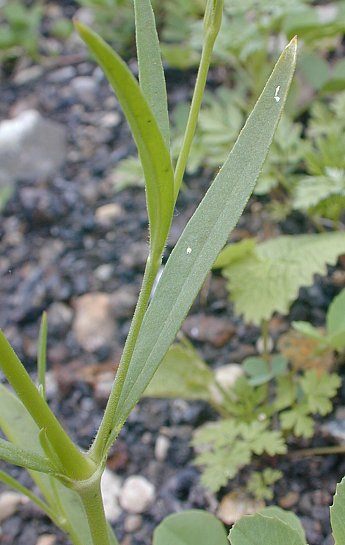
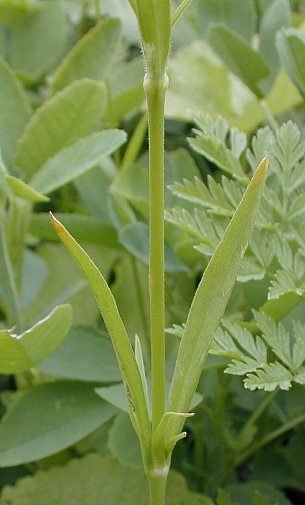
Description: This annual plant is about ½–1½' tall. It has stems that are unbranched or sparingly branched below, becoming more branched above; they are ascending to erect. The stems are light green, terete, slender, and glabrous to minutely pubescent. In addition, there are usually sticky patches along the stems between adjacent pairs of leaves; these sticky patches are often discolored and they may have dead insects, spider webs, and other debris clinging to them. The nodes of the stems, where pairs of leaves occur, are somewhat swollen and enveloped by short sheaths with membranous upper margins. Opposite leaves are sparsely distributed along the entire length of each stem, where they are sessile. These leaves are up to 2" long and 10 mm. across, although they are usually about one-half that size. The leaves are linear-lanceolate or linear-elliptic in shape, while their margins are entire (toothless) and minutely ciliate. The upper and lower surfaces of leaves are light green or light-medium green; they are glabrous to sparsely and minutely pubescent, except at their bases, where some white hairs occur. The leaves usually have conspicuous central veins, along which they are either flat or angled slightly upward. The upper stems terminate in small clusters of flowers (one floral cluster per stem); each floral cluster has relatively few flowers (typically only 2-4). The pedicels are up to 12 mm. (½" long), light green, terete, and slender.
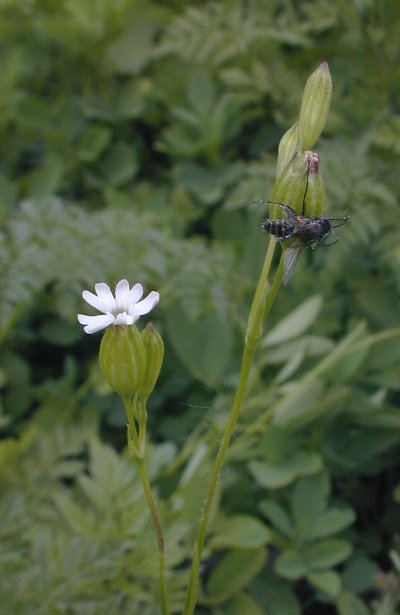
Each flower is about 4-5 mm. across, consisting of an open-ovoid calyx with 6 teeth, 5 small petals, 10 stamens, and a pistil with 3 styles. The petals are usually white, although sometimes they are pink or purple to a greater or lesser degree. Some plants produce bicolored petals that are white above and purple below, while other plants produce flowers that lack petals. These petals are obovate in shape and notched at their tips. A mature calyx is about 6-9 mm. long and about one-half as much across. Each calyx has 10 longitudinal ribs that are slightly elevated, angular-convex, and relatively thick; they are separated by narrow shallow furrows. The ribs of the calyx are often a slightly darker shade of green than the furrows; the calyx overall is light-medium green, glabrous, and sticky. The blooming period occurs from late spring to mid-summer, lasting about 1 month for a colony of plants. However, some plants may bloom later in the year in response to disturbance. The flowers are diurnal, opening up in response to bright sunlight. There is no noticeable floral scent. Mature seeds are less than 1 mm. in length, reniform (kidney-shaped), minutely bumpy across their surfaces, and black; they are distributed to some extent by the wind. The root system consists of a branching taproot. Reproduction is entirely by seeds.
Cultivation:
The preference is full sun and rather dry conditions. Poor
gravelly, cindery, or sandy soil is preferred, as this reduces
competition from other plants. In open situations with exposed topsoil,
this plant can reseed itself readily, becoming rather weedy.
Range & Habitat:
Sleepy Catchfly occurs in most counties of Illinois, where
it is widely distributed and native (see Distribution
Map).
Depending on the area, this plant is occasional to common. Habitats
include gravel prairies, hill prairies, dry sand prairies, rocky
glades, thinly wooded bluffs, pastures in upland areas, abandoned
fields, areas along railroads, and roadsides. Sleepy Catchfly is
more common in habitats that have been subjected to occasional
wildfires, or that have been disturbed by human activities.
Faunal
Associations:
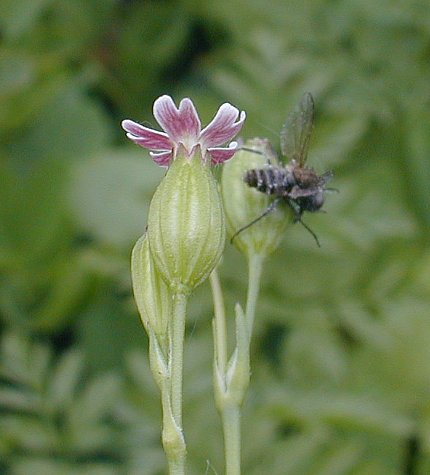
Primarily flies and small bees visit the flowers for nectar or pollen.
Flies and other small insects can become stuck on the sticky surface of
the calyx, while ants
can become stuck on the sticky patches of stems. Sleepy
Catchfly is not able to absorb nutrients from these trapped insects,
however, in the manner of a carnivorous plant. An aphid, Aphis sambuci
(Elder Aphid), uses Silene
spp. as summer host plants, feeding on the sap of their
roots. There are also two tortoise beetles, Cassida flaveola
(Pale Tortoise Beetle) and Cassida
azurea (Neon Tortoise Beetle), that have been introduced
into North America to control such Eurasian weeds as Silene vulgaris
(Bladder Campion) and Silene
pratensis (White Campion). It is possible that these
tortoise beetles may feed on some native Silene spp. in open
weedy areas,
although this has not been demonstrated for Sleepy Catchfly.
Photographic Location:
The photographs were taken near an abandoned railroad in Urbana,
Illinois, on black cindery ground.
Comments: Sleepy Catchfly is a highly variable plant that is easily overlooked, except where it occurs in substantial colonies and happens to be in bloom. The plant in the photographs is a form of Sleepy Catchfly with bicolored flowers, Silene antirrhina bicolor, which is supposed to be uncommon. Plants that produce flowers without petals are referred to as Silene antirrhina apetala, while plants without sticky patches on their stems are referred to as Silene antirrhina deaneana; see Mohlenbrock (2001) for a short discussion of these forms. Prior to flowering, Sleepy Catchfly resembles some species of chickweed (Stellaria spp.) with grass-like leaves. However, Sleepy Catchfly can be distinguished from these species by the sticky patches on its stems. In addition, the flowers of Sleepy Catchfly differ from those of chickweeds by having larger bladder-shaped calyces, as described above. There are also non-native Silene spp. that resemble Sleepy Catchfly to some extent (e.g., Silene conica, Silene dichotoma, and Silene gallica). These species also lack sticky patches on their stems, and their flowers can differ in such characteristics as the number of styles, the number of stamens, the number of ribs or veins along the sides of their calyces, the number of teeth along the upper rims of their calyces, and the presence of hairs or bristles along the sides of their calyces.