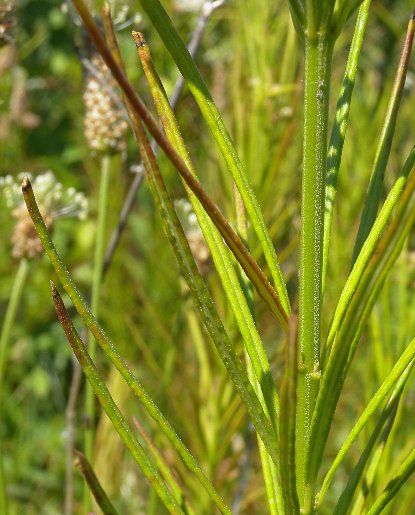
Description: This perennial herbaceous plant is ½–2' tall and more or less erect; it is either unbranched or sparingly branched along the upper half of its central stem. The central stem is yellowish green or medium green and terete; it has vertical lines of short pubescence. Whorls of 4-6 leaves occur along the nodes of the central stem; because the internodes of this stem are fairly short, these leaves are produced in abundance. Relative to the orientation of the central stem, the leaves are usually ascending, although sometimes they are widely spreading or drooping. The leaves are 2-3" long, 2-3 mm. across, and linear in shape; their margins are entire (toothless) and strongly revolute (rolled downward). Sometimes whorls of smaller secondary leaves are produced from short lateral stems that develop from the axils of leaves along the central stem. The upper leaf surfaces are yellowish green or medium green and glabrous to sparsely short-pubescent; they are narrowly grooved along the middle where the midribs occur. The lower leaf surfaces are whitish green and short-pubescent; they are partially obscured by the rolled leaf margins. The leaves are sessile or they have very short petioles (less than 2 mm. long). From the axils of middle to upper leaves, umbels of flowers are produced on short peduncles (flowering stalks); there can be 1-4 umbels of flowers at each node. Individual umbels span ¾–1½" across, consisting of 7-20 pedicellate flowers.
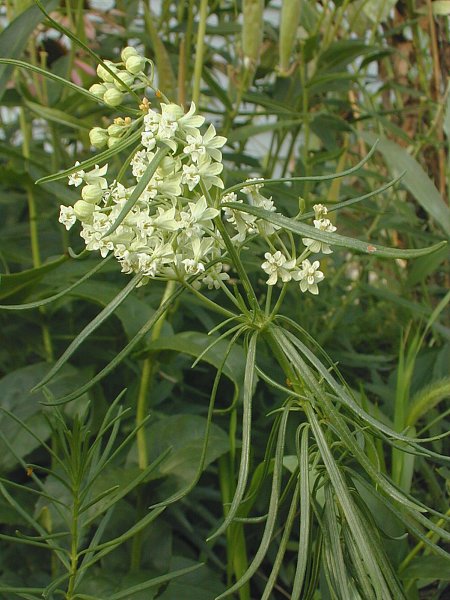
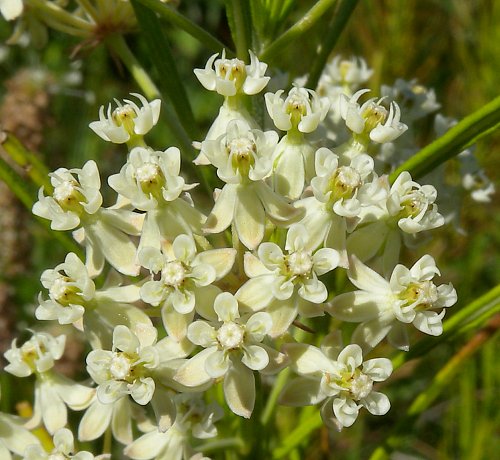
Each flower is about 5-6 mm. across and 8-10 mm. long, consisting of 5 sepals, 5 petals, 5 hoods with horns, and a central reproductive column. The sepals are light green, short-pubescent, and lanceolate in shape; sometimes they are tinted purple toward their tips. These sepals are visible at the bases of flower buds, but they are hidden by the petals when the flowers bloom. The petals are white or greenish white, sometimes with pale purplish tints toward their tips; they are oblong-elliptic in shape and strongly declined (bent downward), curving slightly upward toward their tips. The erect white hoods are open-tubular in shape and somewhat oblique, their lower sides facing the center of the flower. The slender white horns are sickle-shaped and inwardly curved; there is one exserted horn per hood. The short reproductive column is white at its apex and light green below. The slender pedicels of the flowers are light green to nearly white, sometimes becoming purplish at their bases; they are 8-12 mm. long, terete, and short-pubescent. The peduncles are ½–1½" long, light to medium green, glabrous to short-pubescent, terete, and ascending. The blooming period occurs from early to late summer, lasting about 1-2 months. There is little or no floral scent. Afterwards, successfully cross-pollinated flowers are replaced by ascending to erect follicles (seedpods that open along one side). These follicles are 3-4" long and about ½" across; they are narrowly lanceoloid in shape and fairly smooth (lacking warts or soft prickles). At maturity during autumn or winter, these follicles split open to release their seeds to the wind. Mature seeds are about 4-5 mm. long, ovate-flattened in shape, brown, and narrowly winged along their margins; their apices have large tufts of white hair. The root system is fleshy-fibrous and long-rhizomatous. Colonies of clonal plants are often produced from the rhizomes.

Cultivation:
The preference is full sun, mesic to dry conditions, and soil
containing loam, clay-loam, sand, or gravel. Infertile soil is actually
preferred because it reduces competition from taller plants. During hot
dry weather, the lower leaves may turn yellow and fall off, or the
foliage of the entire plant may become yellowish green. In open sunny
areas with exposed soil, this plant can spread aggressively.
Range & Habitat:
The native Whorled Milkweed occurs occasionally throughout most of
Illinois, except for a few southern counties (see Distribution
Map), where it is rare or absent.
Habitats include upland prairies, sand prairies, gravel prairies, hill
prairies, openings in rocky upland forests, sandy savannas, limestone
glades, rocky bluffs along major rivers, bluegrass meadows, pastures
and abandoned fields, grassy slopes along highways, and waste
areas. Whorled Milkweed is a pioneer species that prefers open
disturbed areas.
Faunal Associations: The nectar of the flowers attracts many kinds of insects, including honeybees, bumblebees, Halictid bees (Halictus spp., Lasioglossum spp.), Halictid cuckoo bees (Sphecodes spp.), sand-loving wasps (Tachytes spp.), weevil wasps (Cerceris spp.), Sphecid wasps (Sphex spp., Prionyx spp.), Five-banded Tiphiid Wasp (Myzinum quinquecinctum), Northern Paper Wasp (Polites fuscatus), spider wasps (Anoplius spp.), Eumenine wasps (Euodynerus spp., etc.), Syrphid flies, thick-headed flies (Physocephala spp., etc.), Tachinid flies, flesh flies (Sarcophagidae), Muscid flies, Painted Lady (Vanessa cardui) and other butterflies, Peck's Skipper (Polites peckius) and other skippers, Squash Vine Borer Moth (Melittia cucurbitae) and other moths, and Pennsylvania Soldier Beetle (Chauliognathus pennsylvanicus); sources of information include Robertson (1929) and personal observations. Among these floral visitors, bees and wasps are usually more effective at cross-pollination. Some insects feed destructively on the foliage, flowers, seedpods, and other parts of Whorled Milkweed. These species include the Small Milkweed Bug (Lygaeus kalmii), Milkweed Leaf Beetle (Labidomera clivicollis), Yellow Milkweed Aphid (Aphis nerii), and a moth, the Delicate Cycnia (Cycnia tenera). Although this insect does not occur in Illinois, in the southwestern United States, the Horsetail Milkweed Longhorn (Tetraopes discoideus) feeds on Whorled Milkweed and closely related milkweed species (Asclepias spp.); sources of information include Betz et al. (1997), Yanega (1996), and personal observations. Mammalian herbivores usually avoid the foliage of Whorled Milkweed as a food source because it is one of the more toxic milkweed species.
Photographic
Location:
Photographs were taken at the webmaster's wildflower garden in Urbana,
Illinois, and a bluegrass meadow near Parkland College in Champaign,
Illinois.
Comments:
This small milkweed blooms later in the year than most milkweed species
(Asclepias spp.),
and its small umbels of flowers attract many kinds of insects,
including butterflies. Whorled Milkweed (Asclepias verticillata)
superficially resembles the common Field Horsetail (Equisetum arvense)
because of its whorled linear leaves. It can be distinguished from this
latter species by the milky latex of its foliage and the later
development of its flowers and seedpods. Field Horsetail is a
spore-bearing plant that lacks true flowers. Whorled Milkweed is
readily distinguished from other milkweed species in Illinois by its
more narrow leaves (only 2-3 mm. across). Narrow-leaved
Milkweed (Asclepias
stenophylla)
is an exception, because its linear leaves are almost as narrow.
However, this latter species has leaves that are alternate to nearly
opposite along its stems, rather than whorled. So far, it has been
found in only a few counties of western Illinois.