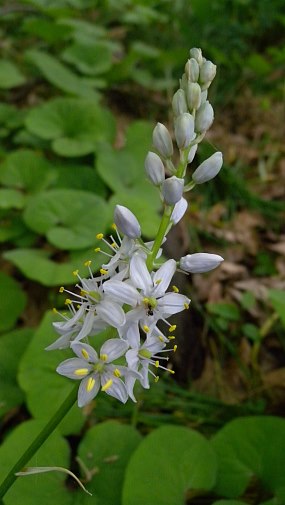
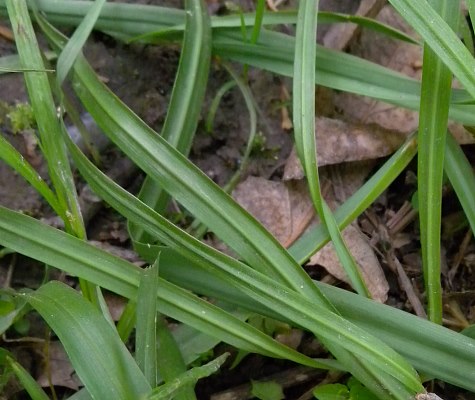
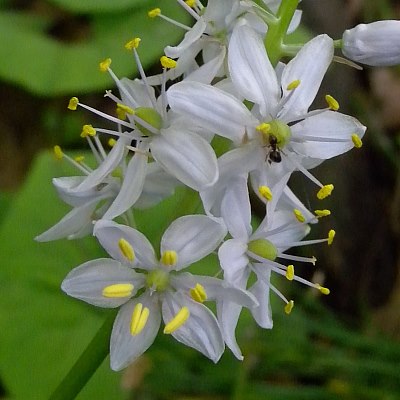
Description: This perennial wildflower consists of a low rosette of basal leaves up to 1½' across and a flowering stalk about 1½–2' tall. The floppy basal leaves are 6-12" long and 1/3" (8 mm.) across; they are medium to dark green, linear in shape, parallel-veined, glabrous, and smooth along their margins. Along the underside of each basal leaf, there is a prominent mid-rib. The erect central stalk is slender, light to medium green, and glabrous; it terminates in a spike-like raceme of flowers that is several inches in length. Underneath the floral spike, there are usually 1-3 bracts along the stalk. These bracts are green, linear to linear-lanceolate in shape, and up to ¾" long. Each flower is ¾–1" across, consisting of 6 tepals, 6 stamens with bright yellow anthers, and a green central ovary with a slender style. The tepals are light blue-violet to nearly white; they are oblong in shape and spread widely from the center of the flower. Each tepal (petal or petal-like sepal) has 1-3 poorly defined veins along its length.
At the
base of each flower, there is a single linear bract up to ¾" long that
is early-deciduous. The slender pedicel of each flower is about the
same length as the bract. The flowers begin to bloom from the bottom of
the raceme and continue to bloom upward toward the apex; each flower
lasts only 2-3 days. The blooming period occurs from mid- to late
spring and lasts about 2-3 weeks. Each fertilized flower is replaced by
a 3-celled seed capsule that is about 1/3" in length and nearly as much
across. Each seed capsule contains many small seeds that are black and
shiny. The basal leaves turn yellow and wither away by mid-summer. The
root system consists of a bulb with fibrous roots. This wildflower
reproduces by reseeding itself.
Cultivation:
The preference is full sun to light shade, moist conditions, and rich
loamy soil. Wild Hyacinth is slow to develop, but fairly long-lived.
Vegetative growth and development occurs during the cool weather of
spring, when adequate moisture is essential.
Range & Habitat:
Wild Hyacinth is found occasionally throughout Illinois (see Distribution
Map), where it is native. Habitats include moist black soil
prairies, moist
savannas, moist open woodlands (particularly along the banks of
streams), rocky wooded slopes, and limestone glades. This species is
typically found in high quality habitats, whether prairies or woodlands.
Faunal
Associations:
The flowers attract their fair share of insects, including many bees
and flies, and occasional butterflies and wasps. Most of these insects
seek nectar from the flowers, although some short-tongued bees also
collect pollen. Bee visitors include honeybees, bumblebees, Cuckoo bees
(Nomada spp.),
and Halictid bees (Halictus
spp., Lasioglossum
spp.,
etc.). Other floral-faunal relationships are poorly understood.
White-Tailed Deer occasionally chomp off the tops of the basal leaves.
Both the foliage and bulbs are not known to be toxic to mammalian
herbivores.
Photographic Location:
Along a woodland stream in Douglas or Coles County in east-central
Illinois.
Comments: Wild Hyacinth has attractive flowers that are conspicuous during the spring. It is usually found in woodland habitats, but also occurs in prairies. Wild Hyacinth differs from the less common Camassia angusta (Prairie Hyacinth) in several ways, among them: 1) It has slightly larger flowers than the latter, 2) its flowers are usually a slightly lighter shade of blue-violet, 3) its seed capsules are about as broad as long, while Prairie Hyacinth has seed capsules that are slightly longer than broad, 4) the bracts of its flowering stalk are less persistent than those of Prairie Hyacinth, and 5) it blooms earlier in the spring.