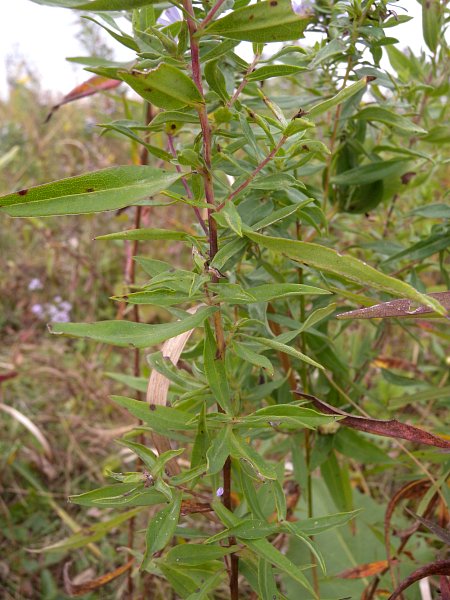
Description: This herbaceous perennial plant is 2-5' tall, branching occasionally. The larger stems are occasionally reddish, and they have lines of white hairs. The alternate leaves are up to 5½" long and ¾" across, becoming smaller and narrower as they ascend up the stems. The leaves are lanceolate, narrowly ovate, or linear in shape with toothless margins; they are short-petioled or sessile. Above, the leaves are light to medium green, while below the leaves are whitish green with a reticulate network of fine veins; the latter is quite conspicuous.
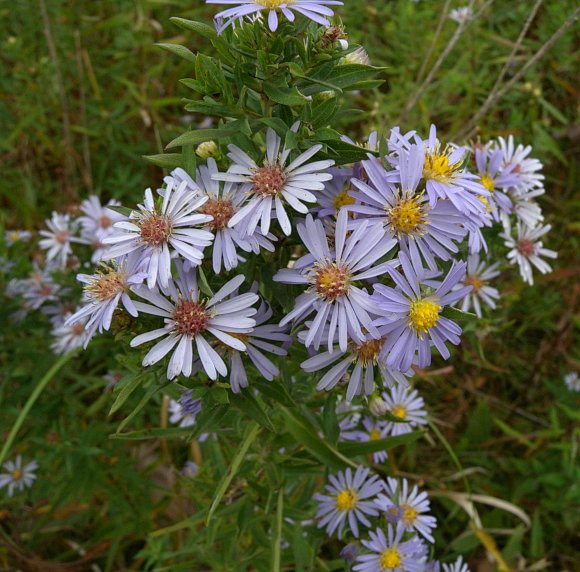
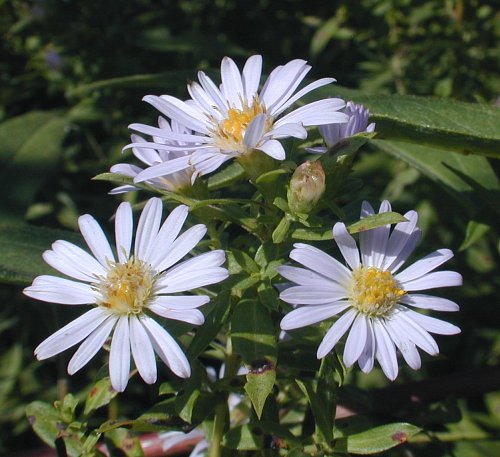
The inflorescence is large and pyramidal, containing abundant leafy bracts and numerous daisy-like composite flowers about ½–¾" across. Each flower has 20-30 has lavender (less often white) ray florets surrounding numerous yellow disk florets that eventually become reddish purple. The blooming period occurs from early to mid-fall, and lasts about a month. There is no noticeable floral scent. The achenes develop with small tufts of hair, and are dispersed by the wind. The root system is fibrous and rhizomatous. The Willow Aster often spreads vegetatively to form small to large colonies.
Cultivation:
The preference is full sun, moist conditions, and fertile loamy soil.
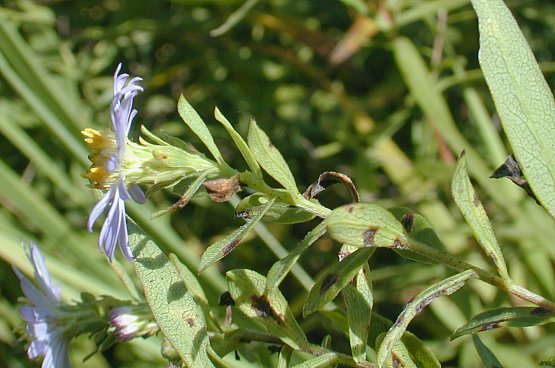
Foliar disease occurs occasionally, which may involve some yellowing of
the leaves and the formation of black spots. This affects primarily the
older leaves near the base of the plant, otherwise the foliage remains
attractive. Some standing water is tolerated if it is temporary.
Range &
Habitat:
The native Willow Aster is widely distributed, and it occurs in most
counties of
Illinois (see Distribution
Map). This plant is occasional to locally common. Habitats
include
moist black soil prairies, moist sand prairies, moist meadows along
rivers and lakes, prairie swales, typical thickets and sandy thickets,
roadside ditches, moist areas of abandoned fields, and other poorly
drained
areas.
Faunal Associations: Many kinds of insects visit the flowers, including long-tongued bees, short-tongued bees, flies, butterflies, and skippers. Among the bees, this includes such visitors as honeybees, bumblebees, Halictine bees, and some Andrenid bees that fly late in the season. Some Syrphid flies and beetles may feed on the pollen, otherwise these insects seek nectar; bees also collect pollen for their larvae. The caterpillars of the butterflies Chlosyne nycteis (Silvery Checkerspot) Phyciodes tharos (Pearl Crescent) feed on the foliage, as well as the caterpillars of several species of moths (see Moth Table). Various insects suck the juices from this and other asters, including plant bugs, leafhoppers, mealybugs, and aphids. The Wild Turkey eats the foliage and seeds to a limited extent. Deer browse on this plant occasionally, while rabbits nibble on the foliage of immature plants.
Photographic
Location:
The photographs were taken at Loda Cemetery Prairie in Iroquois County,
Illinois.
Comments:
This is another attractive aster for autumn bloom, producing abundant
flowers. The Willow Aster can be distinguished from other asters (Symphyotrichum spp.)
by the
conspicuous reticulated pattern on the lower surface of its leaves. In
addition, the stalks of the flowerheads are covered with relatively
large leafy bracts. Unlike many woodland
asters, the leaves of Willow Aster are always narrow and willow-like,
even at the base of the plant, and they lack toothed edges. The
rays of the flowerheads are usually lavender, although sometimes they
are white. Local ecotypes of this aster are somewhat variable in regard
to the width of the leaves.