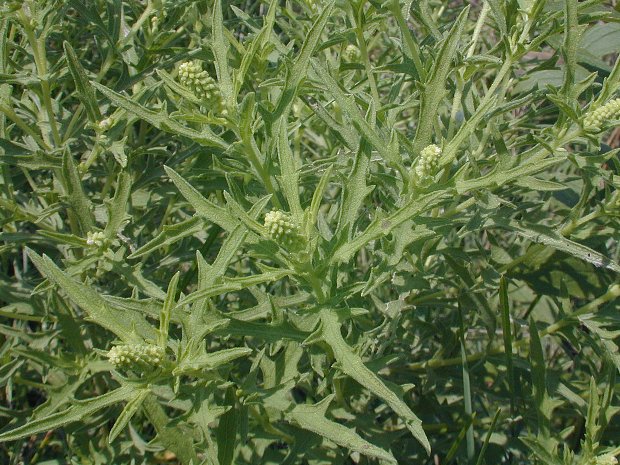
Description: This perennial plant is usually 1-2' tall, but sometimes it becomes considerably higher; this plant often branches in the upper half. The stems are are pale green, terete, and pubescent-hairy; they have vertical lines of fine hairs. Both alternate and opposite leaves occur along the length of the central stem. The leaves are up to 5" long and 2" across; they are lanceolate in outline, but their structure is primarily simple-pinnate (although some leaves may be double-pinnate with secondary lobes that are few in number and small in size). The primary lobes are narrowly lanceolate or lanceolate in shape and shallow to moderately deep, tapering to blunt narrow tips; the sinuses between the lobes are either flat or concave. Depending on the local ecotype, these lobes are widely spaced along the leaf margins, or they are more abundant and crowded. The leaf margins are toothless or nearly so, and they are either flat or somewhat elevated. Both the upper and lower leaf surfaces are grayish green or whitish green and more or less covered with short fine pubescence.
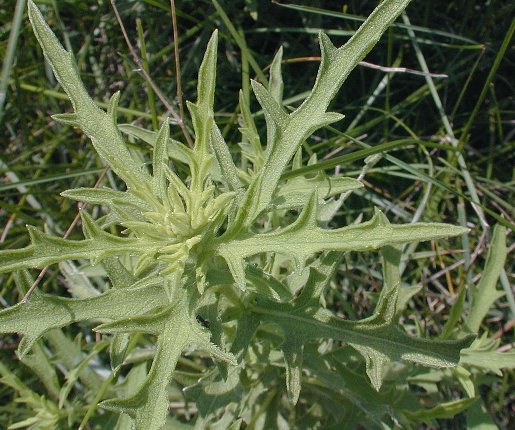
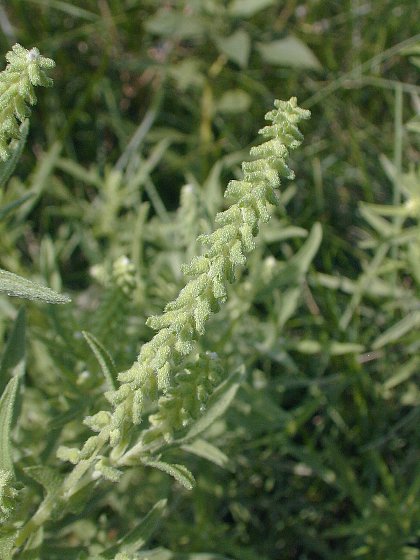
Western Ragweed (Ambrosia psilostachya) is monoecious, producing spike-like racemes of staminate (male) florets from the upper stems, while cyme-like clusters of pistillate (female) florets are produced below. The staminate racemes are 1-4" in length (becoming longer as they mature), cylindrical in outline, and whitish to yellowish green. The staminate flowerheads are produced along the entire length of their racemes, facing in all directions. Each staminate flowerhead spans 2-5 mm. across, becoming short-campanulate (short bell-shaped) during the blooming period. Each staminate flowerhead has 3-5 phyllaries (floral bracts) that are broadly ovate and pubescent; they are arranged in a single series and joined together along their lower halves. The interior of each staminate flowerhead has 4 or more staminate florets; these florets have stamens with yellow anthers. The peduncles of staminate flowerheads are 1-4 mm. long and pubescent; these flowerheads often droop from their short peduncles. Underneath a cluster of pistillate flowerheads there is a leafy outer bract up to 1¼" long. In addition, pairs of smaller outer bracts are located immediately below individual pistillate flowerheads. Each pistillate flowerhead has a cup-shaped involucre about 8 mm. long and 3 mm. across that has several tooth-like projections; this involucre consists of fused phyllaries (floral bracts) and it is pubescent. The interior of this flowerhead contains a single pistillate floret. The blooming period can occur from mid-summer to autumn, lasting about 1-3 weeks for a colony of plants. The florets are cross-pollinated by the wind. Afterwards, the pistillate florets are replaced by achenes. Mature achenes are 2.5–4 mm. long, dark brown, and obovoid in shape; each achene usually has a short beak at its apex and about 4 tiny tubercles around the edge of its upper margin. The root system is fibrous and rhizomatous. This plant often forms clonal colonies of varying size from its rhizomes.
Cultivation:
The preference is full sun, mesic to dry conditions, and poor soil.
Although this plant can grow perfectly well in moist fertile soil, in
Illinois it is usually found on drier soil that contains significant
amounts of clay, sand, or gravelly material, as this reduces
competition from other ground vegetation. This plant is easy to grow,
but it can become aggressive in situations that are well-drained and
sunny. It doesn't appear to be bothered much by foliar disease.
Range & Habitat:
Western Ragweed occurs occasionally in northern and western Illinois,
while in the rest of the state it is uncommon or absent (see Distribution
Map).
It is unclear if this plant is adventive from the west, or native to
Illinois. Habitats include upland areas of prairies, old cemeteries,
areas along railroads, roadsides, abandoned fields, pastures, and
barren waste areas. Western Ragweed is more common in disturbed areas,
especially if the soil contains clay, sand, or gravel. Sometimes this
plant is used in prairie restorations, or it shows up unexpectedly in
prairie restorations as a result of contaminated seed.
Faunal Associations:
The flowers are wind-pollinated and rarely attract pollen- or
nectar-seeking insects. Larvae of the Ambrosia Seed Moth (Exaeretia gracilis), Common Pinkband (Ogdoconta cinereola),
Ragweed Flower Moth (Schinia
rivulosa), and other moths feed on ragweeds (Ambrosia
spp.); see the Moth Table) for a listing of these
species. Such grasshoppers as the Little Pasture Grasshopper (Melanoplus confusus),
Red-legged Grasshopper (Melanoplus
femurrubrum), and Migratory Grasshopper (Melanoplus sanguinipes)
feed on the foliage of Western Ragweed (see Grasshopper
Table).
These grasshoppers are an important source of food to
some insectivorous songbirds and upland gamebirds. Other insects
that feed on Western Ragweed include the Brown Ambrosia Aphid (Uroleucon ambrosiae),
the stink bugs Chlorochroa
persimilis and Chlorochroa
uhleri, and such leaf beetles as Exema dispar, Microrhopala xerene,
and Zygogramma suturalis.
Like Common Ragweed (Ambrosia artemisiifolia), the
seeds of Western Ragweed are a popular source of food for many kinds of
granivorous songbirds and upland gamebirds (see Bird Table).
The seeds are nutritious and remain available through the winter
months. Some rodents eat the seeds, including the Thirteen-Lined Ground
Squirrel (Martin et al., 1951/1961). Mammalian herbivores eat the
bitter foliage
of this and other ragweeds to a limited extent.
Photographic
Location:
Photographs were taken at the Windsor Road Prairie in Champaign,
Illinois.
Comments:
Like other ragweeds, the airborne pollen of Western Ragweed (Ambrosia psilostachya)
can cause allergic reactions in people during the late summer and fall.
This plant has high ecological value to birds, grasshoppers, and other
insects. Across its range, there is some variability in the pubescence
of its foliage, and in the number and shape of the primary lobes
of its leaves. Western Ragweed resembles Common Ragweed (Ambrosia artemisiifolia)
to some extent. However, the leaves of Western Ragweed are usually
simple-pinnate, while the leaves of Common Ragweed are
double-pinnate and more deeply lobed. Plants that display mixed
characteristics may be hybrids of these two species.