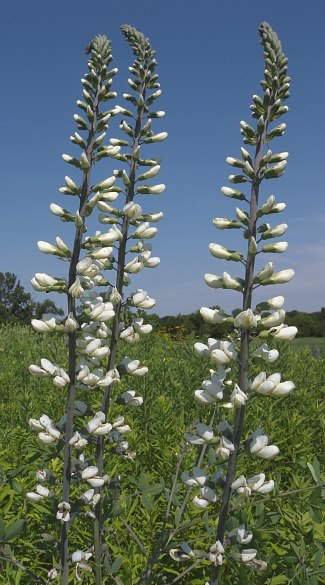
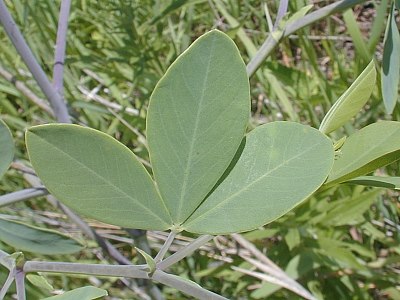
Description: This herbaceous perennial plant is about 3-6' tall and forms an erect, sparsely branched bush, although it is herbaceous. The stout central stem and upper side stems are smooth, light green or reddish purple, and glaucous. The compound leaves are trifoliate. They are usually greyish green or blue green, and hairless. Each leaflet is ovate or oblanceolate and pointed at both ends, with smooth margins, and about 2" long and ¾" across. The white flowers occur in erect spike-like racemes up to 2' long and are quite showy. They are typical pea flowers in overall structure, and about 1" long. There is no floral scent. The blooming period occurs from late spring to mid-summer and lasts about 1-1½ months. The flowers are replaced by large oblong seedpods, which are also rather showy. They are about 2" long and initially green, but later turn black. There is a stout deep taproot, and rhizomes that may form vegetative offsets. Once established, White Wild Indigo grows very quickly during the spring – it often towers above the surrounding plants by blooming time.
Cultivation:
The preference is full sun and moist to slightly dry soil. The soil can
contain significant amounts of loam, clay, gravelly material, or sand.
This plant is not fussy about growing conditions, and is easy to grow.
However, it dislikes alkaline soil and may fail to bloom in shady
conditions. Like other wild indigos, this plant may take several years
to reach blooming size, but it is long-lived. The roots increase
nitrogen levels in the soil.
Range & Habitat:
The native White Wild Indigo is widely distributed and occurs in almost
every
county of Illinois, but it is usually uncommon (see Distribution
Map). In a few areas that are scattered around the state,
this plant is locally common. Some local populations may be escaped
cultivated plants, or the result of restoration efforts. Habitats
include moist to dry black soil prairies, sand prairies, thickets,
edges of marshes and sandy marshes, borders of lakes, limestone glades,
and dry clay hills. White Wild Indigo is typically found in less
disturbed habitats, partly because of limited seed dispersion.
Occasional wildfires are readily tolerated.
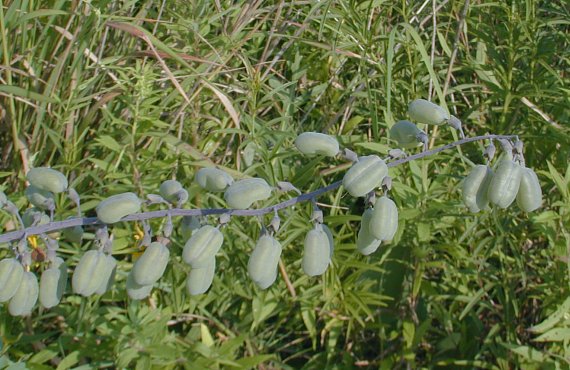
Faunal Associations: Worker bumblebees pollinate the flowers. The caterpillars of some skippers and butterflies occasionally feed on the foliage, including Erynnis baptisiae (Wild Indigo Duskywing), Achelerus lyciades (Hoary Edge), Colias cesonia (Southern Dogface), and Colias eurythema (Orange Sulfur). The caterpillars of the moth Dasylophus anguina (Black-spotted Prominent) can also be found on the foliage. Another insect, Apion rostrum (Wild Indigo Weevil), feeds on this plant and other Baptisia spp. The adult weevils eat both the leaves and flowers, while their grubs stay in the pods and eat the seeds. Because White Wild Indigo is poisonous, it is not much bothered by mammalian herbivores. If cattle, horses, or other kinds of livestock consume sufficient quantities of this plant, they can be seriously poisoned.
Photographic
Location:
The photographs of the racemes and leaf close-up were taken at
Meadowbrook Park in Urbana, Illinois.
Comments:
Large specimens of this wildflower are very striking while they are in
bloom. White Wild Indigo is considerably taller than the related Baptisia
bracteata (Cream Wild Indigo), which has spreading racemes of
flowers that bloom earlier in the year. Other species of this genus in
Illinois have yellow or blue-violet flowers. Another scientific name of
White Wild Indigo is Baptisia leucantha.