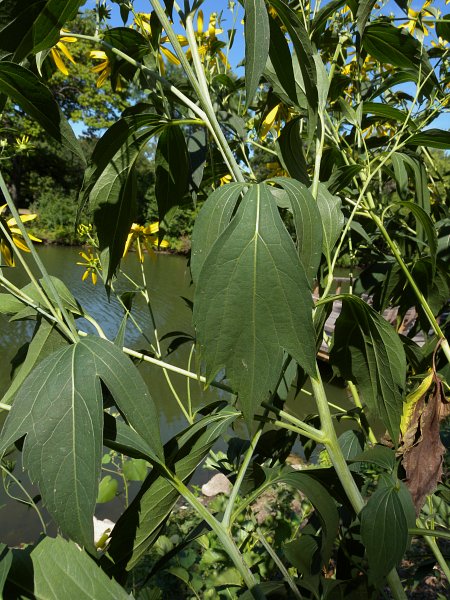
Description: This herbaceous perennial plant is 3-8' tall; it branches occasionally in the upper half. The stems are light green, terete, usually glabrous, and sometimes glaucous. The alternate leaves are up to 12" long and 12" across, becoming gradually smaller as they ascend the stems. These leaves spread outward from their stems on narrowly winged petioles and they have a tendency to droop. The lower to middle leaves have 3-7 large lobes and smooth to coarsely dentate margins. The lobes of these leaves are elliptic to ovate in shape; the terminal lobes of some leaves are subdivided into 2 smaller lobes. Sometimes the lower leaves are pinnate with a pair of basal leaflets and a lobed terminal leaflet. The uppermost leaves on the flowering stalks are much smaller in size and lanceolate to ovate in shape; they lack lobes. The upper leaf surface is dark green and hairless to sparingly short-hairy, while the lower leaf surface is pale-medium green and glabrous to sparingly hairy.
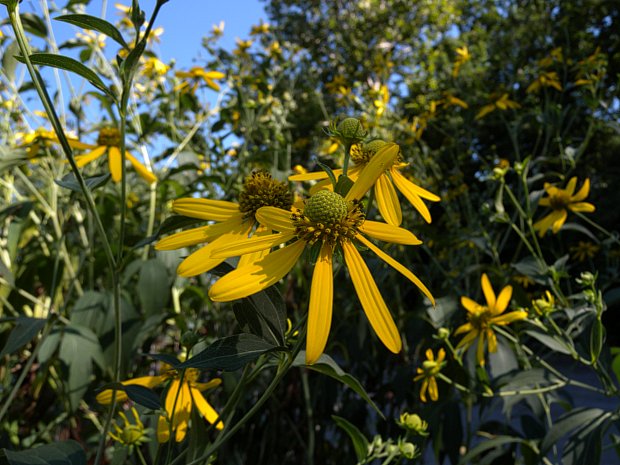
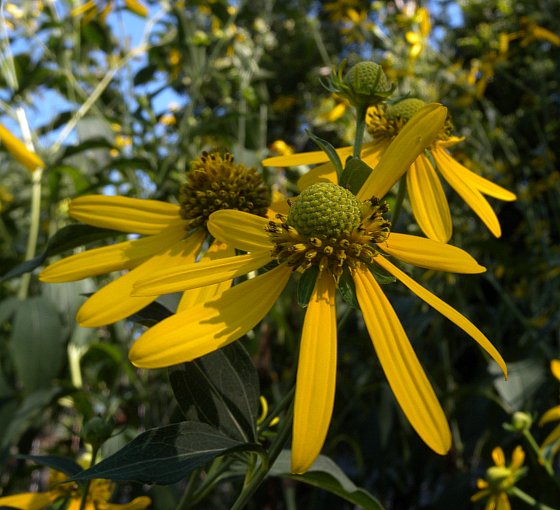
The upper stems terminate in either individual or cyme-like clusters of flowerheads on stalks 2" or more in length. Each flowerhead spans about 2-3" across; it has a daisy-like structure consisting of a globoid central cone that is surrounded by 6-12 ray florets. The central cone is light green while immature, but it later becomes yellow and resembles a pincushion to some extent because of the corollas of its tubular disk florets. The petaloid rays surrounding the central cone are yellow, oblong in shape, and drooping. The base of each flowerhead is defined by 8-15 floral bracts (phyllaries); these bracts are light green, oblong-ovate in shape, and hairless to hairy. The blooming period occurs from mid-summer to early fall and lasts about 1-2 months. Each disk floret is replaced by an oblongoid achene (3-4.5 mm. in length) that has a crown of tiny blunt teeth at its apex. The root system is fibrous and rhizomatous. Clonal colonies of plants are often formed from the long rhizomes.
Cultivation:
The preference is partial sun, moist conditions, and fertile loam or
silt-loam. At a site that is too sunny and dry, the leaves may droop
excessively and wither away, otherwise this plant is easy to cultivate.
In some areas, it may spread aggressively by means of its rhizomes.
Range & Habitat:
Cutleaf Coneflower is widely distributed and occasional to locally
common in most areas of Illinois (see Distribution
Map),
where it is native. Habitats include open bottomland forests, moist
meadows in wooded areas, woodland borders, moist thickets, sloughs in
partially shaded areas, low areas along rivers, partially shaded river
banks, calcareous seeps, margins of poorly drained fields, and
pastures. Occasionally, this species is
grown in flower gardens. It prefers partially shaded areas that are
poorly drained and may be prone to occasional flooding during the
spring.
Faunal
Associations:
The nectar and pollen of the flowerheads attract many kinds of insects,
including long-tongued bees, short-tongued bees, predatory wasps,
butterflies, skippers, moths, and various kinds of flies. Insects that
feed destructively on the Cutleaf Coneflower include the leaf beetle Sumitrosis inequalis,
Uroleucon rudbeckiae
(Golden Glow Aphid), larvae of the fruit fly Strauzia intermedia,
leaf-mining larvae of the moth Marmara
auratella, and larvae of the butterfly, Chlosyne nycteis
(Silvery Checkerspot). Other insects that feed on this and other
coneflowers (Rudbeckia
spp.) include the larvae of gall flies, larvae
of the sawfly Macrophya
simillima, and larvae of some Tortricid moths.
Larvae of such moths as Synchlora
aerata (Wavy-Lined Emerald) and Eupithecia miserulata
(Common Pug) feed on the florets. A bird, the Common Goldfinch, eats
the seeds to a limited extent. The foliage of Cutleaf Coneflower may be
somewhat poisonous to some mammalian herbivores.
Photographic Location:
A flower garden in Urbana, Illinois, and an area that is adjacent to a
pond at Crystal Lake Park in the same city.
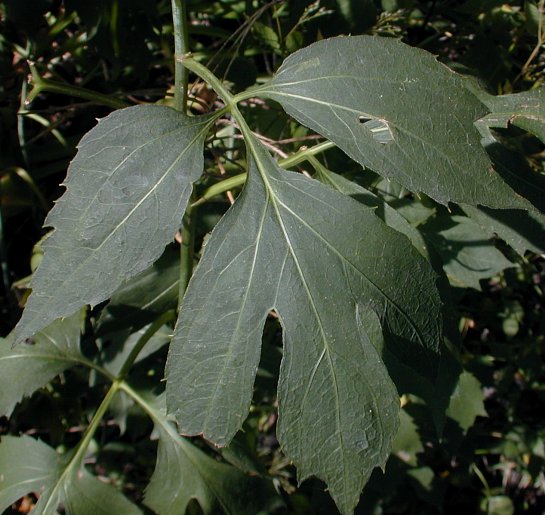
Comments: This is a tall-growing wildflower with a rather lanky appearance. A cultivar of this species, called 'Golden Glow' has double flowerheads with more ray florets (greater than 12) than the wild form. Cutleaf Coneflower is one of several Rudbeckia spp. with yellow flowerheads. It has larger and more widely separated disk florets than these other species, which provides the mature central cone of its flowerheads with a slight pincushion appearance. The central cones of Cutleaf Coneflower are light green to yellow (depending on their maturity), while the central cones of other Rudbeckia spp. are dark brown to black (e.g., Rudbeckia hirta, Rudbeckia triloba, & Rudbeckia fulgida) or grey to brown (e.g., Rudbeckia pinnata). The leaves of Cutleaf Coneflower have 3-7 deep lobes, while the leaves of other Rudbeckia spp. have fewer lobes or none. An exception is Rudbeckia pinnata (Yellow Coneflower), which has leaves with as many lobes. However, the lobes on its leaves are more narrow than those of Cutleaf Coneflower. Other common names of Rudbeckia laciniata include Green-headed Coneflower and Wild Golden Glow.