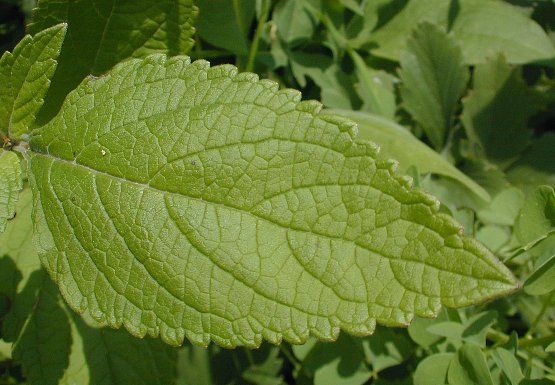
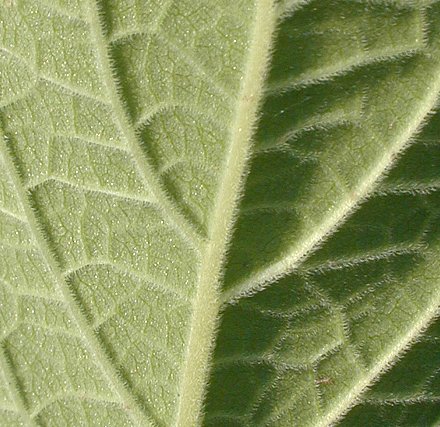
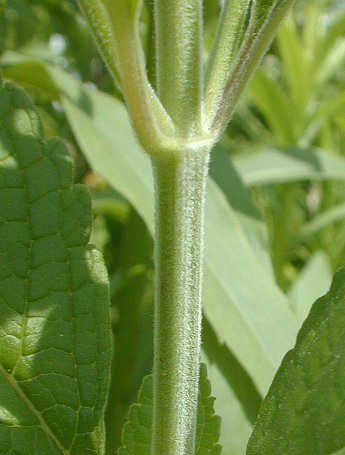
Description: This perennial plant is 2-3' tall and little branched, except near the apex. The erect central stem is whitish green, bluntly 4-angled, and finely pubescent. The opposite leaves are up to 3" long and 1½" across; they are ovate in shape and crenate along their margins. The upper leaf surface is pale-medium or yellowish green and glabrous or nearly so (except for young leaves), while the lower leaf surface is whitish green and finely pubescent. The pubescence on the elevated veins of the leaf undersides is somewhat longer than the pubescence between the veins. The petioles are short (up to ½" in length), whitish green, and finely pubescent. From the middle to upper leaf axils, short secondary stems with smaller leaves may form.
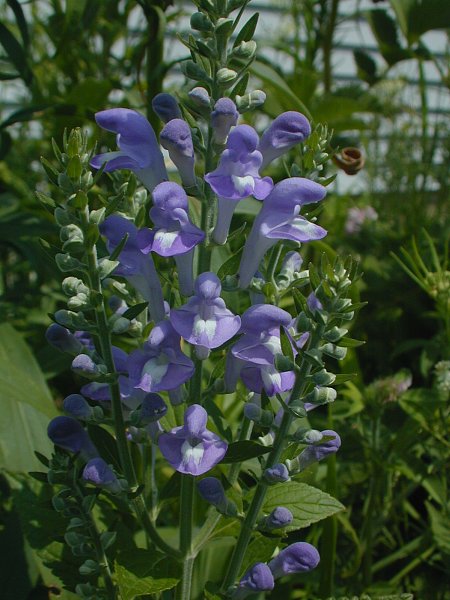
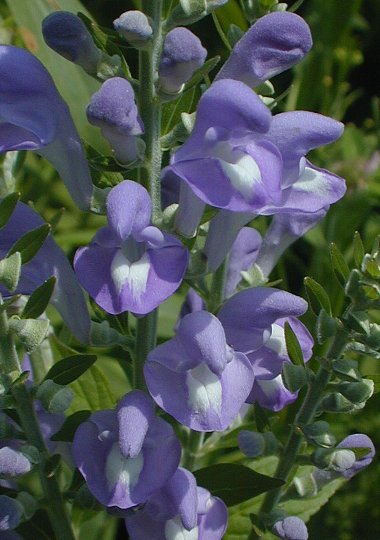
The upper stems terminate in spike-like racemes of flowers up to 6" in length. These racemes are held upright and they have densely-spaced pairs of flowers. Each flower has a 2-lipped tubular corolla about ¾" long that is mostly blue-violet, and a short tubular calyx about ¼" long that is whitish green and finely pubescent. The reproductive organs of the flower are inserted within the corolla. The upper lip of the corolla is hood-like with lateral margins that are curled back, while its lower lip is larger and broader; there is a conspicuous patch of white in front of the throat of corolla. A very fine pubescence (canescence) covers the outer surface of the flower, particularly on the hood (visible with a 10x hand lens). The calyx has a conspicuous protuberance on its upper side. Both the central rachis of each raceme and the pedicels of the flowers (up to ¼" in length) are whitish green and finely pubescent. At the base of each pedicel on a raceme, there is a small leafy bract up to ½" long that is lanceolate or elliptic in shape. None of the hairs on this plant are glandular or sticky.
The blooming period occurs from mid- to late
summer, lasting about 1-1½ months. There is no noticeable
floral scent. The flowers are replaced by oddly shaped capsules that
contain 2-4 nutlets. The upper surface of each capsule is concave with
a protuberance on one side. At maturity, these capsules turn brown and
split open to release their nutlets; this process may be facilitated by
raindrop logistics. The root system is rhizomatous, often forming tight
colonies of clonal plants.
Cultivation:
The preference is partial sun and mesic to dry-mesic conditions. Full
sun or
light shade and moist conditions are also tolerated. The soil can
contain loam, clay-loam, or some rocky material, which
corresponds to the conditions in which this plant normally grows.
Foliar disease rarely bothers this plant; some of the lower leaves may
turn yellow and drop off the stem if there is a severe drought, but
this member of the Mint family withstands dry conditions rather well.
Occasionally, insects may chew holes in the leaves, sometimes
causing major damage. Overall, this plant is easy to grow in a garden
setting.
Range & Habitat: The native Downy Skullcap occurs occasionally in the southern half of Illinois, while in the rest of the state it is largely absent (see Distribution Map). Illinois lies along the northern range limit of this species. Habitats include upland forests, rocky slopes of woodlands, thinly wooded bluffs, rocky slopes along rivers, upland meadows in wooded areas, thickets, and roadsides that run through woodlands. Downy Skullcap usually occurs in and around upland forests, but it occasionally strays into adjacent meadows. This plant is usually found in higher quality natural areas.
Faunal Associations: The flowers are pollinated by bumblebees primarily, which suck nectar or collect pollen. Less common visitors are bee flies, skippers, or small butterflies, but these visitors are less likely to cross-pollinate the flowers. Some species of wasps may perforate the base of the flower and steal nectar (specifically, the Eumenid wasp Euodynerus foraminatus has been observed to do this), and Halictid bees sometimes take advantage of these perforations to suck nectar themselves. Insects that feed destructively on Downy Skullcap and other Skullcaps (Scutellaria spp.) include the flea beetles Phyllobrotica circumdata and Phyllobrotica limbata, the leaf-mining larvae of Caloptilia scutellariella (Skullcap Caloptilia Moth), and the larvae of Prochoreutis inflatella (Skullcap Skeletonizer Moth). Because the foliage is bitter-tasting and possibly toxic, mammalian herbivores usually don't bother this plant to any significant degree.
Photographic
Location:
The photographs were taken at the webmaster's wildflower garden in
Urbana, Illinois.
- Comments: Downy Skullcap has attractive foliage and flowers; it is one of the more showy species in this genus. It is similar to Agastache foeniculum (Anise Hyssop) in the appearance of its foliage and habitat preferences, but its flowers are larger and more attractive. Therefore, it's surprising that this plant is not grown in flower gardens more often. Distinguishing Scutellaria spp. (Skullcaps) is rather tricky, but here are some key characteristics of Downy Skullcap: 1) Except for the lowest leaves, the leaf bases are well-rounded, rather than heart-shaped; 2) this species of Skullcap blooms later and grows taller than most; 3) except for the upper leaf surfaces, the entire plant is finely pubescent, and it has no sticky glandular hairs; and 4) the racemes of its flowers are terminal, rather than axillary.