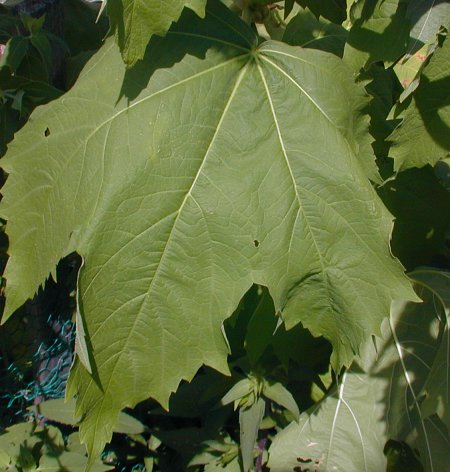
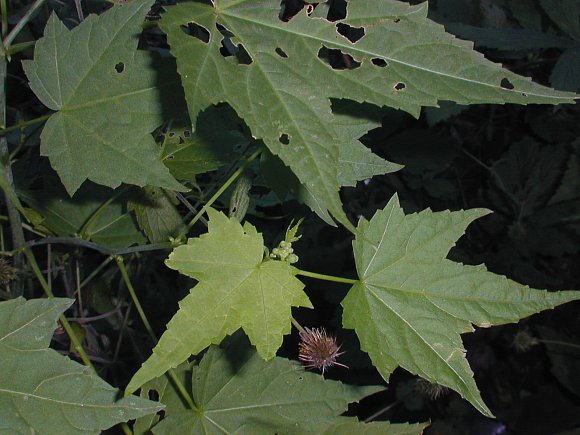
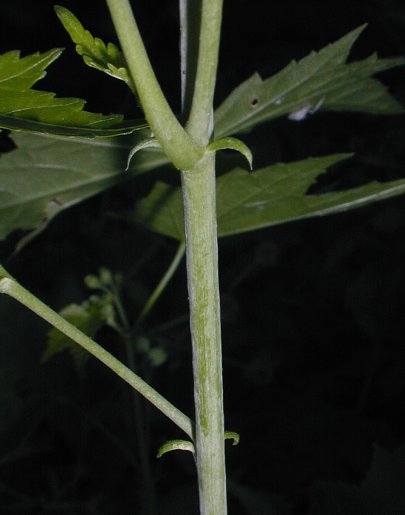
Description: This herbaceous perennial plant is 3-9' tall, consisting of a central stem that is more or less erect, and occasional lateral stems in the upper half of the plant that are ascending. These stems are light green, terete, glabrous to sparsely pubescent, and often glaucous. The alternate leaves can be quite large, up to 18" long and 18" across, becoming smaller as they ascend the stems. They have 3-5 palmate lobes; both the sinuses and tips of the lobes are acutely angled. The leaf margins are coarsely dentate. The upper leaf surfaces are medium to dark green and glabrous, while the lower leaf surfaces are pale green and glabrous to sparsely pubescent.
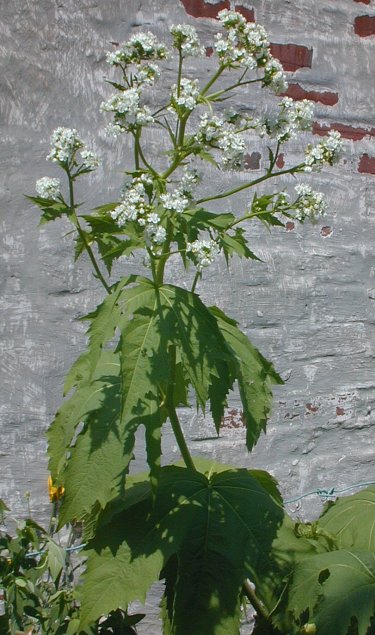
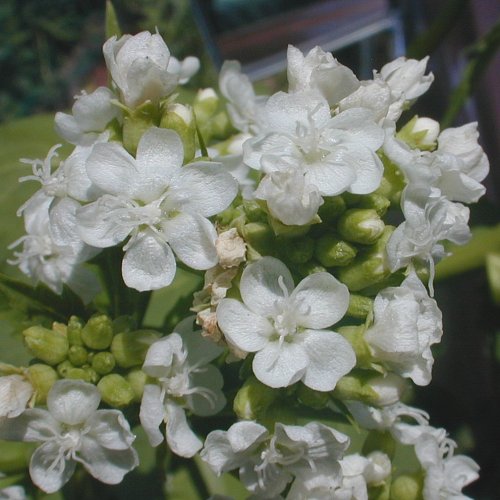
The petioles are usually a little shorter than the leaves (up to 8" long); they are light green and glabrous to sparsely pubescent. At the base of each petiole, there is a pair of linear stipules about ¼" in length. The central and upper stems terminate in one or more panicles of flowers up to 2' long and 2' across. The branches and pedicels of these panicles are light green and glabrous to sparsely pubescent. There are small leafy bracts (less than 3" long) that are located where the branches of the panicle diverge. The flowers tend to be organized into clusters near the tips of the terminal branches; their pedicels are up to 1" long. Because Glade Mallow is dioecious, each flowering plant has either all male (staminate) or all female (pistillate) flowers, but not both. Each male flower is about ½-¾" across, consisting of a short-tubular calyx with 5 broad teeth, 5 white petals, and several stamens; the latter are joined together into a narrow white column. At the apex of this column, the stamens become separated into short white filaments and small plumes of tan to pink anthers. The calyx is light green and glabrous, while the petals are widely spreading and obovate to oblanceolate in shape.
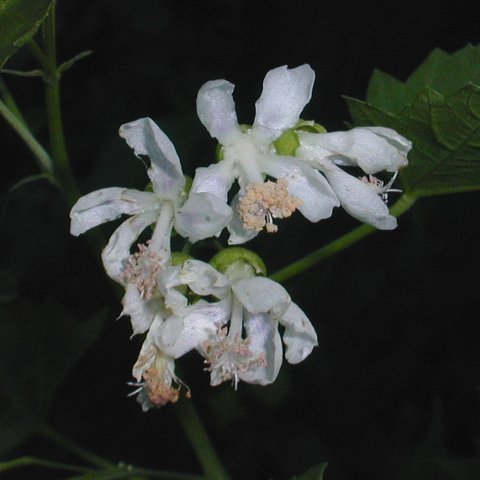
Each female flower is about ½-¾" across, consisting of a short-tubular calyx with 5 broad teeth, 5 white petals, and a compound pistil with several white styles. The calyx is light green and glabrous, while the petals are widely spreading and obovate in shape. The blooming period occurs from early to mid-summer, lasting about 1 month. There is a pleasant floral fragrance. Afterwards, the female flowers are replaced by dry fruits (schizocarps); there are 8-10 seeds per fruit that are probably distributed to some extent by water. The root system consists of a hollow taproot that branches occasionally, and it also produces rhizomes. Colonies of plants can develop from the rhizomes.
Cultivation: The preference is partial to full sun, moist conditions, and soil consisting of loam or silt-loam with decaying organic matter. This plant doesn't like to dry out, and the leaves will wilt rapidly and become ragged in appearance if this is allowed to happen. It may also topple over in a strong wind, particularly when the flowering stage is reached. Therefore, plant the Glade Mallow in a moist, sheltered location. Disease does not appear to be a significant problem. Propagation can be accomplished by seed through cold moist stratification or by division of the rhizomes.
Habitat & Range: The Glade Mallow is an uncommon plant that occurs sporadically in the northern half of Illinois (see Distribution Map), where it is native. This plant is endemic to the Midwest. Habitats include river-bottom prairies, soggy thickets, openings in floodplain forests, terraces along rivers, low areas along streams, and depressions along railroads. This plant doesn't occur in glades in the hillier parts of southern Illinois, contrary to what its common name suggests. Occasional wildfires, particularly during the spring or autumn, are probably beneficial as this reduces the encroachment of woody vegetation.
Faunal
Associations:
The flowers are cross-pollinated by bumblebees (Bombus spp.),
Halictid
bees (Lasioglossum spp.),
and Andrenid bees (Andrena
spp.); they are
also visited by Syrphid flies and Calliphorid flies. These insects are
attracted to the nectar and pollen of the flowers (Iltis, 1963). The
foliage of Glade Mallow is readily browsed by cattle and other farm
animals, and it may also be consumed by deer. Because this is a large
leafy plant that often forms colonies, it provides significant cover
for a variety of vertebrate animals and insects.
Photographic Location:
Dave Monk's postage stamp prairie in downtown Champaign, Illinois, and
a wildflower garden in Urbana, Illinois. The
population of plants at the former location no longer exists.
Comments: Overall, this wildflower is very showy while it is in bloom. It is the only member of the genus that occurs in Illinois. Because of its unisexual flowers, the Glade Mallow is one of the more unusual members of the Mallow family. Its range is restricted to only a few states in the Midwest. Its flowers are much smaller in size than those of the native Rose Mallows (Hibiscus spp.) and rare Kankakee Mallow (Iliamna remota), but they are more numerous. The most similar species to the Glade Mallow is the River Mallow (Sida hermaphrodita). Like the Glade Mallow, the River Mallow is a tall-growing mallow with small white flowers that are produced in abundance; both of these species prefer similar damp habitats. This latter species, however, has bisexual flowers and the lobes of its palmate leaves are more narrow and pointed than those of the Glade Mallow. The River Mallow is not found in Illinois; it has a more eastern distribution.