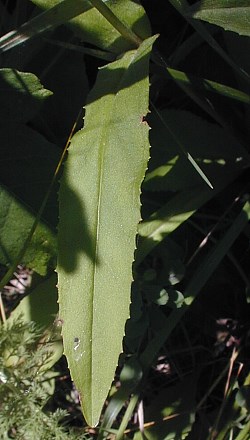
Description: This herbaceous perennial plant is about 1-3' tall and unbranched, except for a few flowering stems near the apex. The central stem may have fine white hairs, otherwise it is glabrous. The opposite leaves are up to 5" long and 2" across, becoming smaller as they ascend the stem. They are yellowish green to medium-dark green, ovate to lanceolate-oblong, devoid of hairs, and have widely spaced teeth along their margins. The leaves are sessile or they clasp the stem; sometimes they are slightly cordate at the base.
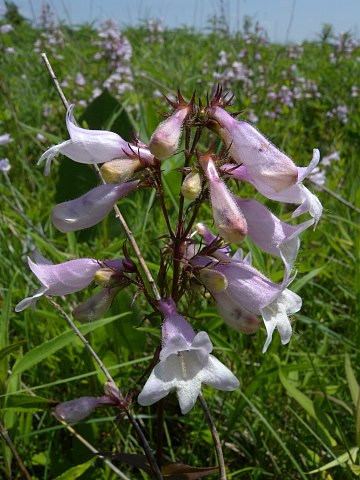
An elongated
panicle of flowers occurs at the apex of the central stem, and smaller
panicles of flowers may occur on upper side stems. The stems of each
inflorescence (peduncles and pedicels) are usually covered with fine
white hairs. Each tubular flower is about 1" long, with 2 upper lobes
and 3 lower lobes; the lower lobes do not project outward any further
than the upper lobes. On the outer surface, the corolla is light violet
or purple and covered with fine hairs, while the inner surface is
white. The lower inner surface of the corolla is smooth and lacks
ridges. The anthers and style are inserted within the corolla. The
calyx of this penstemon is divided into rather long linear-lanceolate
segments that are about 1/3" (8 mm.) long. The blooming period occurs
during
late spring or early summer and lasts about a month. There is no floral
scent. The flowers are replaced by small capsules containing numerous
seeds. These small seeds can be carried several feet by gusts of wind.
The root system consists of a taproot. The flowering stalk dies down
after the blooming period, although it is replaced by low basal leaves
that persist until the spring of the following year.
Cultivation:
The preference is full to partial sun, rich loamy soil, and moist to
mesic conditions. Like other penstemons, this species rarely has
problems with foliar disease.
Range & Habitat:
The native Long-Sepal Penstemon occurs occasionally in eastern and
southern
Illinois, but it is rare or absent in northwestern areas of the state
(see Distribution
Map). Habitats include open rocky woodlands, woodland
borders, oak savannas, moist meadows within woodlands, pastures, black
soil prairies, and edges of old cemeteries. This species appears in
both high quality habitats and more disturbed areas.
Faunal Associations:
Long-tongued bees are the most important pollinators of the flowers,
including honeybees, bumblebees, Anthophorine bees, digger bees, mason
bees, and leaf-cutting bees, which seek nectar primarily. Less
important visitors include Halictid bees, Sphinx moths, and
hummingbirds. The caterpillars of the moth Elaphria
chalcedonia (Chalcedony Midget) may feed on the foliage of
this penstemon. The foliage of penstemons is not a preferred food
source for most mammalian herbivores.
Photographic Location:
The photograph of the flowers was taken at Prospect Cemetery Prairie in
Ford County, Illinois, while the photograph of the leaf was taken in
Vermilion County, Illinois, at the edge of an old cemetery in a wooded
area.
Comments:
This species has reasonably attractive flowers, and it should be
cultivated in wildflower gardens more often. Long-Sepal Penstemon
resembles Penstemon digitalis (Foxglove Penstemon)
somewhat, but it is usually a little smaller and has light violet or
purple flowers, while Foxglove Penstemon has white flowers that are at
most tinged with violet. Long-Sepal Penstemon also has longer sepals.
Another native penstemon, Penstemon hirsutus (Hairy
Penstemon), also has pinkish flowers, but the corolla of its flowers is
more constricted at the mouth and its stems are more hairy. Other
features to consider while identifying a penstemon species include the
presence or absence of ridges on the lower inner surface of the
corolla, the presence or absence of hairs on the leaves, and whether or
not the lower lip of the corolla extends further forward than the upper
lip.