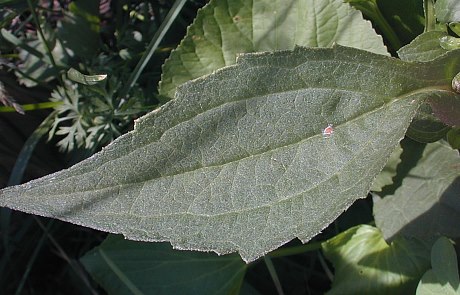
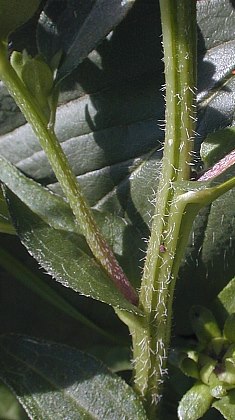
Description: This perennial wildflower is about 1½-2½' tall, branching occasionally. Low basal leaves are produced initially that are oval in shape and dentate along their margins; their bases are rounded to slightly cordate. Later, stems are produced that are light green with spreading white hairs. The alternate leaves are up to 5" long and 2½" across, becoming smaller and more narrow as they ascend the stems. Alternate leaves are ovate, broadly elliptic, or elliptic in shape, and dentate along their margins. The upper surface of each leaf is either hairless or sparsely covered with short appressed hairs; it is medium to dark green. The base of each alternate leaf tapers to a winged petiole; the base of the petiole is either sessile or clasps the stem.
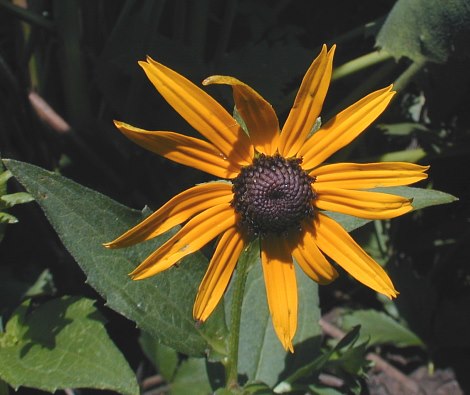
The upper stems
terminate in individual flowerheads spanning 2-3" across. Each
flowerhead consists of 10-20 ray florets surrounding numerous tiny disk
florets. The petal-like rays of the ray florets are yellow to
orange-yellow with notched tips; they spread outward from the center of
the flowerhead. The tiny disk florets are dark brownish purple and
tubular-shaped. Each disk floret has 5 tiny lobes along its upper rim
that are erect, rather than spreading outward. Each disk floret has a
divided style with blunt tips. The blooming period occurs from
mid-summer into the fall and lasts about 2 months. The mature achenes
are oblongoid, 4-angled, and black; the upper end of each achene is
truncate with a minute crown of tiny teeth (the pappus). Each achene is
about 3 mm. in length or a little less. These achenes are light weight
and can be blown about by the wind, but they usually don't stray far
from the mother plant. The root system is fibrous and rhizomatous. In
open disturbed areas, vegetative colonies are often formed from the
rhizomes.
Cultivation:
The preference is partial to full sun, moist to mesic conditions, and
loamy or rocky soil that contains organic material. At a dry sunny
site, there is a tendency for the leaves to wilt and the flowerheads
may not develop properly. This coneflower requires cross-pollination
with genetically distinct plants to produce viable seeds.
Range &
Habitat:
Sullivant's Coneflower is an uncommon native wildflower that is found
primarily in scattered counties in the eastern half of Illinois (see Distribution
Map). Habitats of this coneflower are rather variable: they
include moist rocky woodlands, savannas and barrens, woodland openings
and edges, moist meadows, limestone glades, moist rocky
ledges, fens, hillside seeps, and swamps. Sullivant's Coneflower is
typically found in
high quality natural habitats, but it will temporarily colonize open
disturbed areas.
Faunal Associations:
Like other Rudbeckia spp., the showy flowerheads of
Sullivant's Coneflower attract their fair share of pollinating insects;
both nectar and pollen are available as floral rewards. Floral insect
visitors include bees (leaf-cutting bees, Andrenid bees, Halictid
bees), small butterflies and skippers, various flies (especially
Syrphid flies and bee flies), and sometimes beetles (soldier beetles,
weevils).
Several moth caterpillars are known to feed on Rudbeckia spp.;
they are usually found on the flowerheads, and include such species as Chlorochlamys
chloroleuca (Blackberry Looper Moth), Eupithecia
miserulata (Common Eupithecia), Synchlora aerata
(Wavy-Lined Emerald), and Homoeosoma electellum
(Sunflower Moth). Mammalian herbivores that browse on the foliage
include deer, rabbits, groundhogs, cattle, and other farm animals.
Photographic Location:
The wildflower garden of the webmaster in Urbana, Illinois.
Comments: Orange Coneflower (Rudbeckia fulgida) is quite variable in appearance from one site to another. Consequently, this species has been a source of taxonomic problems that continues to this day. Some authorities classify Orange Coneflower as a single species consisting of several varieties, while others regard it as a complex of several closely-related species. Here, Sullivant's Coneflower is treated as a variety of Orange Coneflower. Sullivant's Coneflower can be distinguished from these other varieties by its larger flowerheads (typically 2-3" across) and the shape of its leaves. Other varieties of Rudbeckia fulgida that may be encountered in Illinois include: Rudbeckia fulgida fulgida (Orange Coneflower), which has more slender leaves and smaller flowerheads (1-2" across); Rudbeckia fulgida deamii (Deam's Coneflower), which has more hairy stems, smaller flowerheads (1-2" across), and larger upper leaves; and Rudbeckia fulgida speciosa (Showy Coneflower), which has slightly smaller flowerheads (1½-2½" across) and lower leaves that are more narrow and shallowly cleft. Among these different varieties, Sullivant's coneflower is the one that is most often cultivated in gardens. It is also possible to confuse Sullivant's Coneflower with the common Rudbeckia hirta (Black-Eyed Susan) in appearance, but it can be distinguished from the latter species as follows: 1) Sullivant's Coneflower has foliage that is less hairy, 2) its leaves have petioles that are conspicuously winged, 3) each of its achenes has a crown of tiny teeth, and 4) it is a perennial. In contrast, Black-Eyed Susan has more hairy foliage, its petioles lack conspicuous wings, its achenes are truncate at the apex, and it is usually annual or biennial in habit.