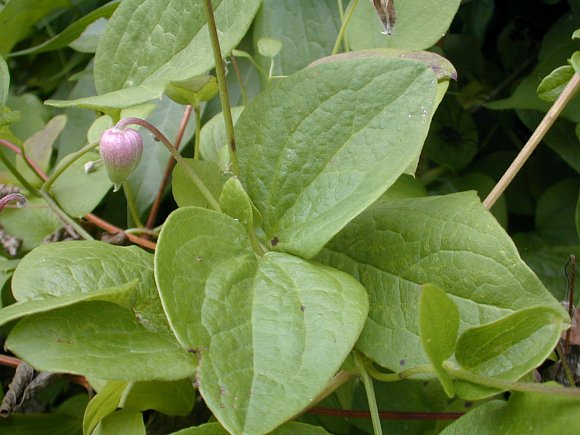
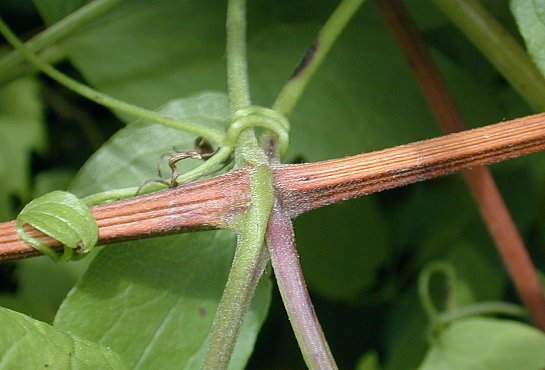
Description: This perennial vine is up to 12' long and slightly woody. The young stems are angular or terete, slightly pubescent, and green or red. Older stems become hairless, brown, and woody, otherwise they resemble the young stems. Pairs of opposite leaves occur at intervals along the vine. These leaves are simple or compound; if the latter, they are odd pinnate. Simple leaves and leaflets are up to 3" long and 2" across. They are ovate or cordate-ovate in shape, smooth along their margins, and largely hairless; sometimes 1 or 2 lateral lobes are present. The major veins of each leaf are parallel, while the secondary veins criss-cross between them. These veins are often elevated and conspicuous on the lower surface. The petioles (basal stalks) of the leaves and petiolules (basal stalklets) of the leaflets are slender and slightly pubescent.
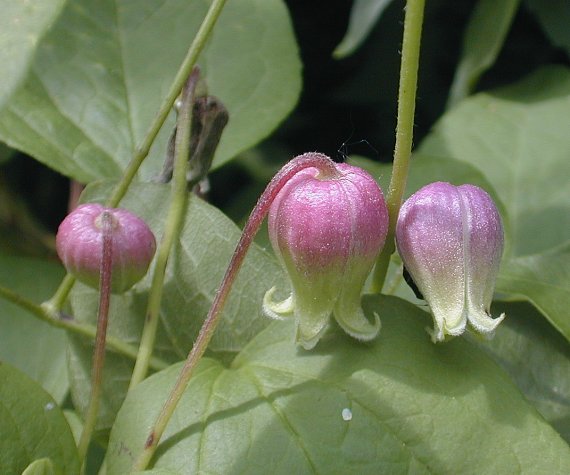
From the axils of the upper leaves, develops one or more flowers on long ascending pedicels; these flowers nod downward. Each flower is about ½-¾" long and bell-shaped. It consists of 4 thick leathery sepals and no petals; within the flower, there are several stamens and styles. The sepals are glabrous to slightly pubescent and light purple, except near their recurved tips, where they are light green or white. The blooming period occurs during the summer (usually mid-summer) and lasts about 1-2 months. Each flower is replaced by a cluster of flattened achenes with long beaks; these beaks are persistent styles. The tips of these styles are slightly hairy, becoming hairless with age. The achenes are light green or burgundy; clustered together, they have a spidery appearance. The achenes become brown or black with age. They are blown about by the wind to a limited extent.
Cultivation:
The
preference is partial sun, moist to mesic conditions, and soil
that is loamy or rocky. Full sun and drier conditions are also
tolerated, but the leaves have a tendency to turn yellow during hot dry
weather.
Range & Habitat:
The native Pitcher's Leather Flower is occasional to common throughout
Illinois,
except for the upper two tiers of counties in NE and north-central
areas of the state, where it is absent (see Distribution
Map). This is one of the more common Clematis spp.
in Illinois. Habitats include open woodlands, rocky bluffs, woodland
borders, areas along woodland paths, powerline clearances through
wooded areas, thickets, and fence rows. This species tolerates
human-caused disturbance to some extent; it doesn't spread to new areas
readily because of the large size of its achenes.
Faunal
Associations:
Bumblebees pollinate the flowers, where they suck nectar and collect
pollen. Other insects feed destructively on the foliage, flowers, or
stems of Pitcher's Leather Flower and other Clematis spp. These
insects include flower-feeding thrips (Thrips varipes),
the Clematis Flower Midge (Prodiplosis
floricola), the Clematis Bud Gall Midge (Contarinia clematidis),
larvae
of a leaf-mining fly (Phytomyza
loewii), caterpillars of the Brown Bark Carpet Moth (Horisme intestinata),
caterpillars
of the moths, Spotted Thyris (Thyris
maculata)
and Mournful Thyris (Thyris
sepulchralis), and the Peach Leaf-roll Aphid (Myzus varians).
These vines are summer hosts of this introduced aphid. The foliage is
probably poisonous to mammalian herbivores. Pitcher's Leather Flower
provides useful cover and nesting habitat for many songbirds in open
wooded areas and other habitats where this vine occurs.
Photographic Location:
The photographs were taken at a powerline clearance in Busey Woods
of Urbana, Illinois, and a roadside fence row in rural
Champaign County, Illinois.
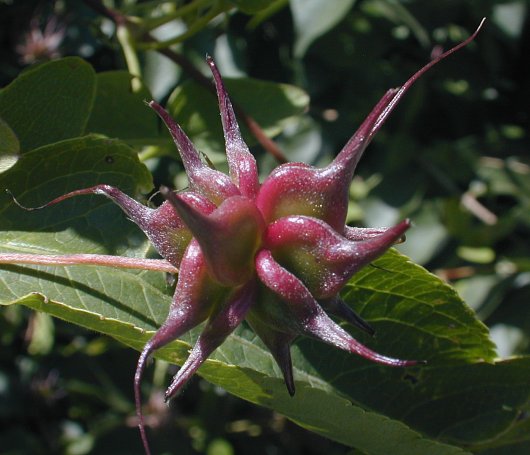
Comments: The Clematis spp. that are Leather Flowers have similar-appearing bell-shaped flowers that nod downward. Other Clematis spp., such as Clematis virginiana (Virgin's Bower), have showier flowers with spreading white sepals and conspicuous stamens and styles. However, both groups of Clematis spp. have clusters of flattened achenes with long beaks that are persistent styles. Pitcher's Leather Flower is somewhat variable in appearance, especially in the western part of its range. There are significant variations in the size of its leaves or leaflets, the thickness of its leaves or leaflets, the elevation of the veins on the undersides of its leaves or leaflets, the size of its flowers (larger in areas west of Illinois), the color of its flowers, and the hairiness of its achenes. Pitcher's Leather Flower has a similar appearance to Clematis viorna (Leather Flower). However, the persistent styles of Pitcher's Leather Flower are glabrous to short-hairy toward their tips, while the persistent styles of Leather Flower have abundant plumose hairs. Sometimes the leaf undersides of Pitcher's Leather Flower have conspicuous elevated veins, while the leaf undersides of Leather Flower are more smooth. However, this distinction is not always reliable. Leather Flower is an uncommon species that occurs in only a few counties in southern Illinois. It is more common outside of the state in areas that are further to the east and south.