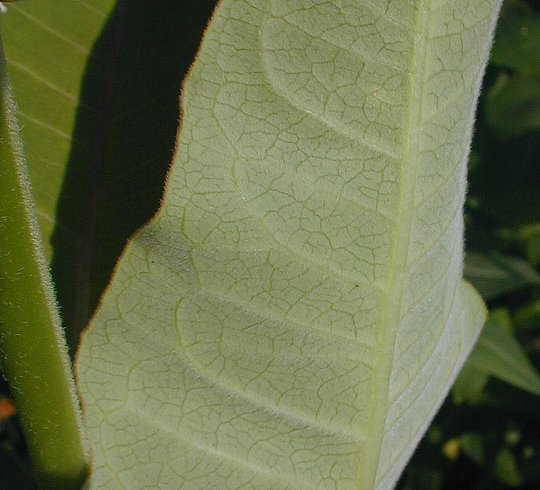
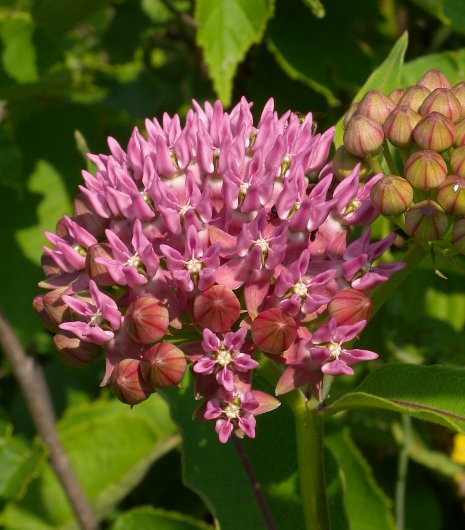
Description: This perennial plant is about 1¾-2¾' tall and unbranched. The central stem is light green, round in cross-section (terete), and glabrous to finely pubescent. The opposite leaves are up to 6" long and 3" across. They are ovate-oblong or broadly lanceolate, with smooth margins that may undulate up and down. The leaves often curl upward from the pinkish central vein. The upper surface of the foliage is mostly glabrous and yellowish green to dark green (depending on light conditions), while the lower surface is light green and softly pubescent (at least along the major veins). Leaf venation is pinnate. The central stem terminates with 1-6 umbels of flowers; there may be a few axillary umbels from some of the upper leaves as well. Each rounded umbel is about 2-3" across. These flowers have the typical structure for milkweeds; they are pale purple to deep purple, sometimes with greenish or rosy tints. However, the central reproductive column and the bases of the deflexed petals are more pale than the rest of the flower.
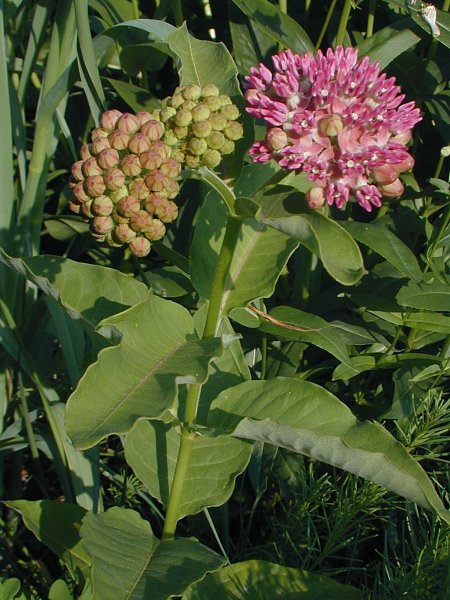
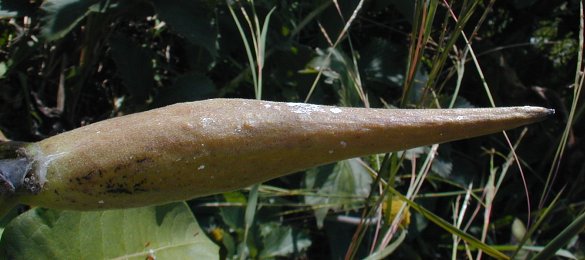
The hoods are much taller than the horns; the latter curve inward toward the reproductive column and appear spike-like (but are slightly thicker toward the base). The blooming period occurs from late spring to mid-summer, and lasts about one month. The flowers have a pleasant fragrance. If cross-pollination occurs, the flowers are replaced by seedpods (follicles) that are held erect. These seedpods are up to 6" long and 1" across; they are narrowly lanceoloid in shape. They have a smooth surface and are finely short-pubescent or canescent. The seeds have large tufts of white hair; they are distributed by the wind. The root system consists of a fleshy taproot and rhizomes; small colonies of plants are sometimes produced from the rhizomes.
Cultivation:
The
preference is partial sun and mesic conditions; this plant also
tolerates light shade and full sun, as well as considerable variations
in the moisture regime. Immature plants are inclined to wilt during a
drought, and should be watered. The soil can consist of
moisture-retaining loam or clay-loam. The plants make rapid growth
during the late spring until they flower and form seedpods, then they
gradually degenerate. It takes 3 years or more for a small transplant
or seedling to reach flowering size. The leaves have tendency to turn
yellow and curl in response to dry sunny conditions, or when they
become old.
Range & Habitat:
The native Purple Milkweed is an occasional plant that is widely
distributed in
Illinois (see Distribution
Map).
However, it is uncommon or absent in some areas of NW, central, and
east-central Illinois. Habitats include lower slopes of hill prairies,
meadows in wooded areas, thickets and woodland borders, bluffs and open
woodlands, oak savannas, glades, and roadsides. This plant usually
occurs along prairie edges near wooded areas, rather than
in open prairie. It is usually found in higher quality habitats.
Faunal Associations: The nectar of the flowers attracts long-tongued bees, butterflies, and skippers. To a lesser extent, green metallic bees and other Halictid bees may visit the flowers, but they are less effective at pollination. Another unusual visitor of the flowers is the Ruby-Throated Hummingbird. Among the butterflies, such visitors as the Pipevine Swallowtail, Giant Swallowtail, American Painted Lady, Red Admiral, Clouded Sulfur, Eastern Tailed-Blue, Regal Fritillary, Great Spangled Fritillary, and many others have been reported. A group of oligophagous insects feed on milkweeds. They include caterpillars of the butterfly Danaus plexippes (Monarch); caterpillars of the moths Cycnia inopinatus (Unexpected Cycnia) and Cycnia tenera (Delicate Cycnia); the aphids Aphis asclepiadis, Aphis nerii, and Myzocallis asclepiadis; Lygaeus kalmii (Small Milkweed Bug) and Oncopeltus fasciatus (Large Milkweed Bug); and Tetraopes tetrophthalmus (Red Milkweed Beetle). Mammalian herbivores rarely consume Purple Milkweed and other milkweeds because of the bitter-tasting, toxic foliage, which contains cardiac glycosides.
Photographic
Location:
The photographs were taken at the webmaster's wildflower garden in
Urbana, Illinois, and at the Coneflower Hill Prairie near Lake
Shelbyville in east-central Illinois.
Comments:
The flowers of Purple Milkweed are quite attractive. This species is
less aggressive than Asclepias
syriaca (Common Milkweed), which it resembles somewhat in
appearance. However, the flowers of Purple Milkweed are usually a
deeper color of purple and more likely to occur in terminal umbels at
the apex of the central stem, rather than as axillary umbels between
the upper leaves. The seedpods of Purple Milkweed are smooth, while the
seedpods of Common Milkweed have soft prickles. Purple Milkweed also
resembles Asclepias
rubra (Red Milkweed), but the horns on the flowers of the
latter species are straight and about as tall as the hoods, while the
horns of Purple Milkweed are shorter than the hoods and curve inward
toward the reproductive column of the flowers.