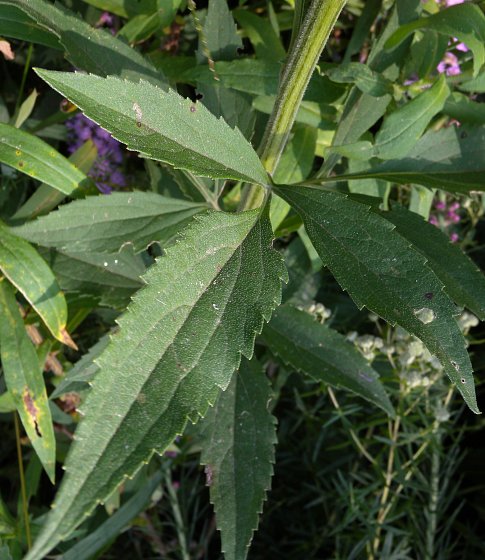
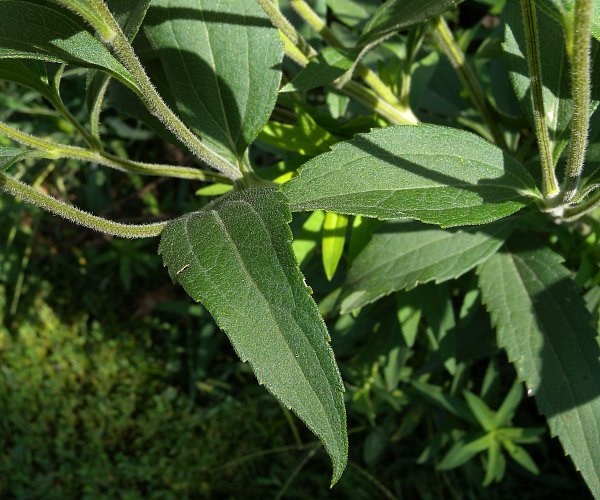
Description: This perennial herbaceous plant is 3-6' tall, branching occasionally. The stems are light green, terete, and sometimes slightly furrowed; they are covered with spreading hairs. The lower to middle leaves usually have 3-5 deep lobes; they are up to 8" long and 4½" across. The upper leaves usually lack lobes; they are up to 3" long and 1" across. The lobes of the lower to middle leaves are more or less lanceolate in shape and coarsely dentate along their margins; the terminal lobes usually taper to petiole-like bases. The upper leaves are elliptic, lanceolate, or ovate in shape, while their margins are sparsely to moderately dentate. The upper leaf surfaces are medium green and rough-textured from short stiff hairs that are sparsely distributed, while the lower leaf surfaces are light-medium green and hairy, especially along the undersides of major veins. The petioles of alternate leaves are up to 1½" long, becoming shorter as they ascend the stems; the uppermost leaves are often sessile, or nearly so. The petioles are pubescent to hairy.
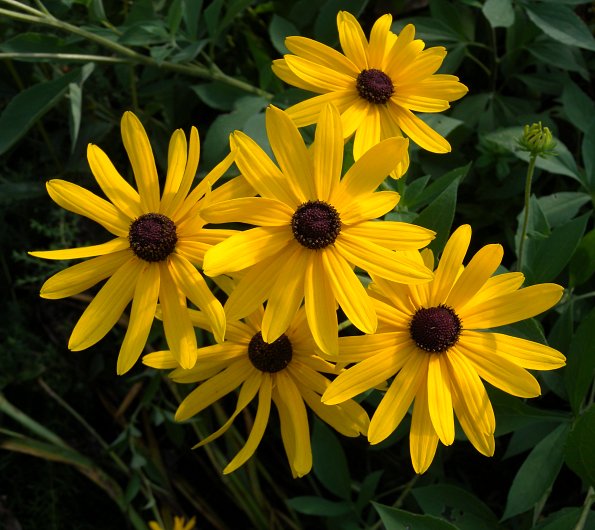
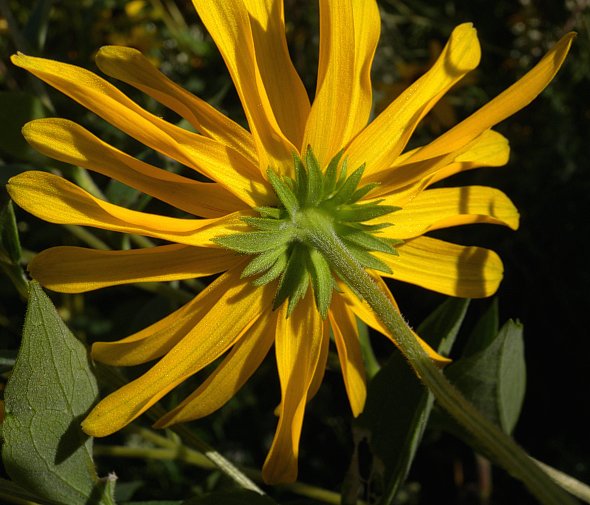
The upper stems terminate in solitary flowerheads on long peduncles. The peduncles are up to 8" long, light green, terete, and hairy. The daisy-like flowerheads are 2–3½" across, consisting of 10-20 ray florets that surround numerous disk florets. The central disks of the flowerheads are hemispheric in shape; they are fragrant after being crushed. The petaloid rays are bright yellow, narrowly oblong, and slightly notched at their tips; they are widely spreading. The corollas of the disk florets are narrowly tubular in shape and dark reddish purple (at least above). The ray florets are infertile, while the disk florets are fertile. Around the base of each flowerhead, there are many overlapping phyllaries (floral bracts). Individual phyllaries are up to ½" long, light-medium green, linear-lanceolate in shape, and pubescent. The blooming period occurs during mid- to late summer, lasting about 1–1½ months. Afterwards, fertile disk florets are replaced by narrow achenes. These achenes are 2-3 mm. long, dark-colored, and narrow in shape; their apices are truncate, sometimes with minute scales. The root system is fibrous and rhizomatous.
Cultivation:
The preference is full or partial sun,
moist to mesic conditions, and soil consisting of loam or sandy loam.
This plant is relatively easy to cultivate, although it may topple over
if it is spoiled by too much water or fertilizer.
Range
&
Habitat: Sweet Coneflower is occasional in most areas of
Illinois,
where it is native. It tends to be more common in central and northern
Illinois than in the southern section of the state (see Distribution
Map). Habitats include black soil prairies, sand prairies,
cemetery
prairies, typical savannas and sandy savannas, thickets, openings in
deciduous woodlands, woodland borders, gravelly seeps, banks of
streams, and banks of ditches. This plant is often cultivated in flower
gardens, from where it occasionally escapes. Sweet Coneflower is
usually found in higher quality natural areas, although it also
colonizes disturbed areas. Fidelity to any particular habitat is low.
Faunal Associations: Many kinds of insects visit the flowerheads for either nectar or pollen. These species include little carpenter bees (Ceratina spp.), Epeoline cuckoo bees, digger bees (Melissodes spp., Svastra spp.), leaf-cutting bees (Megachile spp.), Halictid bees, dagger bees (Heterosarus spp.), Sphecid wasps, Vespid wasps, Syrphid flies, bee flies (Bombyliidae), Tachinid flies, small- to medium-sized butterflies, skippers, beetles, and true bugs (Robertson, 1929). Among these species, bees are the most important pollinators. One bee species, Heterosarus rudbeckiae, is an oligolege (specialist pollinator) of Rudbeckia spp. Other insects feed destructively on the foliage, flowerheads, and roots of Sweet Coneflower and other Rudbeckia spp. They include larvae of a leaf-mining fly (Calycomyza frickiana), Asphondylia rudbeckiaeconspicua (Coneflower Gall Midge), Neolasioptera rudbeckiae (Coneflower Stem Midge), larvae of another gall fly (Lestodiplosis rudbeckiae), larvae of a sawfly (Macrophya simillima), and a few aphids (Uroleucon leonardi, Uroleucon rudbeckiae); see Spencer & Steyskal (1986), Felt (1917), Smith (2006), and Blackman & Eastop (2013). The caterpillars of a butterfly, Chlosyne nycteis (Silvery Checkerspot), sometimes feed on Rudbeckia spp. as host plants, as do the caterpillars of such moths as Epiblema carolinana (Gray-blotched Epiblema), Epiblema tandana, Epiblema tripartitana, Eupithecia miserulata (Common Pug), and Synchlora aerata (Wavy-lined Emerald); see Opler & Krizek (1984), Miller (1987), and Wagner (2005).
Photographic
Location:
The photographs were taken at a prairie garden in Urbana, Illinois.
Comments:
Sweet Coneflower (Rudbeckia
subtomentosa) is also called Fragrant Coneflower. It is
more long-lived than two similar species, Black-eyed Susan (Rudbeckia hirta)
and Brown-eyed Susan (Rudbeckia
triloba). Compared to the Black-eyed Susan, Sweet
Coneflower is a taller plant with many deeply lobed leaves. The leaves
of Black-eyed Susan lack lobes. Compared to Brown-eyed Susan, the
flowerheads of Sweet Coneflower are larger in size with longer and more
abundant petaloid rays. Otherwise they are quite similar to each other
in appearance. Another species, Orange Coneflower (Rudbeckia fulgida),
also lacks lobes on its leaves and it is a shorter plant. All of these
species are native to Illinois and they sometimes share the same
habitats.