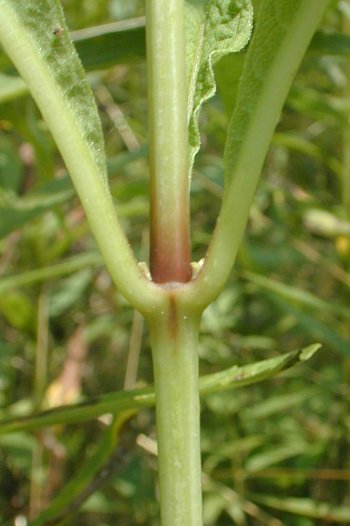
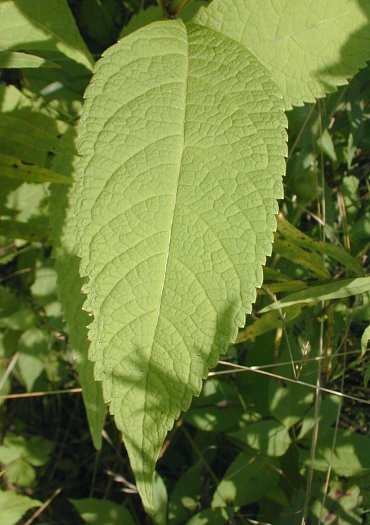
Description: This perennial plant is 3-7' tall and usually unbranched. The central stem is light green and glabrous, except where the whorls of leaves of occur, where it is slightly swollen and purple. There are 3-4 leaves in each whorl along the stem. The leaves are about 6" long and 3½" across, or sometimes larger; they are broadly lanceolate or ovate and crenate-serrated along the margins. Each leaf is dull green and hairless on the upper surface; the lower surface is pale green and hairless to finely pubescent. The foliage may be vanilla-scented, although this varies with the local ecotype.
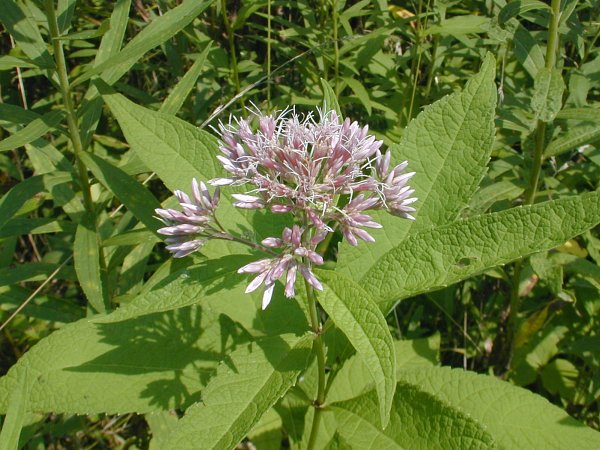
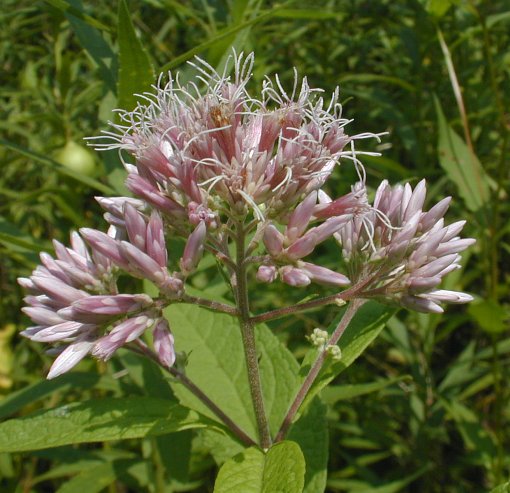
The central stem terminates in one or more panicles of compound flowers that are bunched together; this inflorescence is usually more dome-shaped than flat-topped. Unlike the central stem, the stalks of the inflorescence are sometimes finely pubescent. Each compound flower consists of 5-8 disk florets and several overlapping series of bracts at its base. There are no ray florets. The corolla of each disk floret is whitish pink to purplish pink; it is tubular in shape and has 5 tiny teeth along its upper rim. A divided white style is strongly exerted from each disk floret. The floral bracts are pale pink and oblong. The blooming period occurs from mid-summer to early fall and lasts about a month. Each floret is replaced by a bullet-shaped achene with a small tuft of hair. These achenes are dispersed by the wind. The root system is shallow and fibrous.
Cultivation:
The
preference is light shade to partial sun, moist to mesic conditions,
and a rich loamy soil. The leaves will turn an unattractive yellowish
green in the presence of strong sunlight.
Range & Habitat:
The native Sweet Joe-Pye Weed occurs occasionally in most areas of
Illinois,
except for a few counties in SE Illinois and elsewhere in the state,
where it is uncommon or absent (see Distribution
Map). Habitats include open woodlands, savannas, woodland
borders, thickets, partially shaded seeps, and partially shaded
riverbanks. This plant can survive in wooded areas that are somewhat
degraded. However, populations have a tendency to decline when the
shade of overhead canopy trees becomes too dense.
Faunal Associations: The flower nectar attracts primarily long-tongued bees, butterflies, skippers, and moths. Bee visitors include Bombus spp. (bumblebees), Melissodes spp. (miner bees), and Megachile spp. (leaf-cutting bees). Some bees also collect pollen. The caterpillars of various moths feed on leaves and other parts of Eutrochium spp. (Joe-Pye Weed species), including Carmenta bassiformis (Eupatorium Borer Moth), Emmelina monodactyla (Common Plume Moth), Perigea xanthioides (Red Groundling), Schinia trifasciata (Three-Lined Flower Moth), Phragmatobia fuliginosa (Ruby Tiger Moth), and Eupithecia miserulata (Common Pug).
Other insect
feeders include larvae of the leaf-mining flies Liriomyza pusilla
and Phytobia allecta,
larvae of Dasineura
purpurea (Joe-Pye Blossum Midge), the warty leaf beetle Exema dispar, the
aphid Uroleucon
eupatoricolens, and the treehopper Entylia bactriana.
White-Tailed Deer browse on the leaves of Sweet Joe-Pye Weed sparingly
(personal observation), while the Swamp Sparrow eats the seeds of
various Joe-Pye Weed species to a limited extent.
Photographic Location:
A small opening in a wooded area at Meadowbrook Park in Urbana,
Illinois.
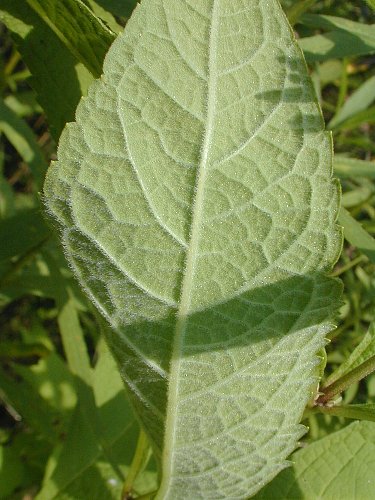
Comments: Sweet Joe-Pye Weed (Eutrochium purpureum) is one of the taller wildflowers in wooded areas. It is often found in habitats that are more shady and dry than other Eutrochium spp. (Joe-Pye Weed species) in the state. To identify a Joe-Pye Weed, it is helpful to examine the central stem: the stem of Sweet Joe-Pye Weed is solid in cross-section and purple where the bases of leaf petioles occur, otherwise it is green and glabrous. The species Eutrochium maculatum (Spotted Joe-Pye Weed) has solid stems that are either purple-spotted and glabrous or solid purple throughout from dark-colored hairs, while Eutrochium fistulosum (Hollow-stemmed Joe-Pye Weed) has hollow stems that are glabrous and glaucous. Sweet Joe-Pye Weed usually has only 3-4 leaves per whorl, while Spotted Joe-Pye Weed has 4-5 leaves per whorl and Hollow-Stemmed Joe-Pye Weed has 4-7 leaves per whorl. Joe-Pye Weed species have been assigned recently to the Eutrochium genus; in the past, they have been assigned to the Eupatorium genus and the Eupatoriadelphus genus. Thus, Eupatorium purpureum and Eupatoriadelphus purpureus are scientific synonyms of Sweet Joe-Pye Weed.