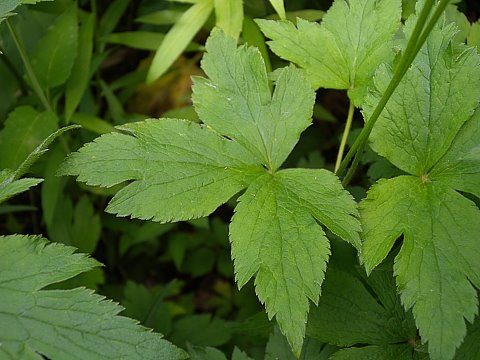
Description: This perennial plant is about 1-2½' tall. The stems have scattered white hairs and there is little branching, except for the production of long stalks for the flowers. The leaves occur in 1 or 2 whorls along the stem, usually in groups of 2 or 3. They are up to 5" long and across, and have long petioles with scattered white hairs. Each major leaf is divided into 2 or 3 deep lobes, which are in turn divided into 2 or 3 shallower lobes. Because these divisions are rather sharp, the leaves are cleft. Furthermore, the margins are coarsely serrate or dentate. The leaves are often light green or yellowish green in bright sunlight.
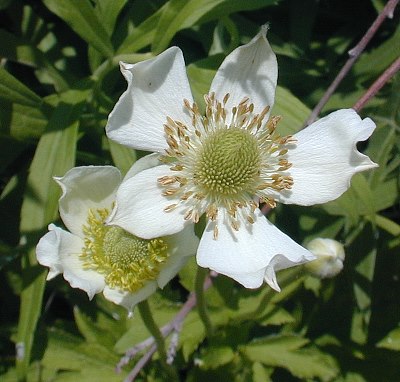
From the upper
axil of each leaf, there occasionally develops a long stalk with a
single flower about ¾" across when it is fully open. This flower
consists of 5 white or greenish white sepals (looking like petals), and
numerous stamens with yellow or light brown anthers surrounding
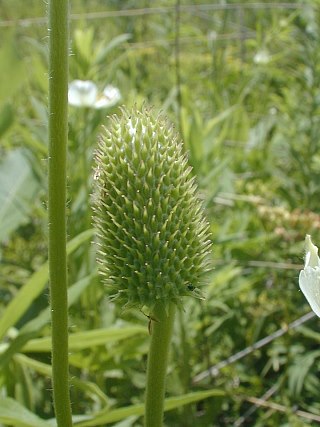
a compound head of pistils. This pistillate head is green
and prickly in appearance. This compound head becomes larger and
more elongated as the
sepals fall off. It is about ¾–1" long and up to ½" across, eventually
turning into a fluffy mass with numerous dark seeds. These seeds are
eventually distributed by the wind. The root system is rhizomatous,
often producing vegetative offsets from the mother plant. Tall Anemone
produces an allelopathic substance, protoanemonin, which inhibits seed
germination and seedling growth in many species of plants.
Cultivation:
The preference is light shade to full sun.
The soil should contain loam with some organic material
to retain moisture. Mature
plants resist drought fairly well, and the leaves are not often subject
to foliar disease.
Range & Habitat: The native Tall
Anemone is a fairly common plant that occurs throughout Illinois,
except for a few southern counties (see Distribution
Map). Habitats include moist to mesic black soil prairies,
savannas, open woodlands, woodland borders, thickets, and limestone
glades. It usually
doesn't stray far from wooded areas.
Faunal
Associations: Small bees and flower
flies visit the flowers occasionally for pollen. Bee visitors include
Plasterer bees (Colletes
spp.) and Halictid bees (Halictus spp., Lasioglossum spp.,
etc.). Mammalian herbivores usually leave
this plant alone because the foliage contains a blistering agent that
can irritate the mouth parts and digestive tract. When this plant forms
colonies, it provides a minor source of cover for small animals.
Photographic Location:
Photographs were taken at Meadowbrook Park in Urbana, Illinois.
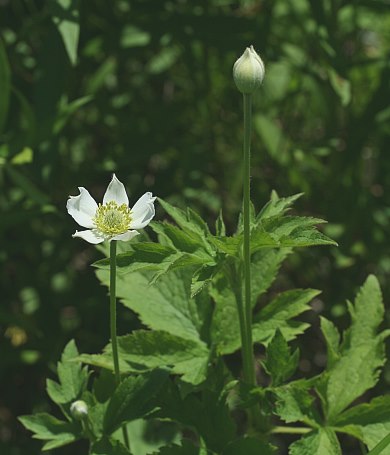
Comments: This curious plant offers different attractions at different times of the year. During early summer, white flowers are produced, which are soon replaced by long-lasting thimble-shaped seedheads. During the fall, these seedheads slowly distintegrate into white cottony masses that remain attractive all winter. Tall Anemone can be easily distinguished from Anemone canadensis (Canada Anemone) because its leaves have conspicuous petioles, while the leaves of the latter species are sessile or perfoliate. Distinguishing Tall Anemone from Anemone cylindrica (Thimbleweed) is a bit trickier, but examination of the following characteristics are helpful: 1) the former species has a shorter, more prickly central head that is greater than 1/3" across, while the latter has a central head that is 1/3" across or less and is at least twice as long as it is wide; 2) the leaves of the former species are sharply tripartite (cleft) and have sharper dentation or serration along the margins, while the leaves of the latter are more likely to be palmate and less cleft and more blunt and fewer teeth along the margins.