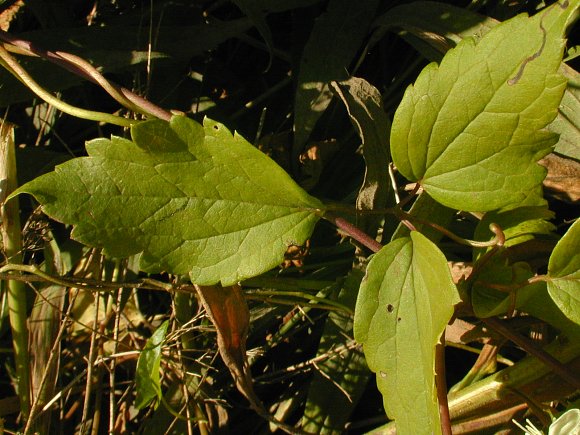
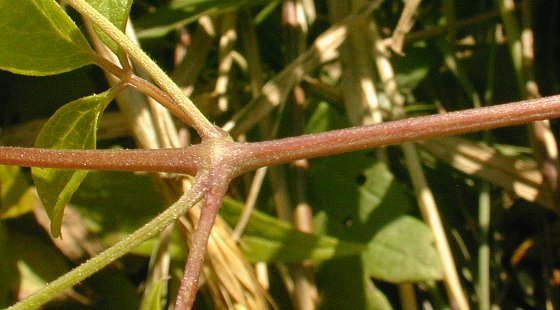
Description: This perennial plant is a woody vine up to 20' long. Its stems can twine about fences and adjacent vegetation and they branch occasionally. These stems are initially green or dull red, but they eventually turn brown and woody. Young stems are sparsely pubescent, terete or angular, and they become somewhat enlarged at the petiole bases. The opposite leaves are primarily trifoliate, although some of them are simple. The petioles of these leaves (whether simple or compound) are up to 2" long; they are green or dull red and sparsely pubescent, like the stems. The leaflets and simple leaves are up to 4" long and 2" across; they are ovate, dentate or shallowly cleft along their margins, and mostly glabrous. However, the undersides of the leaves or leaflets are sometimes slightly pubescent, especially along the major veins. The upper surfaces of leaves and leaflets are yellowish green to dark green, while their lower surfaces are pale green with elevated major veins. The petiolules (basal stalklets) of the leaflets are similar to the petioles, except they are shorter. The petiolule of the terminal leaflet is longer than those of the lateral leaflets.
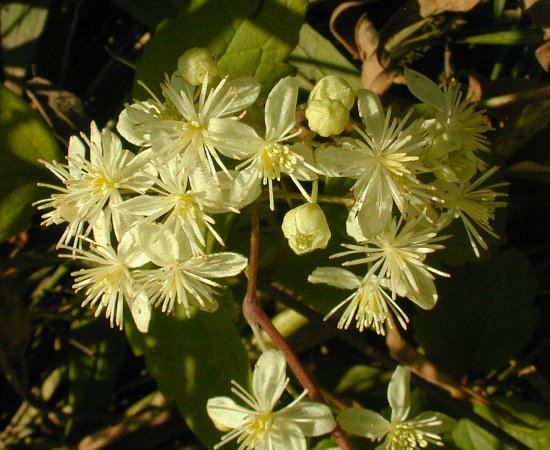
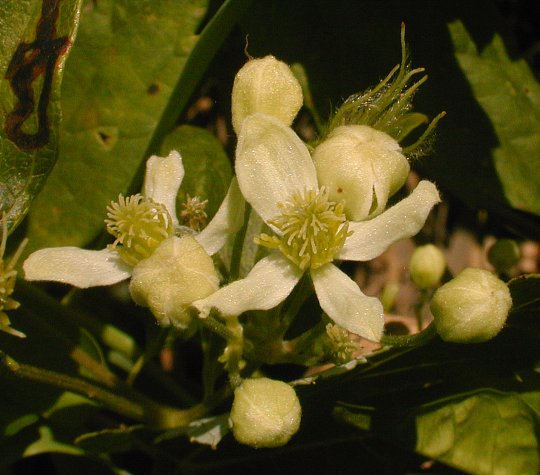
Occasionally, flat-headed panicles of white flowers are produced from the axils of the leaves. Each panicle can span several inches across. A single vine can produce all staminate flowers (male), all pistillate flowers (female), or all perfect flowers (both male & female). Regardless of gender, individual flowers are about ¾" across and they have 4 petaloid sepals that are white or cream-colored and oblong-elliptic in shape. Each staminate flower has abundant long stamens that have white filaments and pale yellow anthers. Each pistillate flower has a cluster of green carpels at its center; each carpel has a short curled style. In addition to the carpels, each pistillate flower has a circle of pseudo-stamens that are sterile. Each perfect flower has a cluster of green carpels at its center, which are surrounded by one or two rows of stamens. The blooming period occurs from mid- to late summer and lasts about a month. The staminate flowers quickly wither away, but each of the pistillate and perfect flowers develop a cluster of pubescent achenes with slender styles (up to 2" long) that are more or less hairy. These achenes and their persistent styles are initially green and silky in appearance, but they eventually turn brown. Each achene contains a single large seed. This plant spreads by reseeding itself.
Cultivation:
The
preference is partial sun, moist to mesic conditions, and a fertile
soil that is loamy or silty. Full sun is also tolerated, although the
leaves may turn yellowish green.
Range & Habitat:
The native Virgin's Bower occurs occasionally throughout Illinois (see Distribution
Map).
It is a little more common in northern and western Illinois than other
areas of the state. Habitats include edges of woodlands, moist
thickets, moist meadows in floodplain areas, banks of rivers, slopes of
drainage ditches, low ground along railroads, and fence rows. Virgin's
Bower can be found in both disturbed and natural areas. It is sometimes
cultivated as an ornamental garden plant.
Faunal
Associations:
The nectar of the staminate flowers attracts Halictid bees (including Sphecodes
clematidis), wasps, and various kinds of flies. No
information is available for pistillate flowers. Insects that feed
destructively on Virgin's Bower and other Clematis spp.
include larvae of Contarinia
clematidis (Clematis Bud Gall Midge) and Prodiplosis floricola
(Clematis Flower Midge), larvae of the leaf-mining fly Phytomyza loewii,
caterpillars of Horisme
intestinata (Brown Bark Carpet Moth), caterpillars of two
moths, Thyris maculata (Spotted
Thyris) and Thyris sepulchralis (Mournful Thyris),
and Myzus varians
(Peach Leaf-Roll Aphid). These vines are the summer hosts of this
introduced aphid. The toxic foliage is avoided by mammalian herbivores.
However, the foliage of Virgin's Bower can provide significant cover
and nesting habitat for many songbirds.
Photographic Location:
A moist thicket near a drainage canal in Champaign, Illinois.
Comments: The flowers of Virgin's Bower are attractive and often abundantly produced; the staminate flowers are slightly more showy than the pistillate flowers. The achenes with their silky-hairy styles are also interesting because of their unusual appearance. The only other species that resembles Virgin's Bower in Illinois is Clematis terniflora (Autumn Clematis), which has been introduced from East Asia as an ornamental plant. Autumn Clematis is also a woody vine that produces masses of white or cream flowers. The flowers of this latter species, in my experience, are slightly larger (about 1" across) and more fragrant than those of Virgin's Bower; they also bloom later in the year. These two species can be easily distinguished by their foliage: The leaf- and leaflet-margins of Virgin's Bower are dentate or shallowly cleft, while those of Autumn Clematis are smooth (entire). While there are other native Clematis spp. within Illinois, their flowers have a completely different appearance.