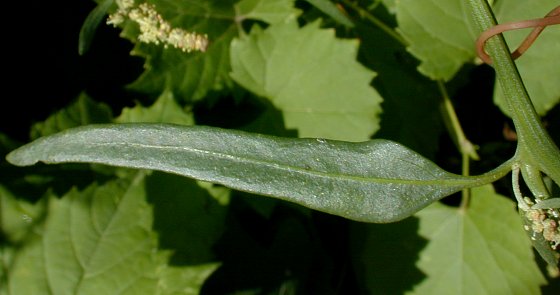
Description: This herbaceous plant is a summer annual up to 4' tall that usually branches abundantly. The lanky stems are erect, ascending, or sprawling (especially the latter if they become entangled with vines). In addition, the stems are light green, glabrous or sparingly white-mealy, and terete or somewhat angular; smaller stems are often finely striated (with many narrow ridges). The alternate leaves are up to 2½" long and 1/3" (8 mm.) across; the lower and middle leaves are narrowly lanceolate or lanceolate-oblong, while the upper leaves are linear-oblong or linear. The leaf margins are smooth or slightly undulate; some of the lower leaves may have 1 or 2 obtuse basal lobes. The upper surface of each leaf is medium to dark green and glabrous, while its lower surface has the same characteristics; however, some of the uppermost leaves may be slightly white-mealy on the lower surface. Each leaf has a prominent central vein, and some of the larger leaves may have a pair of lateral veins that are conspicuous. The slender petioles of the leaves are up to one-third the length of the blades.
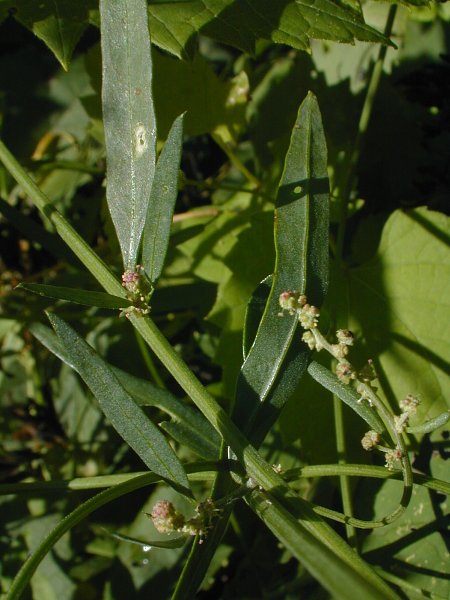
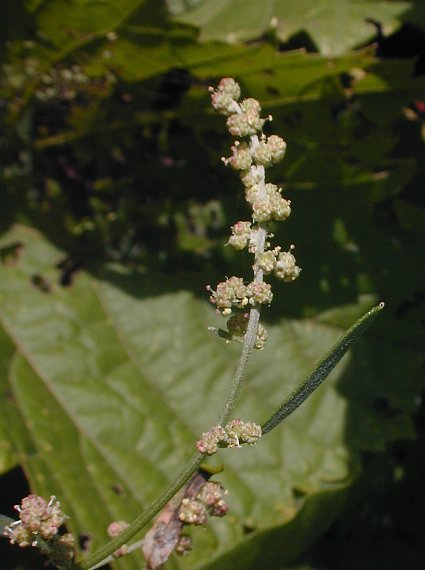
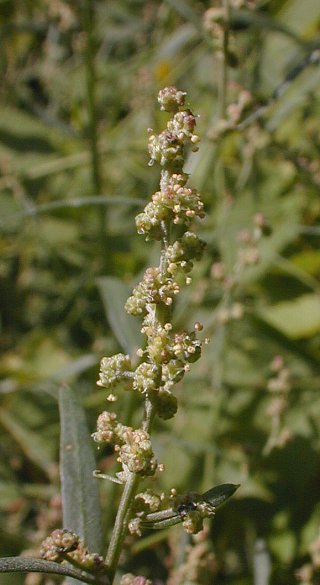
The upper stems terminate in elongated panicles of flowers up to 6" long; these flowers are organized into tight clusters along the branches of each panicle. There are also non-terminal spikes of flowers that originate from the axils of the upper leaves. The branches of each inflorescence are more or less white-mealy. Each flower is up to 1/8" (3 mm.) across, consisting of 5 sepals, 5 stamens, no petals, and a pair of short styles above the ovary. The sepals are green, yellowish green, or purplish green, and more or less white-mealy. The blooming period occurs from mid-summer into the fall and can last 1-2 months for a colony of plants. The flowers are cross-pollinated by the wind; in the absence of cross-pollination, they are self-pollinating. Afterward, each flower is replaced a single small seed about 1 mm. across; the persistent sepals barely cover the upper sides of this seed. Each seed is flattened and round; it is covered by a thin papery membrane that is easy to remove. Once this membrane is removed, the surface of the seed is smooth, shiny, and black. The root system consists of a branching taproot. This plant reproduces by reseeding itself.
Cultivation:
The preference is partial sun or dappled sunlight, moist to dry-mesic
conditions, and soil that contains loam, clay-loam, or stony material.
The size and growth habit of this plant is variable, depending on
environmental conditions.
Range & Habitat:
The native Woodland Goosefoot occurs occasionally throughout Illinois
(see Distribution
Map). However, populations of this species may be declining.
Habitats include open woodlands, woodland borders, thickets, rocky
bluffs, and partially shaded roadsides. Disturbance that
reduces the overhead tree canopy probably benefits populations of this
plant in wooded areas.
Faunal
Associations:
Insects that feed on foliage, seeds, and other parts of Chenopodium
spp. include seed-eating ground beetles and crickets, larvae and adults
of flea beetles, larvae of Anthomyiid flies, aphids, treehoppers,
mealybugs, grasshoppers, larvae of owlet moths (Noctuidae), and larvae
of two skippers, the Common Sootywing (Pholisora catullus) and
Hayhurst's Scallopwing (Staphylus hayhurstii). The Insect Table
provides more information about these and other species. Among vertebrate animals, the seeds of Chenopodium spp. are eaten by several species of songbirds, especially sparrows (see Bird Table).
The seeds are also eaten by the Deer Mouse and wild House Mouse
(Houtcooper, 1978; Whitaker, 1966). Livestock, especially pigs and
sheep, will eat the foliage of these plants, as does the White-tailed
Deer (Georgia, 1919; Myers et al., 2004). Young plants are occasionally
eaten by rabbits (personal observation).
Photographic Location:
A thicket near a little-used railroad in Urbana, Illinois. To some
extent, neighboring vines smothered this plant and caused its stems to
sprawl.
Comments: Woodland Goosefoot is one of the few Chenopodium spp. (goosefoot species) that is native to Illinois. This plant is rather weedy in appearance, but it shouldn't be destroyed unnecessarily. In general, the different species of Goosefoots are difficult to distinguish from each other. Woodland Goosefoot differs from the others by the following combination of characteristics: 1) It has narrow lanceolate-oblong leaves, 2) the lower surface of its leaves is usually as dark and glabrous as the upper surface, and 3) the thin papery membranes covering its seeds are easy to remove. Other goosefoots have wider leaves, and/or the lower surface of their leaves is more pale and white-mealy, and/or the thin papery membranes covering their seeds are persistent and difficult to remove. Other goosefoots with narrow leaves (e.g., Chenopodium lanceolatum, Chenopodium dessicatum, and Chenopodium pratericola) usually occur in sunnier habitats than Woodland Goosefoot. However, the lower surface of their leaves is conspicuously white-mealy. Detailed descriptions and illustrations of the various goosefoots in Illinois can be found in Mohlenbrock (2001).